


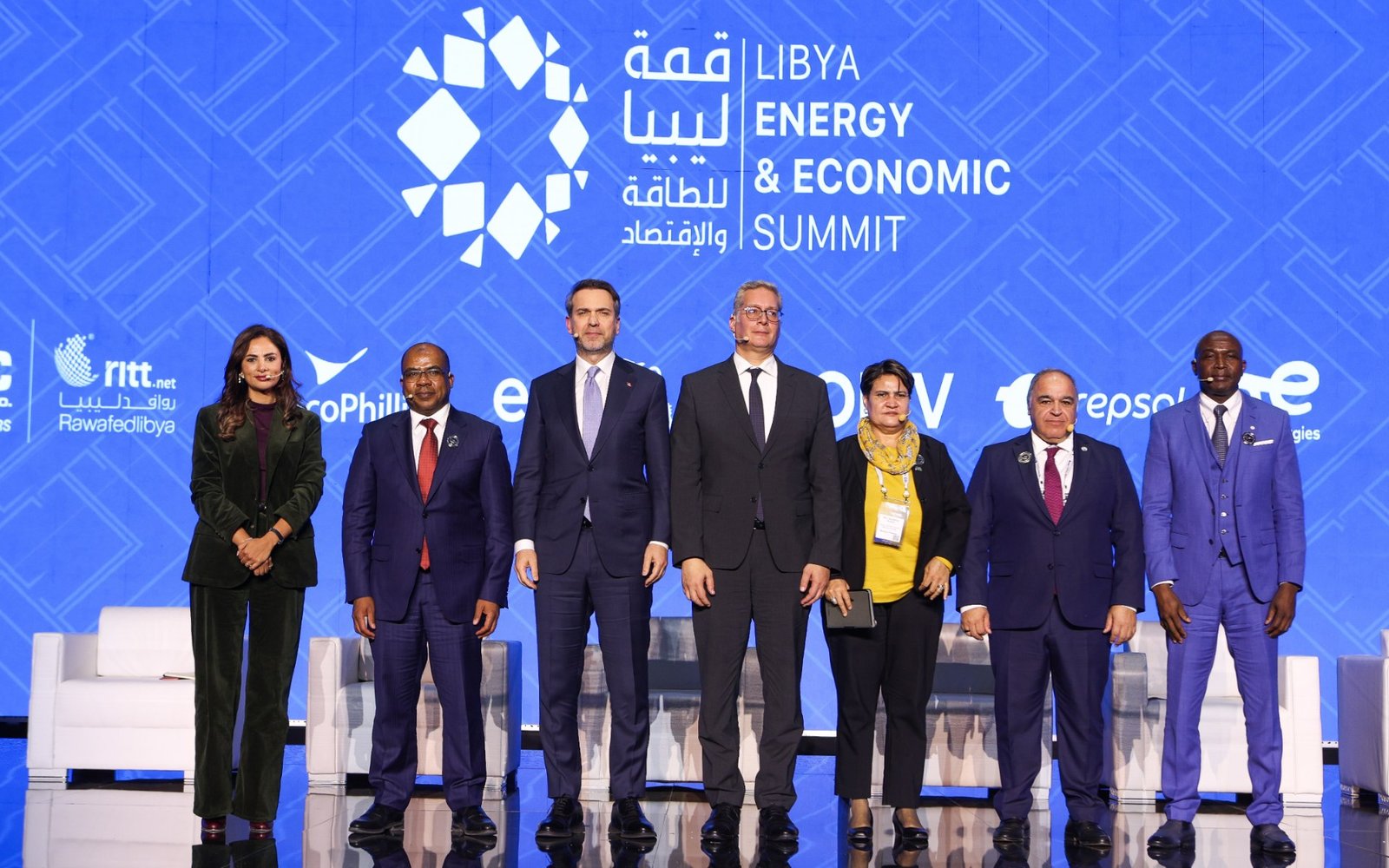
Libya’s energy sector is recovering, attracting investors from around the world and demonstrating a renewed commitment to production expansion, gas monetization and long-term partnerships. At the Libya Energy and Economic Summit (LEES) 2026 held in Tripoli on Saturday, officials outlined a clear roadmap for growth, reform and regional cooperation.
$20 billion investment pipeline
Libya’s oil production will reach an average of 1.375 million barrels per day (bpd) in 2025, the highest in years, and the government aims to reach 2 million barrels per day (bpd) by 2030, backed by a $20 billion investment program.
“We recorded the highest production rate in years, averaging 1.375 million barrels per day. This is strong evidence of our country’s recovery and stability,” Oil and Gas Minister Khalifa Abdulsadegh said. “We have launched programs with 15 companies and expect to increase production over the next five years with an investment of $20 billion.”
The contract term has been extended to 25 years, providing predictable long-term investment terms and consistent with global practice to support multi-decade upstream development.
Gas as a growth engine
Libya is prioritizing gas development to meet domestic electricity needs and support exports to Europe through the GreenStream pipeline. Gas production is expected to reach 700-750 million standard cubic feet per day in 2026.
“One of Libya’s greatest opportunities lies in its geographical location close to one of the world’s largest and richest markets,” said Dr. Philip Mushervilla, Executive Director of the Forum of Gas Exporting Countries. “With an expected supply of 750 million standard cubic feet per day this year, Libya will be able to support domestic power, industry and exports to Europe via the GreenStream pipeline.”
Regional and global partnerships
Libya is deepening cooperation with Egypt to strengthen energy security and resilience in North Africa, leveraging Egypt’s established infrastructure as well as increasing Libyan gas production. Karim Badawi, Egypt’s Minister of Petroleum and Mineral Resources, outlined Cairo’s strategy to position Egypt as a regional energy hub capable of supporting upstream growth, gas monetization, and industrial development across neighboring markets.
“The first part of our strategy focuses on the upstream sector,” Badawi said. “With a market of 120 million people, we aim to efficiently provide petroleum products in all sectors. We are focused on revitalizing existing oil fields through proper reservoir management, accelerating exploration to identify new reserves and creating an attractive environment for global partners.”
The African Energy Bank, led by the African Petroleum Producers Organization (APPO) and Afreximbank and ratified by Ghana and Nigeria, aims to close the financing gap for capital-intensive energy infrastructure projects, including initiatives like the proposed Libya-Algeria power interconnection.
APPO Director-General Farid Ghezali said: “What is true for Libya and its neighbors is true for any oil and gas producing country in Africa. Cooperation in transport, joint energy projects and infrastructure development is essential.” He added: “The Libya-Egypt partnership is a strategic move that will strengthen the region’s energy resilience and benefit global markets.”
Libya is also learning lessons from regional peers such as Namibia, which has built investor confidence through transparent fiscal policies, predictable royalties, and strong local content programs, and Turkey, which is partnering with Libya to expand upstream production.
“Namibia is attractive to investors due to its clear regulatory framework, stable political environment and consistent engagement with the investment community,” said Gaudencia Krone, Deputy Minister of Industry, Mines and Energy in Namibia. “Policies such as 5% royalties and 35% production allocation to states provide predictability and help ensure local benefits and technology transfer.”
Turkish Energy and Natural Resources Minister Alparslan Bayraktar said: “Turkey is committed to joint efforts and pursuing ambitious goals in Libya as part of a broader strategy to become a billion barrel oil and gas producer.” “Diversification is critical in today’s geopolitical environment, and we are meeting these challenges through our sustainable energy strategy and strong partnerships.”
Africa’s energy outlook
From a continental perspective, Libya’s recovery reinforces Africa’s broader energy agenda of converting resource potential into projects, investments and industrial growth.
“Libya’s resurgence is an important turning point for African energy and shows how resource potential can be translated into real projects, jobs and industrial growth when stability and investment frameworks are aligned. Current momentum must be sustained through partnerships, transparency and product-driven development,” said NJ Ayuk, Executive Chairman of the African Energy Chamber.
