


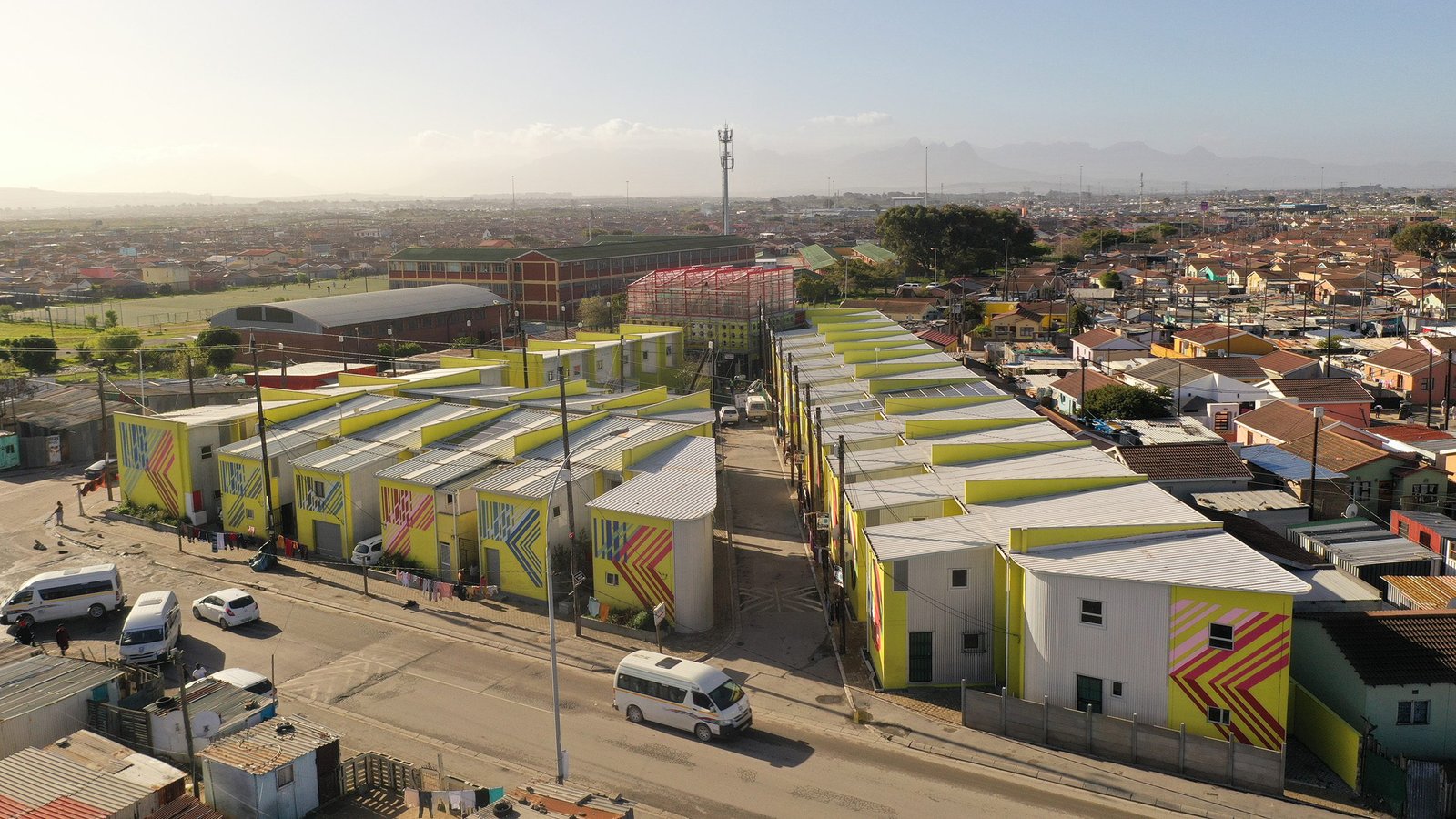
Non-profit firm Urban Think Tank Empower has completed a development in South Africa’s Khayelitsha district, saying it has built triangular terraced houses that serve as a model for how to build in informal settlements in the country.
The development, completed on a site called BT-Soweto at Site C in Khayelitsha on the outskirts of Cape Town, is the company’s first use of the Empower Upgrade model and includes public open space, a community center and play area, as well as 72 homes for 428 residents.
Khayelitsha was one of several suburbs initiated by the apartheid government from 1950 to 1994 as a destination for forced relocation of Cape Town’s non-white population and enforcement of racial apartheid policies.
Since then, the population of these towns has continued to grow, with many residents lacking basic services such as running water and sewage and living in huts they built themselves from tin, wood, and cardboard.
Urban Think Tank Empower (UTTE) aimed to create a financially and ecologically sustainable community-centered model for developing these areas, while addressing some of the deficiencies of post-apartheid building programs that focused on relocating residents into new, low-cost housing units.
“Typically, informal settlements are difficult and seem impossible to develop, so people either move to places where there is vacant land, or they move themselves,” UTTE architect Benjamin Kollenberg told Dezeen.

“What we’re saying is: Is it possible to house people safely and appropriately and with dignity within existing communities, on the same grounds where they already live?” he continued.
“So there are social networks in place, community ties and family support.”
The final model the architects developed retained all the same residents on the site, but replaced the shacks with two-story rowhouses.
Not only does this give each resident more floor space than before, but unlike typical freestanding homes, the homes are placed together, creating more space for amenities and public spaces on the property.

In addition to 72 homes, BT Soweto has a community center with rooftop gardens, public courtyards, playgrounds, business spaces, and a formal roadway that previously was closed to access for emergency vehicles.
UTTE structured the development in six phases, each lasting between three and six months, during which residents stayed with friends and family or in temporary accommodation that could be reused by UTTE.
Completed terrace houses are equipped with bathrooms, kitchens, toilets and water stations, and vary in area and internal layout, from 38 square meters for the smallest to 86 square meters for the largest.

Existing neighborhood dynamics are maintained, such as adult children living next door to their parents.
Other key elements of the UTTE upgrade model include comprehensive community engagement and economic inclusion strategies that employ local workers in construction, as well as efforts to stimulate development with businesses, restaurants, and shops.
The BT-Soweto development was built with readily available materials, including concrete block cavity walls, corrugated sheet facade cladding on a timber substructure, and insulated high-performance composite roof panels to build reusable skills for local workers.

Since starting work on BT Soweto 10 years ago with the participation of just one resident, the team has gained sufficient interest and trust across Cape Peninsula towns to now have 14 other developments underway, most of which have been led by the communities themselves.
UTTE relies on full buy-in from residents, including a 10 percent contribution of housing costs through microloans. The remaining funding comes from a combination of government grants and philanthropic donations.
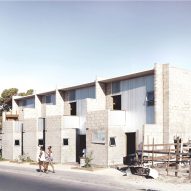
Urban think tank develops low-cost housing for South Africa’s slums
Mr Kohlenberg said the UTTE upgrade model was not intended to be a replacement for the government housing program, formerly known as the Reconstruction and Development Program (RDP) and now Breaking New Ground (BNG), which has delivered millions of homes since 1994.
“We are not a replacement for RDP because RDP is built at a scale that we could never build,” Kollenberg said. “We’re kind of thrown into the mix as an additional model. They’re really prioritizing quantity over quality.”

RDP housing has been criticized for its identity-driven construction and low quality, which Kollenberg said can cause it to fall apart within a few decades.
“That’s understandable, but to be completely honest, it’s actually not acceptable,” he said. “I think there is a lack of execution in certain fundamental areas.”
He said UTTE, a local non-profit subsidiary of the international company Urban Think Tank,’s approach is about slower, more customized development.

“The upgrade model integrates economic inclusion, a humanitarian response to the housing crisis, and building resilient and sustainable communities,” Kollenberg said.
Addressing the legacy of apartheid is a key challenge for South African architects. Elsewhere in Cape Town, architecture firm The Mark is taking a cautious, community-focused approach to building in District 6, a once-prosperous district that has been demolished and its residents forced to relocate to areas such as Khayelitsha.
