


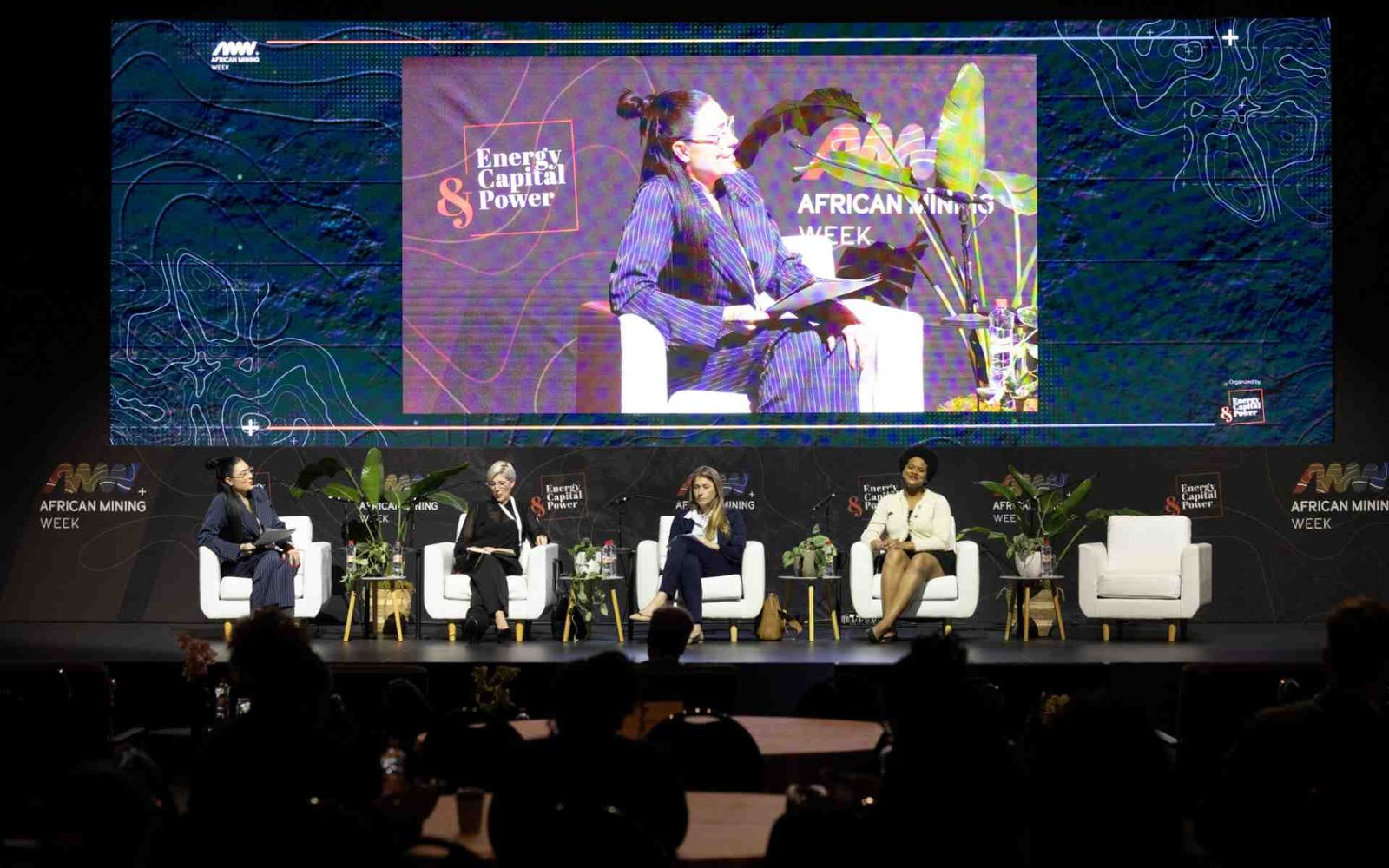
Despite the continuing need to increase female representation in male-dominated sectors, women are increasingly taking on leadership roles in Africa’s mining and construction sectors, with the increase in female CEOs signaling a shift in organizational culture. This was the message from a panel of female mining executives at Africa Mining Week 2025, which stressed that while legislation is helping to open doors, women are demonstrating that their leadership is based on merit, and mentorship is just as important to help more women advance.
Anjana Turner, principal at US-based business law firm Anjana Turner Law, emphasized the importance of building a sustainable talent pipeline. “We must create pathways for women to enter leadership roles. Women need to behave strongly, not as servants, but as confident leaders who can contribute meaningfully at all levels of the company.”
Emma Townsend, Corporate Director of Impala Platinum, South Africa’s leading Platinum Group Metals (PGM) producer, and Platinum Group Metals Women’s Director, said she never felt her gender was a disadvantage as she reflected on her career transitioning from financial markets roles to the mining industry. “I was lucky that because of my experience and exposure, I didn’t feel that being a woman was an obstacle. South Africa has been very progressive in terms of women’s representation under the law and has provided a platform for women’s representation to grow,” she said.
Townsend also pointed out that gaining influence in the boardroom is ultimately not about gender, but about knowing your subject and adding value.
Lili Nupen, co-founder and director of South Africa-based law firm NSDV Law, whose legal team is 70% female, recalls the challenges of being the only woman, and often the youngest, in male-dominated boardrooms, where she was often perceived as an outsider. She pointed out, “Once your expertise reaches the audience, perceptions change.”
“Our approach in the NSDV Act is that if you can prove your expertise, gender should not be a barrier,” she said.
Additionally, she explained that her company’s flat structure encourages all team members to build their own brand, have a voice in boardroom discussions, and fully participate in decision-making.
Challenging stereotypes about women in leadership, Nupen acknowledged that women are often perceived as emotional, but Townsend reframed this as a strength, pointing out that “there is a time and place for positive emotion in business and it is a leadership skill.”
“Women tend to be more introspective and aware of the impact of emotions, which can be healthy for organizational culture,” Townsend says.
Panelists agreed that creating an environment where diversity is valued is a business imperative. With more women entering CEO roles in the mining and construction industries, we need to focus on building a pipeline of future female leaders.
Both Townsend and Turned emphasized that mentorship is as important as compliance in ensuring women are included in leadership roles.
