


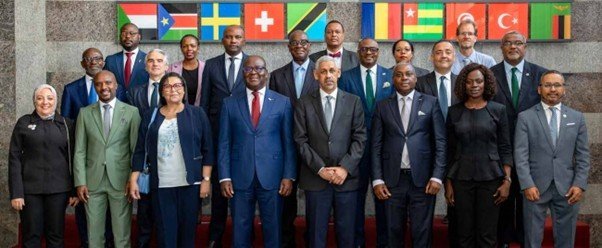
Development finance in Africa is at a critical crossroads. The needs are vast, including infrastructure, renewable energy, industrial transformation, innovative small and medium-sized enterprises, digital technology, and social services. However, the continent continues to face chronic long-term funding shortfalls, with public institutions often overstretched and external aid flows insufficient. In this context, the African Development Bank Group (AfDB) held an unprecedented series of meetings with Africa’s key stock market players and financial institutions from 18 to 19 November 2025 in Abidjan. The objective is to create a new continental financial architecture that can mobilize domestic savings, attract institutional investors and stimulate private equity in high-growth companies.
As the architect of Africa’s capital markets, you are the guardian of financial institutions and the catalyst for the continent’s future.
AfDB President Sidi Ould Tarr said: “As architects of Africa’s capital markets, you are the guardians of financial institutions and the catalysts for the continent’s future.” His statement underscores the institution’s ambitious vision to elevate capital markets from a marginal tool to a central pillar of African finance.
The conference brought together more than 50 representatives from regional and continental banks, private equity, venture capital funds and stock exchanges from West Africa, Central Africa, Casablanca, Tunis, Rwanda, Mozambique, Cape Verde, Nairobi and Ghana. These actors, often dispersed and facing fragmented regulation, are now working together to discuss structural reforms aimed at strengthening market liquidity, expanding access to capital, and developing financial products tailored to Africa’s needs.
BRVM Executive Director Felix Ed Kossi Amenoumbe said: “While there is a gap between financial needs and available resources, we need to consider the reforms needed to leverage Africa’s pension funds. These funds, originally established to fund governments, now have to fund economic development.”
This reflection comes as small and medium-sized enterprises (SMEs) account for nearly 90% of business and more than 60% of employment in Africa, yet access to venture capital remains limited. Discussions therefore focused on promoting private equity and venture capital, creating better structured regional funds, and introducing innovative financial instruments to support small and medium-sized enterprises and champions of emerging industries.
Mobilizing patient funds can provide multiple sources of funding for governments and businesses.
The role of the stock market has expanded beyond direct corporate financing. The Bank emphasizes three strategic pillars for its development: strengthening institutions and regulations, diversifying actors and financial instruments, and training and policy dialogue to enhance the capacity of market managers and regulators. “Capital markets are the basis for sustainable, long-term economic growth. By mobilizing patient capital, they provide diverse sources of financing for governments and businesses, while providing a wide range of opportunities for institutional investors,” said Sidi Ould Tarr.
Digitalization and fintech innovations are also recognized as important tools to expand market access and improve financial inclusion. Financial literacy, especially among young people, is an essential part of this strategy, creating a population of citizens and entrepreneurs who can effectively engage with modern financial products.
Regional coordination is essential to achieve scale-up and policy harmonization
Regulatory challenges and regional coordination remain major obstacles. Donald Waweru Wangunyu, non-executive director of the Nairobi Stock Exchange, said: “We have good projects, but obstacles remain. Regional coordination is essential to achieve scale-up and policy harmonization.” Meanwhile, Sonia Ben Fresi, president of the Tunis Stock Exchange, has stressed the need to update outdated regulations to make the market more attractive to domestic and foreign investors.
This initiative is in line with the Bank’s four core priorities: increasing access to predictable finance, developing capital markets, promoting sustainable finance, and building institutional capacity. These principles aim to reduce Africa’s dependence on development assistance and build a resilient and self-sustaining financial architecture.
Goal: Create an environment in which African capital markets become a strategic vehicle for the continent’s development, job creation and industrialization.
By mobilizing domestic savings, attracting institutional investors and building financial products tailored to the continent’s needs, AfDB aims to transform Africa’s stock markets into real growth engines. The two-day talks in Abidjan are just the beginning of an ambitious process to create an environment in which Africa’s capital markets become a strategic vehicle for development, job creation and industrialization.
As the meetings continue, it appears that Africa’s financial future may depend on a combination of institutional reform, dynamic private equity, digital technology and regional collaboration. AfDB aims not only to facilitate these transformations, but also to work with local and regional actors to build them and usher in a new era in which Africa’s capital markets can fully play their role in sustainable growth and development.
