


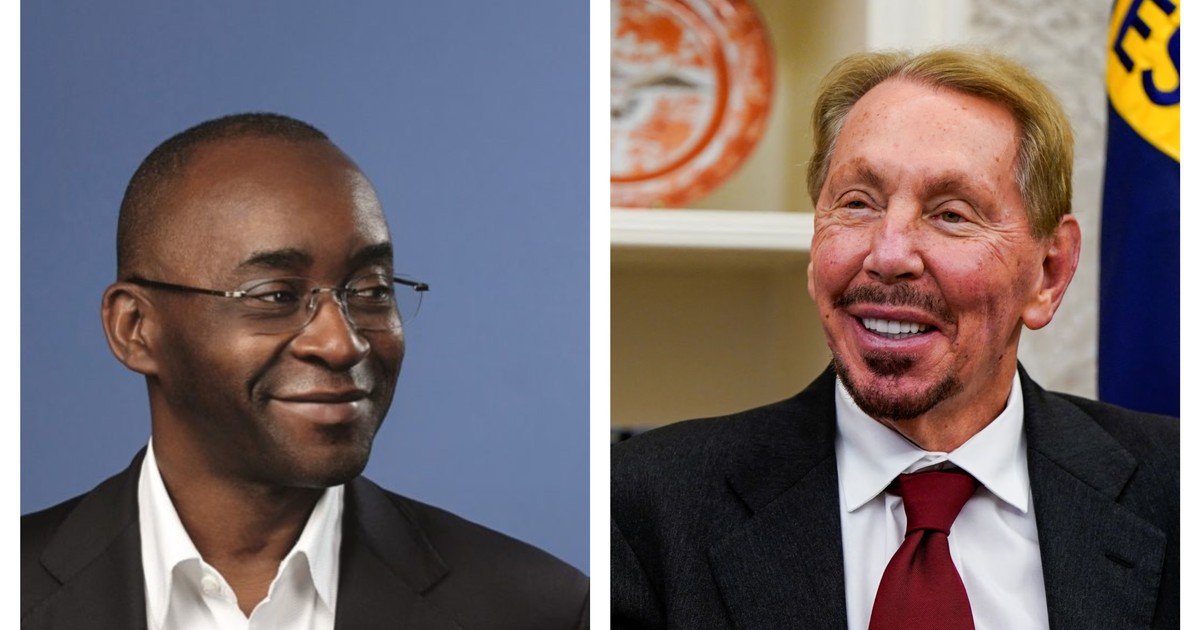
Strive Masiyiwa, the unassuming, soft-spoken telecoms visionary behind Econet Group and Cassava Technologies, is Zimbabwe’s richest person and Africa’s 21st richest person, with a net worth of more than $1.3 billion, according to Forbes.
A builder of systems and ideas, his quiet determination and strategic genius bear a striking resemblance to Larry Ellison. Although different in scale and setting, the depth of purpose and vision is similar.
Early Foundations: The Formative Years of Visionaries
Upon his return, he joined the Zimbabwe Post and Telecommunications Corporation (ZPTC), which had a monopoly on telephone services.
When he left to start his own engineering company, then Econet Wireless, the government fought him bitterly in court for years. He ultimately won, securing a mobile license and changing the history of telecommunications in Zimbabwe.
Econet Wireless Zimbabwe is currently the country’s largest mobile operator, with over 11.5 million active subscribers and an estimated market capitalization of US$500-600 million.
Mr. Masiyiwa oversees operations and investments across the broader Econet Group in more than 17 countries in Africa, Europe, the Americas and East Asia.
Larry Ellison’s childhood was similarly formative, although the circumstances were different. Born in New York City in 1944 and raised by an aunt and uncle in Chicago, Ellison faced challenges from the beginning.
He dropped out of the University of Illinois and the University of Chicago and moved to California in the 1960s, attracted by the emerging technology industry. There he began working on database projects for the CIA, laying the foundation for Oracle Corporation, which he co-founded in 1977.
Masiyiwa faced regulatory barriers and social unrest, and Ellison faced financial and academic setbacks, but they turned those struggles into opportunities.
While Ellison built the backbone of enterprise computing, Masiyiwa is building the continent’s digital infrastructure. Their stories converge around tenacity, foresight, and the will to build systems that last.
Spark of AI: Vision and Inspiration
Larry’s Oracle was born from the idea of Edgar F. Codd’s work on relational databases.
Mr. Ellison, who would go on to become one of Silicon Valley’s most famous billionaires, saw the potential to turn that academic concept into a commercial revolution. “I’ve always believed that the most important thing is to build something that lasts, not something that dazzles for a moment,” he once said.
Masiwa’s inspiration is similarly rooted in important conversations and bold thinking. He recalled meeting Nigerian billionaire Aliko Dangote and former President Olusegun Obasanjo in Singapore.
“Our ‘Baba’ (former President Olusegun Obasanjo as we call him) challenged both of us that day to ‘do something bigger for Africa…what you can do now!’”
Dangote’s new refinery was all the signs he needed. However, the idea had not yet fully materialized. Later, during a panel discussion in which experts argued that Africa can only consume AI, Masiyiwa decided to take action.
“I sat there and thought, ‘If Alico can raise $19 billion, I can certainly raise billions to start AI computing in Africa. After all, most of the key components are already here at my company.’
AI boom and strategic positioning
The AI boom has brought wealth to many, but few have approached it with purpose. Ellison positions Oracle as essential to AI-driven enterprises around the world. Masiyiwa aims to do the same in Africa.
Each facility will house thousands of Nvidia GPUs, giving African researchers, startups, and governments access to high-performance computing locally.
Managed by Cassava Technologies, these factories will leverage a 100,000-kilometre fiber network, 12 renewable energy colocation halls, and last-mile connectivity with Liquid Intelligent Technology.
The first GPU pod in Johannesburg will be operational in Q3 2026, with the full network expected to be operational by the end of the year. By 2027, at least 50% of AI researchers in Africa will have access to these critical resources.
“Our AI factory provides the infrastructure to scale innovation,” said Masiyiwa. “African startups and researchers no longer need to look outside the continent.”

Ellison’s Parallel: From Database to AI Empire
Mr. Ellison is not usually a soft-spoken man and is widely known for his bold, outspoken and competitive personality, but he is now one of the richest people in the world.
In contrast to Mashiiwa’s quiet, methodical approach, Ellison’s style is aggressive and expansive. But both converge at the intersection of disciplined execution.
He turned Oracle into the foundation of a global AI infrastructure, grew the company through decades of strategic acquisitions including Sun Microsystems ($7.4 billion in 2009) and NetSuite ($9.3 billion in 2016), and expanded Oracle into cloud computing, cybersecurity, and enterprise intelligence.
Oracle technology currently powers AI-enabled databases and cloud platforms used by governments and businesses in more than 175 countries. “People want the spotlight, I want architecture,” Ellison once said.
In 2025, the company began building one of the world’s largest AI computing clusters in Abilene, Texas, housing more than 450,000 NVIDIA GB200 GPUs on 1,000 acres.
Oracle also partnered with OpenAI and SoftBank on the Stargate project, a planned US$500 billion investment in AI infrastructure, and signed a multi-billion dollar deal with AMD for 30,000 MI355X AI accelerators to counter NVIDIA’s dominance.
Philanthropy and social impact
Both men combine ambition and purpose.
Mr. Ellison founded the Ellison Medical Foundation in 1997 to fund research into aging and age-related diseases, and later founded the University of Oxford and the Ellison Institute of Technology to address global challenges in AI, robotics, medicine, and food security.
Through the Larry Ellison Foundation, we support health, education, conservation, and climate change efforts, and in 2010 we signed the Giving Pledge and committed to giving away most of our wealth.
He co-founded the Higher Life Foundation with his wife Chitsi to help orphans and disadvantaged children in Zimbabwe, South Africa, Burundi and Lesotho.

Wealth, fortune, and grand hobbies
Larry Ellison’s fortune skyrocketed with the AI boom, making him the second richest person in the world. The Oracle co-founder, who owns about 40% of the company, said it will cross the $400 billion mark in 2025 as demand for AI infrastructure soars.
The instability of Africa’s economies makes Strive Masiyiwa’s path difficult to predict. His wealth has been repeatedly eroded by Zimbabwe’s weak currency and market volatility.
In 2020, his fortune decreased from $2.3 billion to $1.1 billion due to new monetary policies. But his fortunes may soon rise again as he moves deeper into Africa’s AI ecosystem. This time on home soil.
They both have ambition and sophistication. Masiyiwa owns a luxury apartment in New York’s El Dorado Towers worth $24.5 million and a 24-room mansion in the UK worth £24 million. Meanwhile, Mr. Ellison has spent more than $1 billion amassing a global fortune. From Lanai, Hawaii to mansions in Malibu and historic buildings around the world, each is a testament to his obsession with architecture, art, and beauty.

In a world captivated by the daring adventures of Elon Musk and the oil empires of Aliko Dangote, the quiet, calculating rise of Ellison and Masiyiwa is a reminder that real power lies in building the frameworks on which entire industries depend.
As Ellison once said, “It’s not about being the richest person in the world, it’s about being the most prepared.”
Masiyiwa is doing for Africa what Ellison has done for enterprise IT around the world, building the backbone on which the continent’s digital future can thrive.
