


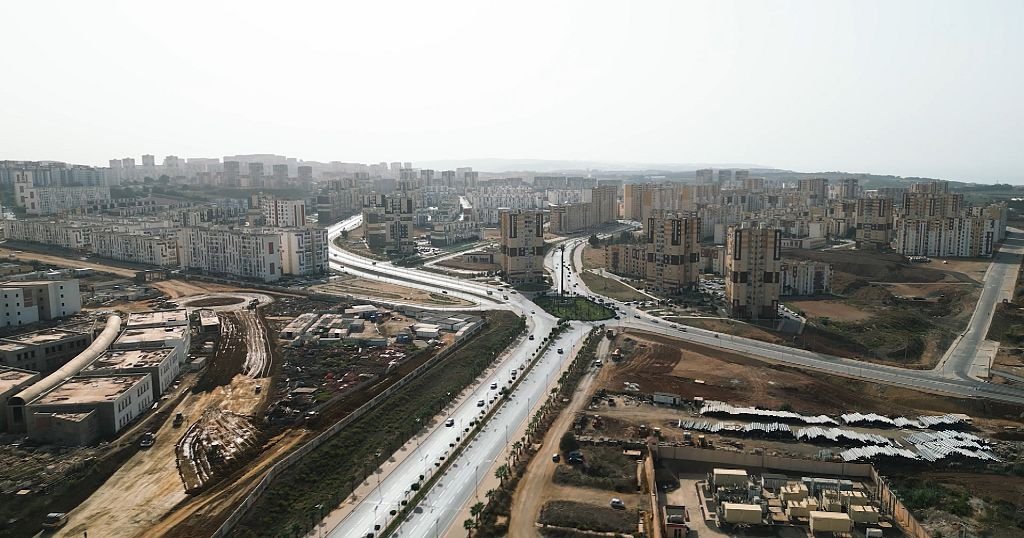
Algeria is embarking on ambitious housing and infrastructure projects, with entire cities rising from the ground and completely transforming urban space.
The new city of Bouezour is under construction 170 kilometers south of Algiers and will be home to around 400 residents.
This futuristic 20,000 hectare urban development project, divided into residential, business and agricultural areas, was launched in a strategic area at the intersection of the north-south and east-west axes.
“We built modern cities to attract the population and balance the coast, the plateau and the south. These are experimental new cities. We hope to extend this experience to other cities later on,” explains Murad Guati, General Manager of Buezur New City Public Facilities.
This futuristic city will be home to the Algerian Space Agency, a new train station, and a new international airport. Basic infrastructure is in place, including electricity, fiber optics, a 28-kilometre network of tunnels for drinking water, and an irrigation network for green areas.
“The technical gallery is a sustainable job, because the new city of Bouezur has a sustainable character,” says Abdelghani Zerrouqi, technical manager of the public facilities of the new city of Bouezur. “So if you need to change pipes or electrical cables, it’s very easy, efficient and noiseless.”
Bouezour is one of five new cities under construction in Algeria. Sidi Abdallah in Algiers is another, as Abdelhak Sedaoui, general manager of the Sidi Abdallah New City Development Committee, explains. “Our Sidi Abdallah New City project is about creating an attractive city, a city with sustainable development indicators, and we want to ensure the comfort of its residents. It is a smart, resilient and connected city.”
One of Algeria’s priorities is to eliminate slums and abandoned housing. In the Sahara Desert region, new housing complexes are being constructed in order to achieve balance between regions. To ease congestion in large cities, the state provides low-cost housing and interest-free loans near satellite cities.
Another priority was the construction of a number of stadiums, including the 50,000-seater Jeunesse Sportive de Cabiry for Tizi Ouzou’s most successful club in the country. The construction work will be personally inspected by Housing Minister Mohamed Tareq Belaribi.
“The realization of all these stadiums is linked to the national enthusiasm for sports and competitions. This youthful enthusiasm led the public authorities to construct these buildings, starting with the sports complex in Oran, which hosted the Mediterranean Games with great success. In addition, two other stadiums in the capital Algiers, one in Barrakis with 40,000 seats, and one in Douella, will be completed in order to host the African-scale competitions.”
In addition to this, 3 million people have benefited from 800,000 new homes in the past two years. “We are no longer dealing with a housing crisis, but rather with a demand. And that is why we have started building these new cities in Algeria, following the instructions of His Excellency Abdelmadjid Tebboune, President of the Republic,” says Tarek Belaribi.
“We are in the process of creating a satellite city. A new Algeria is being built. We are builders in all fields related to architecture, peace and humanity… Anyone who wants to predict our future only needs to look at what we are achieving now. The new Algeria is now,” Belaribi continues.
The symbol of modern Algeria is the recently inaugurated Great Mosque of Algiers. Its minaret is the tallest in the world at 265 meters high and provides a clear view of the country’s progress.
