


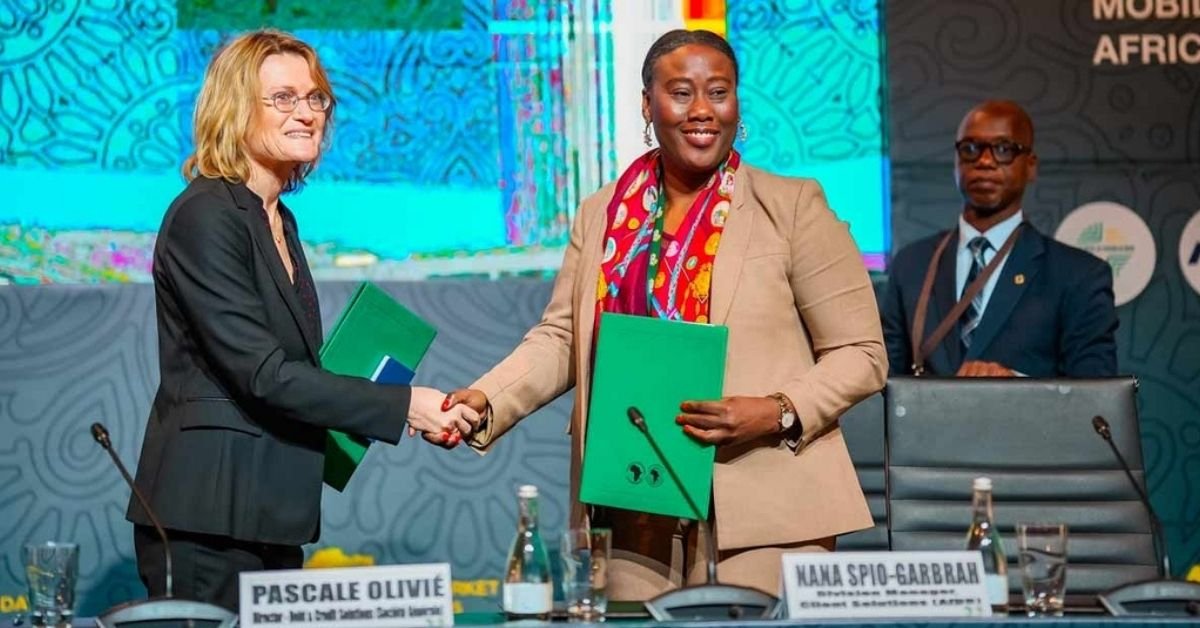
The African Development Bank Group (AfDB) has formally appointed French financial giant Société Générale to lead the design of a ground-breaking multi-originator synthetic securitization platform (SST platform) following the 2025 African Investment Forum (AIF) held in Rabat, Morocco. It is an innovative financial mechanism designed to avoid the continent’s enormous financing gap and dramatically accelerate financing of high-impact sustainable projects by freeing up billions in bank capital.
The agreement, signed at the end of the AIF Market Day, marks a significant strategic shift for the continent’s leading development finance institution (DFI), moving from a traditional direct lending institution to a sophisticated manager of private sector risk.
The SST platform is an advanced financial engine, known in capital markets as synthetic risk transfer, that fundamentally changes the way development banks leverage their balance sheets. For African DFIs, the act of lending money requires setting aside a certain amount of capital against potential losses, which then becomes idle.
This new platform will enable AfDB to transfer credit risk on its existing $2 billion loan portfolio. We provide global private investors with already deployed financing in critical sectors without physically selling assets.
This transfer frees up regulatory capital previously held against these loans, allowing the bank to immediately recycle the funds into new priority loans across Africa. This mechanism is a concrete solution to the persistent problem of capital constraints and ensures that development banks’ reserves are constantly rotated to meet Africa’s growing needs.
Also read: Ethiopia secures $500 million from Bank of China for $12.5 billion Bishoftu mega airport
The urgency for this innovation is rooted in Africa’s severe infrastructure and climate underinvestment. Current statistics show that Africa’s annual infrastructure demand is in the range of $130 billion to $170 billion, but actual investment is barely over $80 billion, leaving a gap of more than $70 billion annually. This deficit is not just a book number. That translates directly into tangible economic impacts, particularly an estimated 2 percentage point loss in annual GDP growth across the continent.
Furthermore, the continent urgently needs nearly $300 billion a year for climate change, but currently receives only a fraction of that, with private climate financing accounting for just 14 percent of the total climate change budget. This is the operational reality that the SST platform aims to change.
By designing the platform to be “multi-originator” and initially incorporating assets from the Development Bank of South Africa (DBSA) alongside the AfDB, the project addresses the issues of scale and standardization, two major hurdles for large international institutional investors.
Political risks and specialized pools of assets within a single country often impede the actions of the world’s pension funds and insurance companies. However, by harmonizing issuance documents and creating a larger, more geographically diversified reference portfolio, the platform creates an asset class that is more palatable and easier to digest for large capital funds.
This scaling-up effort is essential for projects on the ground, whether it’s funding the expansion of the East African power pool connecting millions of people in Kenya and Uganda or funding the West African Economic and Monetary Union’s green transport corridor.
Also read: Morocco champions Africa-centric ESG standards to enable sustainable mining investments
The platform’s ability to potentially introduce standardized credit ratings across multiple institutions in Africa paves the way for a more predictable and transparent investment environment, moving the narrative from one of high-risk frontier markets to one of structured investable opportunities for sustainable growth.
The AfDB’s move suggests that the future of African development finance lies not in big checks from multilateral sources, but in smarter financial technologies that unlock the wealth of individuals already circulating globally, effectively turning DFIs from just providers to sophisticated partners in mobilizing capital.
Connect with us on LinkedIn: Sustainability in Africa matters
