


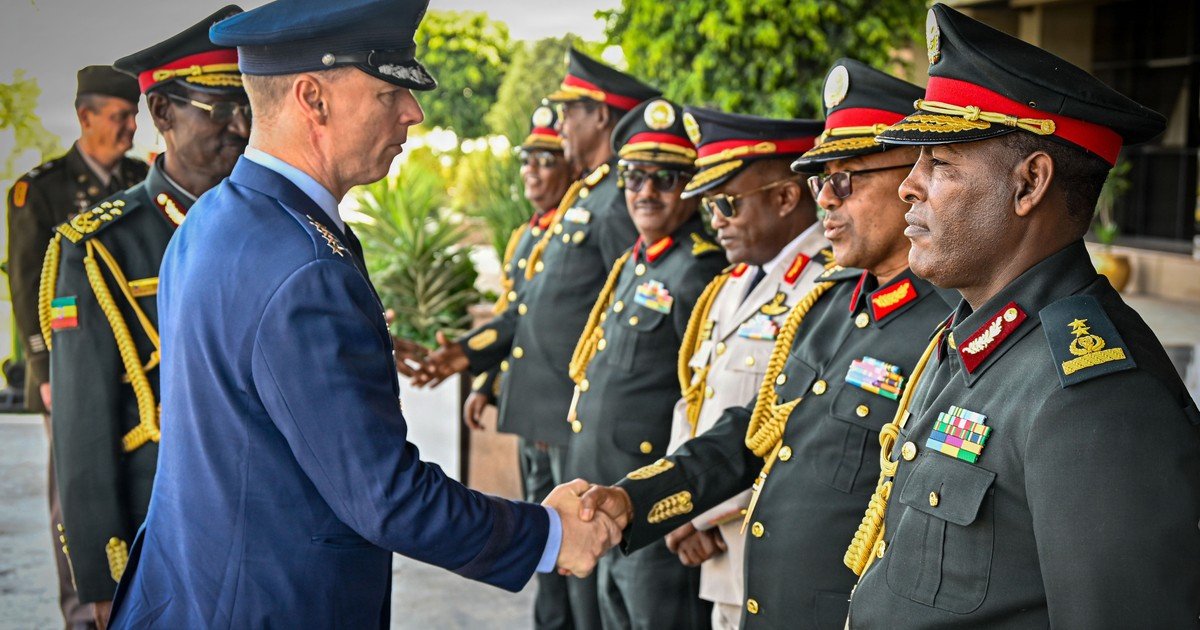
U.S. security priorities in the Horn of Africa gained new momentum this week when Lt. Gen. John Anderson, commander of U.S. Africa Command (AFRICOM), visited Ethiopia, Somaliland, and Puntland, reinforcing the U.S. commitment to exert maximum pressure on ISIS, al-Shabaab, and other extremist networks that are destabilizing the region.
The effort focused on strengthening operational coordination and deepening intelligence-sharing frameworks, which Africom considers essential to preventing the spread of armed groups across East Africa.
Anderson reiterated that the United States supports maximum pressure against ISIS, al-Shabab and other violent terrorist organizations.
“The reason I’m here is because we have a shared threat,” Anderson said. “I’m not new to this region. I understand what the issues are, and we’re here to help our African partners come together to address these threats,” Anderson said.
U.S. Army Gen. Anderson met with Ethiopian Prime Minister Abiy Ahmed and Defense Chief General Birhanu Gyula Gerercha to discuss the growing threat from ISIS and al-Shabab.
In Somaliland, he met with President Abdirahman Mohamed Abdullahi. General Niman Yusuf Othman and Coast Guard Commander Admiral Ahmed Hure Hariyeh also visited and inspected the security and operational capabilities of Berbera Port.
His last stop was Puntland, where he met with Vice President Ilyas Osman Lugator, General Adan Abdi Hashi, and other senior leaders to strengthen joint counter-terrorism efforts.
Anderson praised Puntland’s maximum pressure operation against ISIS in the Goris Mountains, acknowledging its success while stressing the need to step up the operation.
US influence faces increasing competition in Africa’s changing security environment
Anderson’s tour comes at a time of heightened geopolitical conflict over Africa. The Horn remains central to U.S. strategy, both as a buffer against extremist groups and as a key maritime corridor connecting global trade routes.
However, U.S. influence is increasingly being challenged by China’s expanding security cooperation and Russia’s deepening military coordination across the continent.
AFRICOM itself has come under intense scrutiny in recent years.
During the previous leadership’s tenure under Gen. Michael Langley, the command was repeatedly accused by civil society groups, independent analysts, and some African political actors of harboring an “evil conspiracy” aimed at consolidating U.S. military influence rather than supporting African-led solutions.
Criticism centered on concerns about covert operations, a lack of transparency surrounding drone strikes, and concerns that the command’s expanded reach risked militarizing a fragile state.
Although the US government has dismissed these claims as a “misinterpretation” of the counterterrorism mission, the controversy has stimulated broader debate about the long-term role of foreign forces in Africa.
Amid these tensions, African countries are calling for stronger institutions in their security architecture.
Regional blocs such as IGAD and the East African Community are expanding their peace enforcement roles, while the African Union continues to refine its mechanisms to strengthen the continent’s response without relying too heavily on external forces.
