


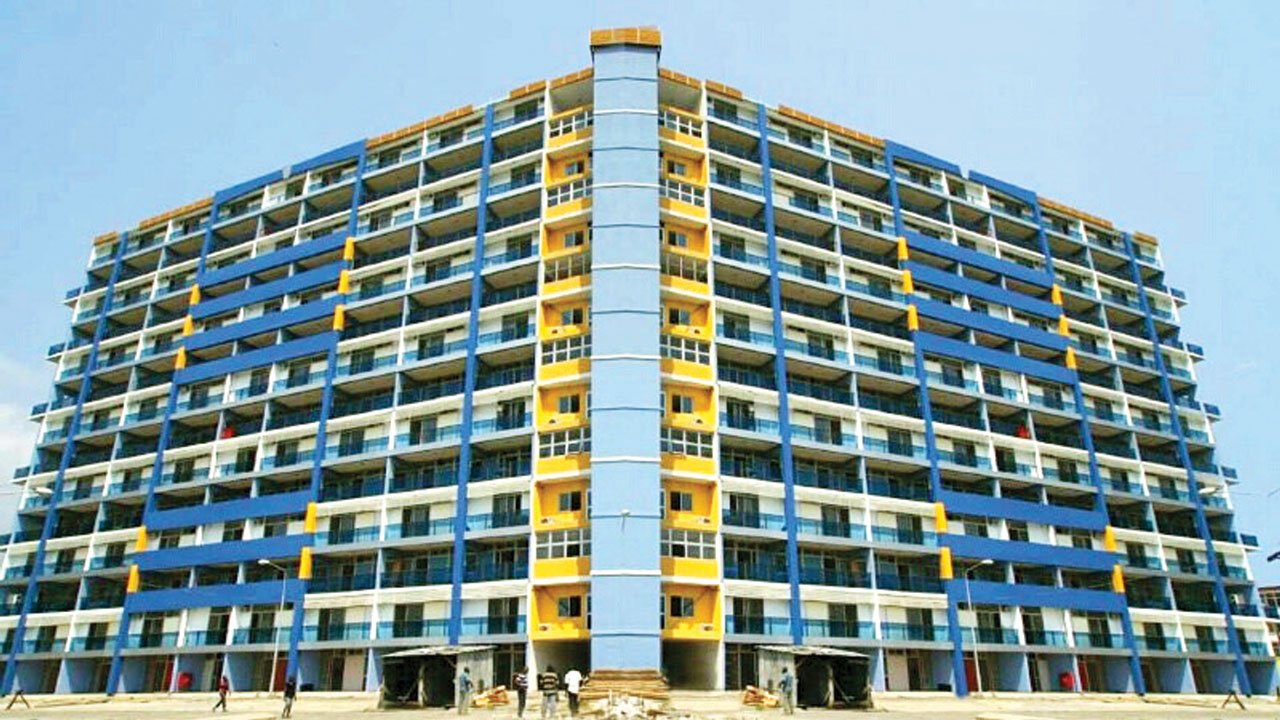
Experts say the benefits of vertical urban development as an urban design concept are to rethink horizontal cities, where normal cities consist of hundreds of buildings, and vertical cities to build a few narrow buildings hundreds of stories high.
With finite space and a growing population, the natural direction of cities is always upwards as architects, developers, and urban planners think toward more sophisticated urban environments. The current trend is to construct large multifunctional buildings (MFBs), most commonly combining residential, hotel, and retail functions.
Although it has been argued that true vertical cities do not exist, the concept of vertical urban development has the potential to create sustainable and dignified lives for all. Vertical cities are designed to provide all the necessary functions that cities typically have, such as recreational and free public spaces, social and government services, education, energy, and food production.
Currently, about 40 percent of the continent’s one billion people live in cities and towns. And it is estimated that within the next few years, some African cities will be home to 85% of a country’s population. Statistics show that by 2030, the middle class in sub-Saharan Africa is expected to more than triple to an estimated 107 million people.
Despite population growth exponentially, housing supply rates across the continent are inadequate to meet this growing demand, and in most cases, the available housing is unaffordable for the majority. As a result, the majority of Africa’s urban population continues to live in inadequate housing.
The development is exacerbating the existing housing shortage, estimated at between 18 million and 23 million units, and many housing experts believe that housing models like vertical urban development could be the missing link, especially in urban areas like Lagos, where about 87 people move in and out every hour every day, putting unplanned pressure on land and housing infrastructure facilities and increasing the number of slums in the state.
Provincial Housing Director Prince Gbolahan Lawal recently pointed out that population growth has created a housing shortage of approximately 3 million units in the province.
In order to curb this increase in the housing stock deficit, they recommend the introduction of vertical urban development, which has many advantages.
The immediate past president of the Nigerian Society of Engineers (NSE), Anyaeji Ortiz, told the Guardian that there is no other way to solve the problem of housing shortage than by adopting vertical urban development.
he said: “If you don’t embrace this vertical urban development, what we want to do is keep building bungalows over long distances. You’ll find that one of the pressing issues is that it’s not easy to extend basic infrastructure over all these distances.”
“If you take electricity as an example, if you were to install basic facilities across a quarter of a town, you could put the entire development of that quarter within the streets and towns of, say, Lagos, but if you had done vertical urban development like in 1004, if you had done it consistently and with good planning, Lagos today would probably be on one-twentieth of the land that is currently in use,” he said.
Otis said this means fewer roads are needed for the service, fewer cables are needed to distribute power to the outside world, and less piping is needed to carry water.
“All this, he said, will lead to more adequate infrastructure for the people living there. When these facilities are expanded to new locations, they can cover almost 50 kilometers of the city, and all this infrastructure needs to be distributed to those locations, even if external infrastructure costs considerably,” he added.
However, Dr Taibut Lawanson from the University of Lagos’s School of Urban and Regional Planning said the planning stage needs to identify the people who will benefit from the scheme. The decision to increase will ultimately depend on conditions in the surrounding area, she said.
While expressing support for the agitation, Rawanson said that while her support is based on principle, she expressed doubts as to whether the available infrastructure could support it, adding that it is of utmost importance to provide adequate infrastructure before decisions are made on conceptual changes from what society is accustomed to.
The National Chairman, Nigeria Institute of Town Planning (NITP) said: Luca Aci stressed that vertical urban development is an idea that has emerged as a result of the growing land shortage in most cities, and that it is a way to save land.
But without the technology, structural integrity, regular electricity supply and other infrastructure, its implementation could be a waste of time, he noted.
“Most buildings in Nigeria are yet to condense 40-storey skyscrapers on the same piece of land. The cultural beliefs of the people may preclude such an idea. The people may complain about building from the ground up. But in a matter of time, Nigeria may have to change to such a plan. At least there was a time when we used donkeys, but now we use cars and planes,” he said.
For Kunle Awobodu, the first vice-chairman of the Nigerian Institute of Buildings (NIOB), there is a need to define and understand the rationale for adopting such an urban development model. He says that in places with high population densities but very low landmass, going vertical is the only natural option to make the most of the limited land available.
“So in some places like Lagos Island, Victoria Island, Ikoyi, the building goes vertical very automatically and you don’t have to argue about it. If the land is too expensive, you have to learn how to make the best use of the land. If you don’t go vertical, the value of the land will be out of proportion to the housing units on the land.”
He warned that embarking on such housing developments would require economic considerations and projections from financial analysts and experts to justify how profitable the investment would be.
“What we should be more concerned about are the areas where people are still building bungalows and two-storey buildings, and the values in such areas should have been expected to be very high within four to five years.”For example, in a housing estate in the Otedola area of Lagos, most of the buildings are bungalows, but this was a mistake, and people were not anticipating the future value of the land. That way it could go vertically. A similar error was committed in Surulere, also known as New Lagos. Designing bungalows in an area with a reputation for high demand will not change the suitable population of the area,” he explained.
Awobodu stressed that Nigeria has unique environmental challenges, including poor infrastructure. technology, power supply, rapid fire extinguishing services in the event of a fire incident, and the necessary expertise.
“It’s a 21-storey building and there is supposed to be an elevator from the fourth floor, but unfortunately we found out that the elevator might not work, especially considering the cost of regular maintenance and the poor power supply high cup. That’s a vertical development problem. We should also have a proper fire extinguisher to cover the situation.”
“It requires decorative techniques and is more difficult to construct. We also have to ask the question of affordability. In terms of costs such as scaffolding and annual painting, can Nigeria really afford it? These are factors that may question readiness for vertical urban development. In terms of technology transfer, Nigeria has model technology that can be copied at any time from other more developed parts of the world,” he said.
Speaking on the cultural aspects of development, he stressed that Africans were never accustomed to high-rise buildings, but noted that with modernization, places like Onitsha, Anambra State, Nigeria, have become known for high-rise buildings, especially among certain sections of the population, which they have used not only to register their economic status and level of sophistication in society, but also as a kind of competition and pride.
(ad unit=2)
