


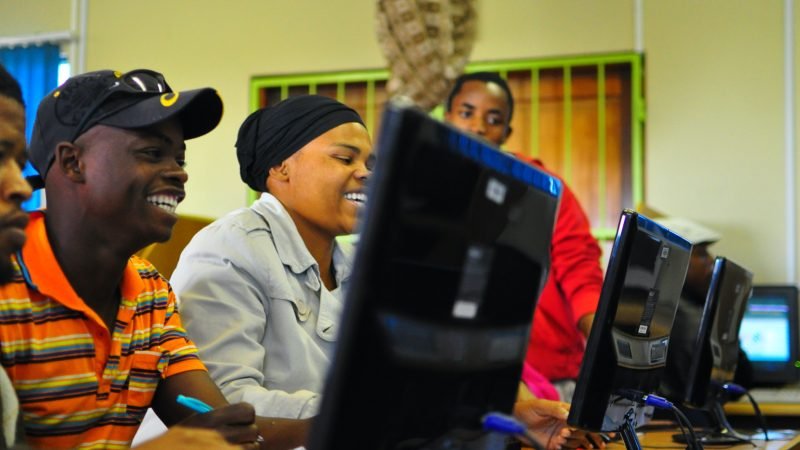
Youth skills training in South Africa. Photo courtesy of Beyond Access via Flickr/CC BY-SA 2.0.
Since the 1990s, several national and international efforts have been undertaken by governments, telecommunications companies, and development organizations to improve Africa’s Internet infrastructure networks.
However, Africa’s internet penetration rate remains the lowest. less than 40 percent compared to the global average of 58 percent In the world. There are only 7 African countries 2019 Network Readiness Index Top 100 rankings — Nothing in the top 70.
Currently, giant technology companies such as Google and Facebook, based in California’s Silicon Valley, are leading the race to invest in Africa’s internet infrastructure. What’s at stake for these tech giants to take such a lead in Africa’s digital future?
Before the arrival of these tech giants, other internet infrastructure projects in Africa were aimed at extending internet connectivity to all Africans. For example, the African Union eAfrica programcommitted by the United States Agency for International Development (USAID) $15 million for Leland projectwhich the African Development Bank helped establish. East African submarine cable system and World Bank pledges approximately $424 Million.
All projects had a common goal: to build an Internet infrastructure that would connect all African countries to each other and to the rest of the world through existing and planned undersea and terrestrial cable systems.
Africa is the fastest growing continent in the world in terms of mobile phone penetration, making it an “attractive business” continent for global technology companies like Google and Facebook.
Silicon Valley tech companies take control in Africa
For many years, private sector Telecommunications has primarily driven the expansion of Internet infrastructure on the continent, but Silicon Valley’s multibillion-dollar tech companies have dominated this expansion in recent years.
Google is First high-tech and non-telecom company to invest in more than just a high-bandwidth submarine cable system The aim is also to lay a dedicated intercontinental cable.
In 2011, Google started an internal project. C Squaredwill build metropolitan fiber optic networks that will be leased on a wholesale model by mobile network operators and Internet Service Providers (ISPs).
The project is now an independent commercially led company, partnering with Mitsui & Co. (Japan), Convergence Partners (South Africa) and the International Finance Corporation (IFC, World Bank Group) to invest in Africa’s broadband internet infrastructure under consolidated funding of $100 million.
The technology company currently owns and operates over 890 kilometers of metropolitan fiber in Kampala and Entebbe cities in Uganda. More than 1,070 kilometers of fiber has been installed in three cities in Ghana and more than 180 kilometers in Monrovia, Liberia.
Google also operates its own private internet infrastructure projects in Africa. project runecurrently active in Kenya, Equiano (named after Nigerian writer and former slave Olaudah Equiano) — an undersea fiber-optic internet infrastructure that will connect Africa and Europe when completed in 2021.
While it’s clear that Google intends to lead the race to invest in Africa’s infrastructure, Facebook also appears to be a fierce competitor, despite its failed attempts to exploit it. solar powered internet drone To provide Internet access.
Facebook tried alternative options to connect Africans to the internet Freebass applicationIn , the company partnered with telecommunications providers in developing countries to allow users to access a pre-selected number of sites, including Facebook, without using any extra data. Freebass was banned in India and heavily criticized by civil society. Including Global Voicesa medium that collects user data and does not actually connect the “unconnected” to the Internet.
Until now, Facebook has primarily focused on leveraging existing internet infrastructure in developed countries rather than investing in new internet infrastructure. for example, Facebook partners with Internet Society Use Internet Exchange Points (IXPs) to bring internet to rural areas in Africa. An IXP is an access point where multiple local and international networks, ISPs, and content providers interconnect their networks instead of going through third-party networks.
The company also Express Wi-Fi Project In Africa, Facebook offers a comprehensive Wi-Fi platform that partners (operators) can leverage to better manage and grow Wi-Fi services to local communities.
In 2013, Mark Zuckerberg explained: essay Why it doesn’t make economic sense to invest in building Internet infrastructure to provide Internet in developing countries:
The costs of building and maintaining networks have made it prohibitive to provide full internet access to everyone in the world, but by focusing on reducing the cost of data delivery and building more efficient apps, it is possible to provide a range of basic online services for free to those who cannot afford it.
But Facebook is currently spending millions of dollars building internet infrastructure in developing countries, including Africa. Zuckerberg knew he needed to be a real athlete to “win” this race against Google.
last year, Facebook partners with Main One Build 750 kilometers of terrestrial open access fiber optic internet infrastructure in Nigeria. partnered We partnered with Airtel to build 800 kilometers of fiber connectivity in Uganda and 100 kilometers of fiber connectivity in South Africa.
Facebook announced this on May 13th. 2 africa — one of the company’s largest investments to date in building internet infrastructure in Africa. The project aims to build perhaps the largest internet submarine fiber optic cable to provide internet to Africa and the Middle East. The partnership includes Facebook, China Mobile International, MTN GlobalConnect (a branch of MTN Group in South Africa), French multinational telecommunications company Orange, Saudi Arabia-based telecommunications company STC, Telekom Egypt, British multinational telecommunications company Vodafone, and Western Indian Ocean Cable Company. Together, the companies plan to build a 37,000-kilometre-long cable that will interconnect 21 landing sites in 16 countries in Europe (to the east via Egypt), the Middle East (via Saudi Arabia) and Africa.
The project is expected to: completed By 2023-2024.
What’s in it for the tech giants?
Who else but these tech giants can ensure that Africa is connected to the internet at the fastest pace and without any delays?
But these tech giants don’t give away billions of dollars worth of freebies without expecting to make a profit.
Quartz writer Yomi Kazeem highlights the obvious profit motive of these technology companies. “As a result, the tens of millions of people who go online represent a larger target market for an ever-growing cache of products and advertising services,” he wrote.
Also, the number of people who can no longer connect to the Internet decrease In Europe and America, Tech companies are looking to explore other emerging and low-income markets to increase revenue and expand market share.
for example, 70% or more Of Facebook’s 2.3 billion monthly active users, they live in Africa and Asia. Google has over 90% market share Leading the search engine market share in Africa. In Kenya, more than half of the country’s mobile traffic is sent through applications Owned by Facebook and Google.
Both companies too derive Most of its revenue comes from advertising (ads account for 98 percent of Facebook’s revenue and 85 percent of Google’s). Profitability depends on increasing the number of users or increasing the revenue generated from each user.
Should Africa be concerned? yes.
Over-reliance on global technology companies to provide the internet is a major challenge in Africa, where around 33 countries do not have data privacy laws.
Policymakers have so far done little to approach or engage with technology companies to address these challenges.
Africa is therefore vulnerable for example, Facebook and Cambridge Analytica Scandal.
Path to Prosperity Committee It rightly points out that in developing countries, “digital design and use is almost completely absent from development policy-making discussions. Potential government regulatory tools primarily revolve around managing telecommunications markets, controlling internet connections to the outside world, and managing domestic digital services ecosystems.”
Facebook has been woefully inadequate in responding to abusive and violent content shared on its platform. Despite receiving warnings, the company has done little to address them, as seen in US President Donald Trump’s recent violent tweets about the ongoing issue. #BlackLivesMatter Protests in the United States. Twitter publicly flagged the tweet for violating its rules, but Facebook did not. zuckerberg Explained:
I strongly believe that Facebook should not dictate the truth of everything people say online. Private companies, especially these platform companies, shouldn’t be in a position to do that.
Should governments take the lead, or should they partner with technology companies?
Governments in developing countries do not seem to prioritize internet access in their policies. Ideally, governments would be able to negotiate with technology companies, but without a framework to start a dialogue, anticipated digital policies and legislation will be impractical.
in 2019 Report published According to the Center for World Development, the authors warn:
However, developing such a framework is not easy. We need to find ways to (1) estimate the value of disparate personal data whose value depends on combining it with other data to produce useful information, and (2) track the value of data across multiple uses.
African governments should recognize that the internet is now pervasive. global public goods and a human right that brings significant social and economic benefits to its users. Without comprehensive and more pragmatic digital regulatory frameworks and policies for these technology companies, their digital platforms will be irresponsibly used to usher in violence and abuse rather than support economic growth and innovation.
