


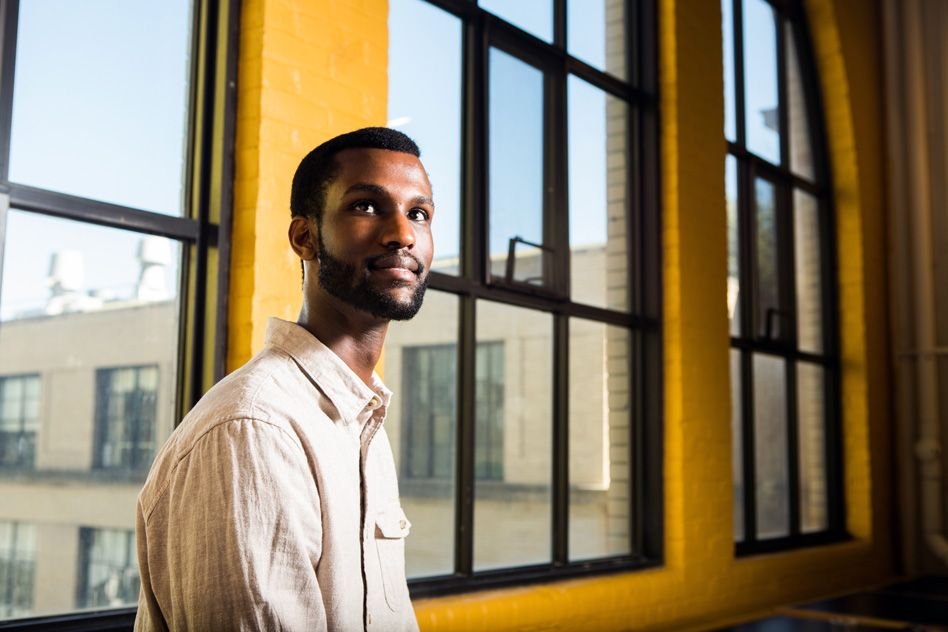
Billy Ndengeingoma’s time at MIT was marked by vicissitudes. He moved from continent to continent, from undergraduate to master’s programs, and from civil engineering specialization to urban planning.
But no matter what happens in life, he has learned to always make time for self-reflection. This practice has led him to discover a lot about himself and think deeply about the impact he wants to have on the world.
Overcoming dual culture
Growing up in Kigali, Rwanda, Ndengeingoma always thought she might go to the United States for college. (His brother and sister both earned master’s degrees in Atlanta.) After hearing a conversation with a family friend whose son had attended MIT, he decided to apply.
Ndengeingoma first encountered MIT through International Orientation. There he and other international students learned about American culture. For Ndengeingoma, the transition process was easier than expected.
“Different people adapt differently,” Ndengeingoma says. “And my students were reaching out to all of the international community and trying to figure out basic things with them, like how to ride a train, but they were also reaching out to the American students, who were very open and talked about the culture here and how things work.”
Ndengeingoma was asked to participate in the documentary “One Day I Too Go Fly” produced by Arthur Musah ’04, MEng ’05 (who was also an international student), giving him a unique opportunity to reflect on his college days and his experience navigating two different cultures.
The documentary, scheduled for release in 2017, follows Ndengeingoma and three of his African classmates during their undergraduate years. Musa also traveled to each student’s home country. For Ndengeingoma, the film provided a much-needed opportunity to take time to digest everything that was happening to her.
“In hindsight, it was a great experience to be a part of because it forced me to reflect and reflect on my own experiences and how cultural negotiations and different forces that influenced me were changing my worldview,” says Ndengeingoma. “And how my own ego and person has changed and evolved over the years.”
The road to urban planning
Academically, Ndengeingoma’s undergraduate years at MIT were a time when he figured out what exactly he wanted to do. After deciding to major in civil engineering, he began dabbling in materials science.
As part of MIT’s Undergraduate Research Opportunities Program (UROP), Ndengeingoma spent a semester in the Atomic and Molecular Mechanics Laboratory, led by McAfee School of Engineering Professor Markus Bühler, where he used computer simulations to observe how graphene is deformed by water.
Ndengeingoma also spent a summer in France through the MIT International Science and Technology Initiative (MISTI), researching another category of emerging materials: silica aerogels.
“They are very light materials and very porous,” says Ndengeingoma, who worked on adapting the general formula that describes how porous materials absorb liquids to the irregular porosity of silica aerogels.
But the biggest shift in Ndengeingoma’s academic interests occurred just before his senior year, during an internship at an architecture firm called MASS Design Group. Mr Ndengeingoma spent the summer analyzing Kigali’s affordable housing market, focusing on factors such as land, infrastructure, construction, building materials and architecture.
This experience gave Ndengeingoma his first exposure to urban planning and helped him understand how well-designed homes can empower people and improve their lives.
“Housing has enormous value in securing people’s right to the city, in ensuring that they feel a sense of dignity in living where they live, and in ensuring that their housing is clearly linked to established social networks and the wider city itself,” Ndengeigoma explains.
Realizing that as an urban planner he could incorporate a strong sense of social responsibility into his work, Ndengeingoma applied to MIT’s urban planning master’s program in the Department of Urban Studies and Planning that fall.
The power of housing design
When Ndengeingoma returned to Kigali in the summer after completing her bachelor’s degree, she decided to start looking at her city through the lens of urban planning.
“I realized that I hadn’t been making enough critical observations about my city and my living environment,” he says. “And I thought photography was the perfect medium to do that and start exploring my city.”
Ndengeingoma focused on Nyamirambo, a district that lacks the usual store windows and is instead lined with small shops painted with colorful images to highlight the products they sell and the services they offer.
“It’s just rainbow-colored and very vibrant,” Ndengeingoma says.
Upon returning to MIT, Ndengeingoma organized a photo exhibition for students and faculty, which was the beginning of his involvement with an organization called UrbanAfrica. The group also organizes large-scale events and invites interesting speakers to campus to engage students and faculty and increase discussion about urbanism on the African continent.
One year after completing his master’s degree, Ndengeingoma continues to focus on housing development in Africa through his research with the Resilient Cities Housing Initiative. Last year, Ndengeingoma assessed how informal housing settlements in Cape Town, South Africa, were improved according to four key resilience criteria: improving residents’ economic livelihoods, protecting them from environmental stresses and risks, providing tools to give residents autonomy, and providing secure land tenure.
“We went through a year-long process, primarily referring to the literature, to come up with our own hypotheses and understanding of how the process happened, how it could have happened better, and how resilience impacts the whole thing,” Ndengeingoma says.
This summer, Ndengeingoma returned to Kigali, where he got his first exposure to the public sector, co-conducting a workshop on the role of design in affordable housing for the Rwanda Housing Corporation.
Ndengeingoma then worked for two months at a nonprofit architecture firm called General Architecture Collaborative, where he went door-to-door collecting local housing data.
“When you’re at the computer reading a paper, it’s really cool to think about the problem theoretically,” he says. “But when you go out there and visit people’s homes and ask them about their own aspirations, it makes a big difference in how they perceive the problem and (seek) comprehensive solutions for them.”
This dual experience led Ndengeingoma to want to work in the public sector, not only because of the ethical responsibility he feels, but also because there is so much scope for adopting innovative solutions.
For Ndengeingoma, working in Kigali is especially meaningful given what his city and homeland have been through over the past few decades. Ndengeingoma is too young to remember the Rwandan genocide; instead, he has watched his country go through a significant rebuilding phase in the years since. After completing her degree, Ndengeingoma plans to return to Rwanda and use her urban planning skills to shape the country’s continued development.
“I had the opportunity to stay in my city and in a safe city that was not always the case. I acknowledge the sacrifices that many people made to secure the right to live in their city in a free environment,” Ndengeingoma says. “I want to equip myself with the academic and professional tools to ensure people have the right to stay in their cities and have decent housing in spaces where they feel safe and proud.”
