


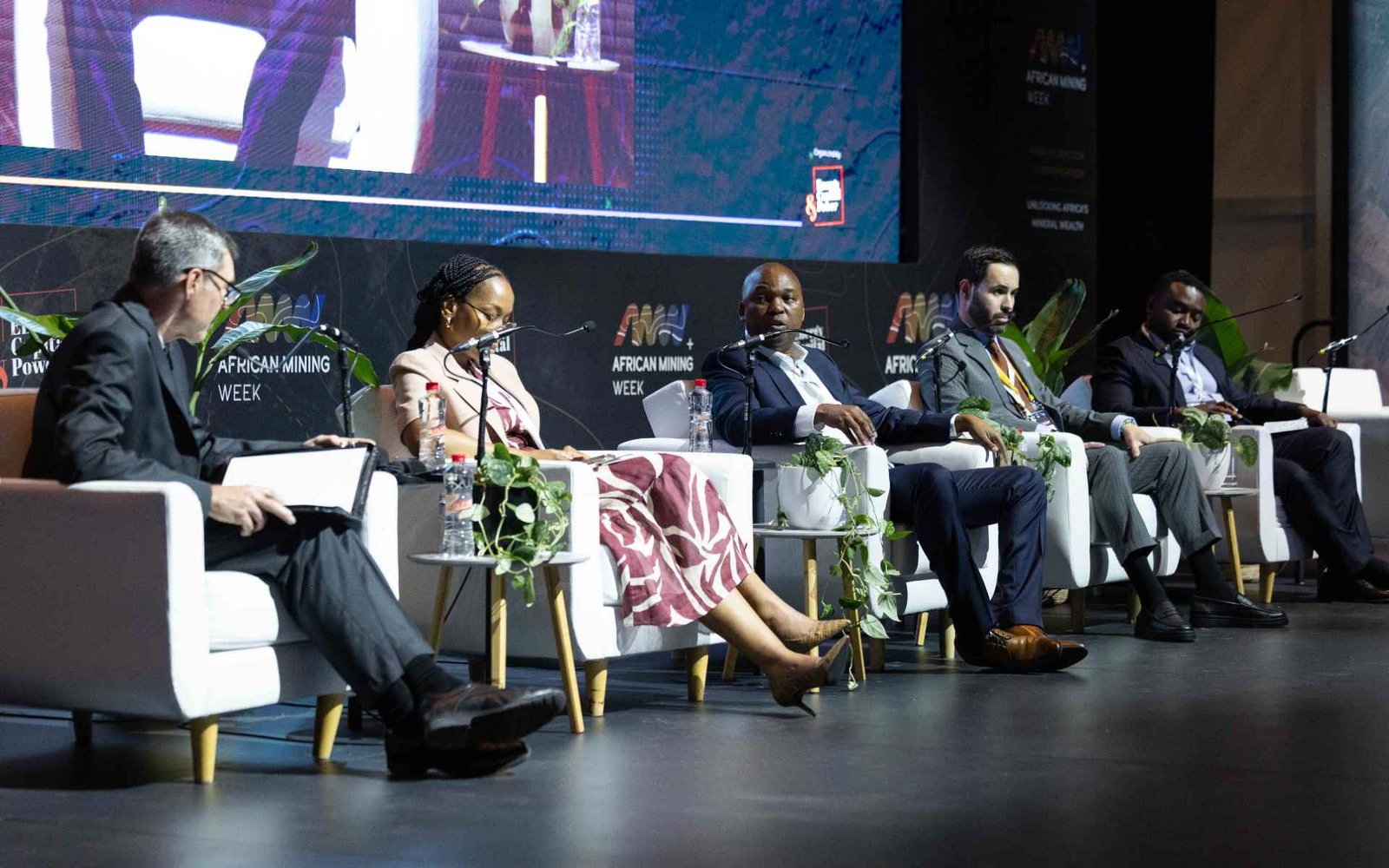
Achieving broad-based economic and industrial development is a non-negotiable factor when investing in Africa’s mining sector development, a panel of financial stakeholders stressed during Africa Mining Week 2025, but there are several available financial sources that can be leveraged innovatively to finance Africa’s mineral industrialization.
Molebogen Mazibuko, associate vice president for metals and mining at the African Finance Corporation, a multilateral development financial institution, said financing for mining projects on the continent must intentionally support regional economic development in the countries in which the mining projects are located. Mazibuko said: “Despite the investment risks, we invest in African countries where there is a need for sustainable economic development. By helping address infrastructure deficits, we can promote industrial activity in these African countries with the aim of increasing the economic impact of specific countries.”
Vusumzi Dube, Business Development Manager at development finance institution Industrial Development Corporation of South Africa (IDC), highlighted the importance of using mining projects as a means to simultaneously finance economic development, saying domestic value addition and how projects are integrated with local economies and communities are key investment considerations for IDC.
“The mining projects we support must be established in a way that achieves local economic development,” he said.
Other factors that make mining projects more investable from a development finance perspective include strong market demand and aggressive pricing for the product, Dube added. “These typically include batteries and critical minerals essential to the energy transition, such as graphite, lithium, copper, manganese and chromium, because these are the goods the world needs for human progress.”
Furthermore, Mr. Dubé highlighted that projects such as Africa’s transformative infrastructure project, the Lobito Corridor, which is large enough to support and absorb additional industrialization opportunities, such as associated railway and energy infrastructure developments, provide opportunities to further industrialize Africa through mining.
Ope Osinubu, a senior associate at global law firm Clifford Chance, who assists lenders in ensuring that projects are bankable, noted that multilateral development finance institutions play an important role in filling the capital gap needed during the risky early development stages. He also pointed out that commodity traders play an important role as financing sources related to the production of mineral projects. “Traders have become an important source of finance in recent years, providing a critical financing bridge during the development of mining projects by acting as intermediaries to finance these projects where commercial banks do not invest directly,” Osinubu said.
Unpacking the potential for forward-looking financing for the development of Africa’s mining sector, Sebastian Wagner, head of natural resources at discretionary investment firm Apeiron Investment Group, said: “There are too many of the same pools of capital chasing the same opportunities. Next generation financial instruments such as stablecoins and mineral tokens can be used by mining companies to tokenize unmined resources as a means of raising capital.”
