


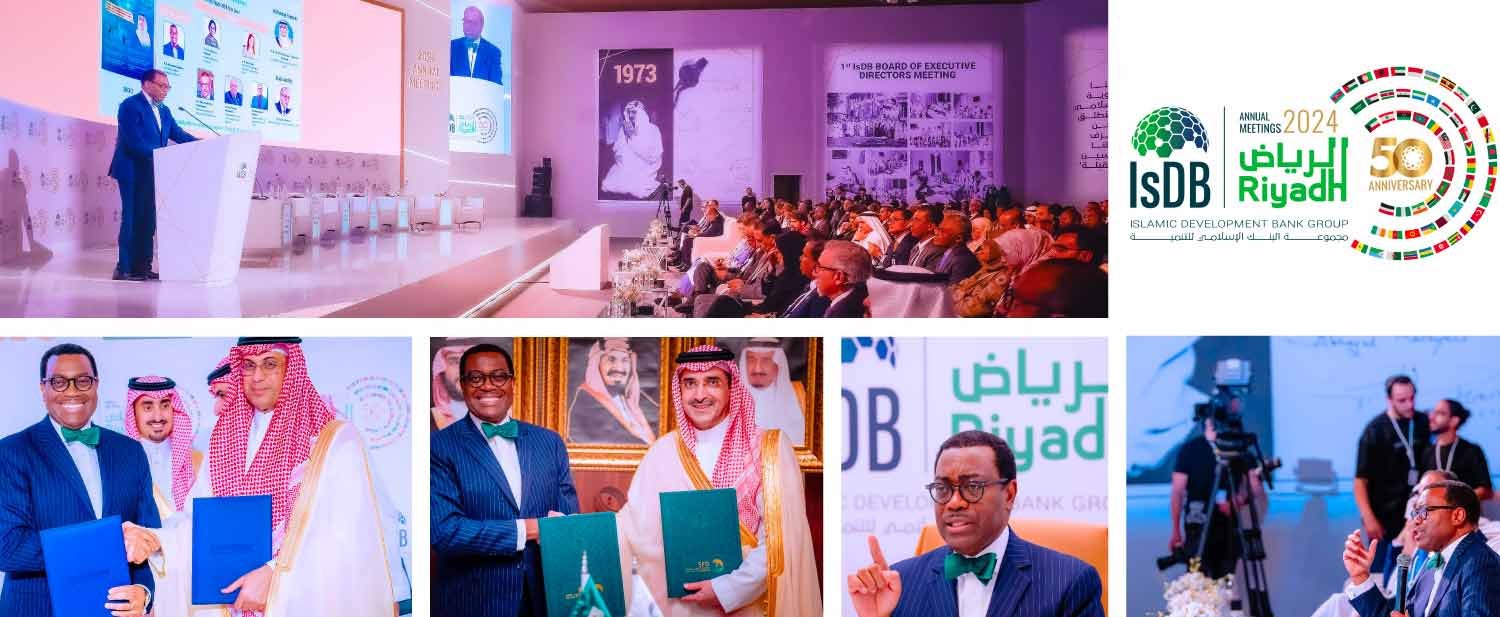
Dr. Akinwumi A. Adesina, President of the African Development Bank Group, stressed that a significant increase in financing is essential to achieving the Sustainable Development Goals (SDGs).
Speaking at the 50th anniversary celebrations of the Islamic Development Bank in Riyadh, he highlighted the growing fiscal shortfall of $4 trillion a year, which threatens to derail efforts to achieve the SDGs by 2030.
Mr. Adesina addressed a distinguished audience that included dignitaries, financial leaders and private sector representatives gathered to mark the occasion. This session focused on assessing the financial strategies essential to advancing global development in a context characterized by economic instability and intensifying environmental challenges.
The African Development Bank president said the annual gap is now $4 trillion, up from $2.5 trillion in 2015, and has been widened by recent global economic pressures and the lingering effects of the COVID-19 pandemic. He elaborated on the important role of multilateral development banks in addressing these needs through increased collaboration and innovative financial solutions.
Strategic responses to pressing global issues
Mr. Adesina also noted that the African Development Bank’s Strategic High-5 Program is the cornerstone of progress, as highlighted by an independent analysis by the United Nations Development Programme. Hi 5, that is; let’s illuminate and empower Africa. Feeding Africa, industrializing Africa, integrating Africa and improving the quality of life for Africans are not just ambitious goals, they are the continent’s strategic blueprint. Achieving these high fives would mean achieving nearly 90% of Africa’s Sustainable Development Goals, he noted.
In this regard, Mr. Adesina highlighted five core areas where immediate action and innovative financing are critical: climate change, food security, energy access, health security and mobilizing more resources for the SDGs.
Climate change: African Development Bank President Adesina said climate change is the most important challenge to achieving the SDGs, and detailed the disruption it causes to economies through droughts, floods and cyclones. Despite being the world’s most severely affected region, Africa receives the least amount of climate financing. “Africa needs $277 billion a year to combat climate change, yet it receives only $30 billion a year.” The African Development Bank said it has “set a target to raise $25 billion for climate adaptation by 2025.”
Africa is the region in the world most severely affected by climate change, yet it receives the least amount of climate financing. (Photo: Nairobi floods, April 24, 2024. Credit: AFP)
Food security: He also addressed the issue of volatile food prices, exacerbated by geopolitical conflicts, supply disruptions, and trade-restrictive practices of some major food exporting countries. Mr. Adesina reiterated the African Development Bank’s commitment of $25 billion to support Africa’s food self-sufficiency by 2030. He shared with the audience significant successes in transforming agricultural productivity and food security across Africa. He cited the Africa Agricultural Transformation Technologies (TAAT) program, which is already providing climate-resilient crop varieties of wheat, maize and rice to 13 million farmers. With the introduction of high temperature tolerant wheat varieties through the TAAT programme, Ethiopia achieved self-sufficiency in wheat production within four years and became a net exporter of wheat. He thanked the Islamic Development Bank for its $7 billion commitment at the Feed Africa Summit held by the African Development Bank, the African Union and the Senegalese government early last year. The summit brought together 34 heads of state and government to develop a country-led food and agricultural delivery compact to achieve food security by 2030.

At the Feed Africa Summit (Dakar 2) held in January 2023, 34 heads of state and government committed to implementing country-led food and agricultural supply compacts to achieve food security by 2030.
Energy Access: Highlighting the disparity in electricity access, with more than 675 million people worldwide lacking electricity, 80% of whom live in sub-Saharan Africa, he highlighted the Bank’s efforts through the desert-to-power initiative. The project will develop 10,000 megawatts of solar power across the Sahel, providing electricity access to 250 million people.
Health Security: Given the wide disparities in health services in Africa, Adesina advocated for increased investment in health infrastructure and local pharmaceutical capacity to prepare for future pandemics. He noted that the current annual investment of $4.5 billion in health infrastructure is grossly inadequate compared to the actual need of $25 billion. He cited the harsh lessons Africa has learned from the COVID-19 pandemic, particularly emphasizing the need for medical independence to prepare for future pandemics. To combat this, the African Development Bank Group has committed $3 billion to quality health infrastructure and an additional $3 billion to develop Africa’s pharmaceutical industry. This includes significant investments to boost the production of medicines and vaccines directly on the continent, and is reinforced by the establishment of the African Pharmaceutical Technology Foundation, which aims to expand access to critical technologies and intellectual property rights.

Dr. Adesina said the current annual investment of $4.5 billion in health infrastructure is grossly inadequate compared to the actual need of $25 billion.
Mobilizing resources: Addressing the need for innovative financing, the African Development Bank President spoke of groundbreaking steps taken by the African Development Bank, including the issuance of $750 million in ground-breaking hybrid capital. The financial instrument is a first for a multilateral development bank and is intended to act as equity and strengthen the bank’s lending capacity. He also said that the African Development Bank, in a joint initiative with the Inter-American Development Bank, is pioneering the use of Special Drawing Rights (SDRs) as hybrid capital, subject to IMF Board approval. This move could quadruple the Bank’s leverage capacity and significantly expand the financial resources available for the SDGs.
Furthermore, Mr. Adesina emphasized that the private sector plays a vital role in scaling SDG investments from billions to trillions. He advocated harnessing the power of the world’s $128 trillion in institutional investor assets through broader use of guarantees, developing investable projects, and addressing foreign exchange and currency risks.
In his opening remarks, Dr. Mohammed Al Jasser, President of the Islamic Development Bank, said crises such as climate change, pandemics and ongoing conflicts continue to threaten decades of hard-won gains.

“Islamic finance principles of shared prosperity, shared risk and ethical investment offer a clear path to closing the SDG financing gap,” said Dr. Mohammed Al Jasser, President of the Islamic Development Bank.
Furthermore, Al Jasser said, “The stark reality we face is that the global financial system has not kept pace with the urgency needed to realize the SDGs. We must collectively work towards a global financial system that fosters a more inclusive, fair and sustainable future.”
“In this context, Islamic finance adds value, prioritizing not only financial profits but also the overall well-being of individuals and the planet. The principles of shared prosperity, shared risk and ethical investment present a clear path to closing the SDG financing gap,” he said.
Engaging world leaders for collective action
“The UN Secretary-General’s call for a $500 billion annual SDG stimulus package should be fully supported,” Adesina said in a call to action to achieve the ambitious goals set out in the 2030 Agenda for Sustainable Development.
“Developed countries need to increase support by allocating at least 0.70% of their gross national income to official development assistance,” Adesina added, among other important actions.
His message was clear. “Let’s give the world hope by achieving these goals for a sustainable and just future!”
Late Sunday, Adesina held a series of bilateral meetings with key government officials and development agencies in Riyadh.
President of the Banking Group and CEO of Saudi Export-Import Bank Engineering. Prime Minister Saad Al Harb signed a memorandum of understanding to strengthen bilateral trade and cooperation between Saudi Arabia and the African continent. Dr. Riyad M. Al-Khalaif, President of the African Development Bank of Saudi Arabia and Vice-Chairman of the International Monetary and Financial Committee, witnessed the signing of the MoU.

From left to right: Dr. Akinwumi Adesina, President of the African Development Bank Group, Dr. Riyad M. Al-Khalaif, President of the African Development Bank in Saudi Arabia, and Mr. Saad Al-Khalb, CEO Engineer of the Saudi Export-Import Bank.
The Saudi Fund for Development and the African Development Bank Group also signed a memorandum of understanding to promote sustainable international development by financing projects and programs in African beneficiary countries.

From left to right: Dr. Akinwumi Adesina and Mr. Sultan bin Abdulrahman Al-Marshad, CEO of the Saudi Development Fund.
The agreement was signed at the Fund’s headquarters by Sultan bin Abdulrahman Al-Marshad, CEO of the Saudi Development Fund, and Mr. Adesina.
The signing ceremony was attended by Dr. Riyad bin Mohammed Al-Khalaif, President of the African Development Bank Group in the Kingdom of Saudi Arabia, and Vice President of Engineering at SFD. Faisal bin Mohammad Al-Qaftani.
Through this MoU, both sides will exchange experience and knowledge, promote best practices in co-financing, contribute to achieving the Sustainable Development Goals, maximize development impact, and more.
