


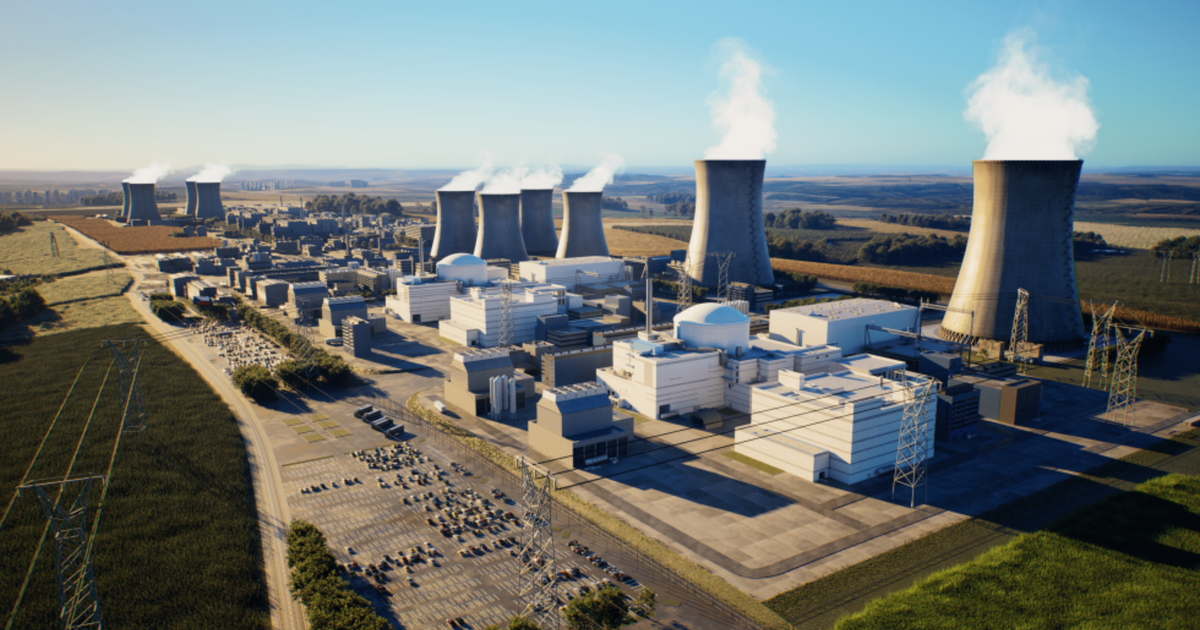
Dr. Robert Sogbazi, Minister of Energy and Green Transition, has already identified two sites in the Western and Central regions, one for a large industrial facility and one for a small industrial facility, respectively, as part of efforts to diversify the country’s energy mix.
“It has already been decided where the new nuclear power plants will be located. One site will have a large power plant, and the other site will have a small power plant located in an industrial area,” he said.
Preparations underway, but construction partner not disclosed
Speaking on the sidelines of the 9th Ghana Energy Awards, Dr. Robert Sogbaji confirmed that preparatory work is underway, including acquiring land and facilitating power purchase agreements.
“Steps are underway to secure the acquisition of that land, and we should be able to cut the grass for construction by approximately 2027,” he said.
Dr. Sogbazi added that the ministry is working on a timeline of less than six months to expand electricity access with a target of 90% nationwide coverage.
In February 2025, Ghana held the first IAEA Site and External Event Design Review Mission with experts from Pakistan, Turkey, the United Kingdom, and the United States, at the invitation of the Government and under the auspices of Atomic Energy Ghana.
The team reviewed proposed nuclear facilities, with Nusban in the Western Region as the priority location, and Obuton in the Central Region as backup, and evaluated the site selection process, criteria and data collection.
Mission Leader Kazuyuki Nagasawa said, “The implementation organization and management system are well designed and the site approval report has been carefully prepared. Ghana followed IAEA safety standards in the site selection process.”
Although Ghana has not said which company will be responsible for construction, the move reflects a broader trend in Africa.
A Reuters report last year said several companies were vying for contracts for Ghana’s nuclear power project, including France’s EDF, US-based NuScale Power and Regnum Technology Group and China Nuclear Corporation.
South Korea’s Korea Electric Power Co., its subsidiary Korea Hydroelectric and Nuclear Power Corporation, and Russia’s Rosatom are also competing over the contract, which is expected to run for the next 10 years.
In addition to Egypt’s El Daba’a nuclear power plant currently under construction, Rosatom is supporting a series of nuclear power and research projects across the continent, including a planned nuclear science and technology center in Rwanda, stalled but ongoing negotiations to build Nigeria’s first nuclear power plant, and a nuclear research and training facility in Zambia aimed at promoting medical and agricultural applications.
Africa’s nuclear ambitions gain momentum
Across Africa, nuclear power is increasingly seen as a solution to chronic power shortages and a way to accelerate industrialization.
South Africa is the only country in Africa with a fully operational commercial nuclear power plant in Koeberg, continuing to provide reliable baseload electricity and supporting industrial growth.
Egypt’s El Dabaa power plant and South Africa’s Koeberg power plant, scheduled to come online by 2028, are demonstrating the potential of nuclear power to stabilize national power grids and boost economic growth. If Ghana joins, it will join a select group of countries betting on nuclear power to complement hydro, solar and heat sources.
Dr Sogbaji stressed that the nuclear program is part of Ghana’s broader energy transition strategy. “This year we laid the foundation, but next year we are rising as we seek to achieve universal access to electricity,” he said.
The challenge for Ghana will be to translate these ambitious plans into operational capabilities while navigating financing, regulatory and technical hurdles, a familiar test for many African countries pursuing nuclear energy as part of their long-term development strategies.
