


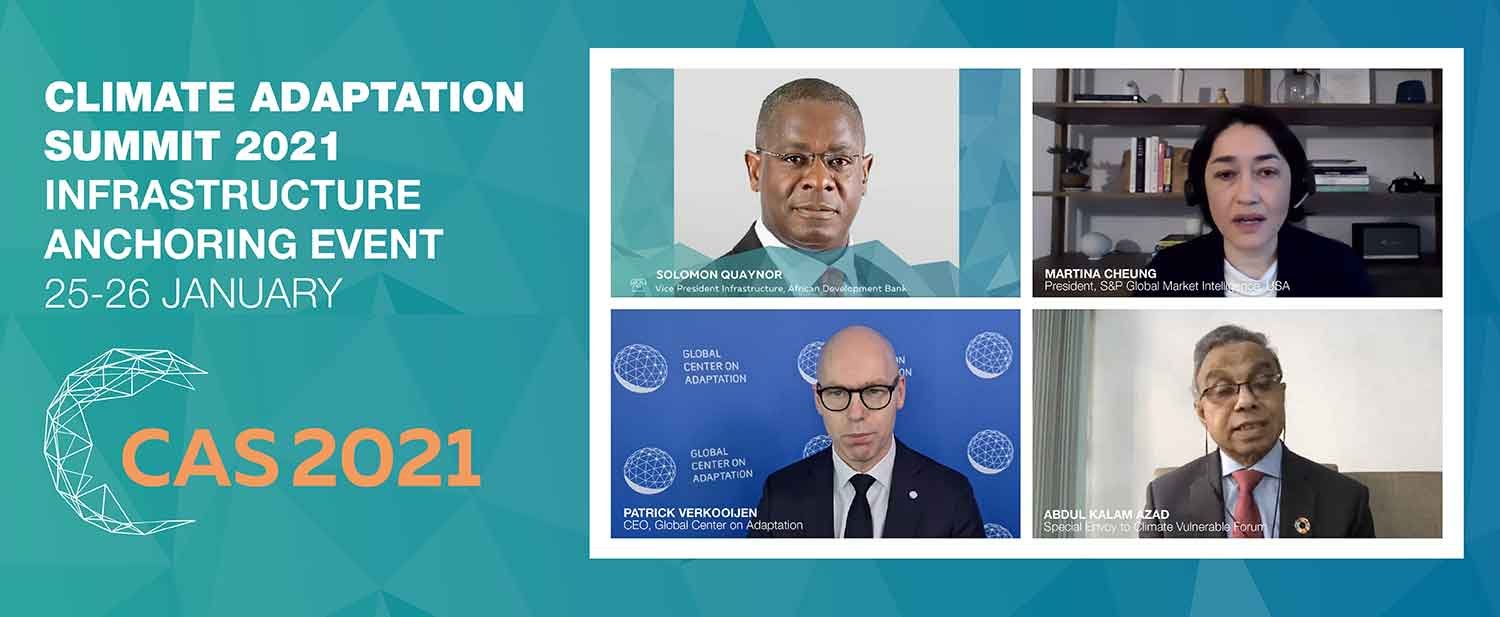
Panelists at the 2021 Climate Adaptation Summit said on Tuesday that governments and the private sector need to adopt a “whole-systems approach” to urgently deliver the climate-resilient, clean infrastructure that Africa needs.
Participants said expanding infrastructure, partnerships, gender integration, risk mitigation and mobilizing private sector finance are all essential for long-term progress towards the Sustainable Development Goals.
Speaking on the summit’s infrastructure panel, African Development Bank Vice President (Private Sector, Infrastructure and Industrialization) Solomon Quayner said: “African governments cannot afford to pay for replacements, so it is best to build resilient, high-quality infrastructure from the start and immediately implement adaptive improvements to existing infrastructure.”
Quainor added: “Overall, the African Development Bank has committed to doubling its current level of climate finance to US$25 billion between 2021 and 2025, from a total of US$12.5 billion between 2016 and 2020, to support low-carbon and climate-resilient development.”
The African Development Bank supports governments with investments in sustainable transport, waste and pollution management, energy, water, and other services that can withstand climate change. This ensures sustainable urban development and promotes resilience to climate change.
Cora van Nieuwenhuizen, Minister of Infrastructure and Water Management of the Netherlands, emphasized the reality of climate change and its serious impacts, and reiterated the importance of partnerships to achieve resilient infrastructure. “The good news is that adaptation fosters growth and development, creates business opportunities, reduces inequality and protects nature,” she said.
Other speakers, including Lawrence Slade, CEO of the World Infrastructure Investors Association, also shared their views on the need for stronger partnerships to ensure infrastructure is prepared for the impacts of climate change.
“From a financial perspective and from a business perspective, there is a strong case for making sure we invest in that resilient infrastructure from today,” Mr Slade said.
Speaking earlier, World Bank Vice President for Infrastructure Mahtar Diop emphasized the need to foster private sector financing to develop climate-resilient infrastructure. “What we are trying to do at the World Bank is to reduce risk as much as possible to make private sector investment more attractive in critical areas,” he said. Diop added that the World Bank is also considering the use of appropriate technology to develop resilient infrastructure.
The COVID-19 pandemic has increased the need for additional funding, including funds to support the needs of low-income countries to address climate change. Ambroise Fayol, vice president of the European Investment Bank, emphasized this: “We need to take a system-wide approach.”
In her contribution, Cynthia Asare Bediako, Secretary-General of Ghana’s Ministry of Environment, Science, Technology and Innovation, emphasized the importance of incorporating gender issues in building resilient infrastructure.
“That is why we are pleased to be pioneering this effort in Ghana to improve our understanding of how best to plan, invest in and manage climate-resilient infrastructure,” Bediako said. He added: “The first phase of this research has already identified areas of risk and promise for strengthening resilience. It also shows the impact of climate change on different groups, highlighting in particular the importance of gender issues for resilient infrastructure.”
The annual Climate Adaptation Summit aims to respond to UN Secretary-General António Guterres’ call for more concrete plans and targets from more countries and businesses to increase the planet’s resilience to climate change.
Listen to Vice President Quayner.
