


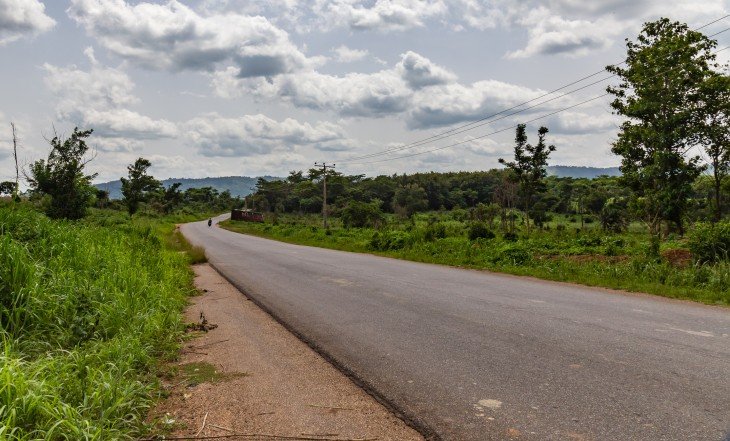
Nigeria’s new minister, David Umahi, is promoting the use of rigid pavements in road construction, as opposed to the predominantly used flexible pavements. As the Minister pointed out, this is because flexible pavements in the country are in a precarious state.
Hard pavement is a road surface covered with reinforced concrete, while soft pavement or asphalt pavement is a road surface covered with bitumen (tar).
Asphalt roads are the most common type of paved roads in Nigeria. Examples include Lagos-Ibadan, Port Harcourt-Enugu, Lokoja-Abuja and Abuja-Kaduna expressways. Concrete roads include Kaba-Obajana road in Kogi state and Apapa-Oshodi road in Lagos state.
Road infrastructure is essential in modern economies. Economic growth and development requires mobility and accessibility.
As an engineering professor who has studied the use of reinforced concrete and asphalt on Nigeria’s roads, I offer some insight into the problems raised by the Minister’s decision.
The choice is between using additional services for higher costs or using fewer services for lower costs. This is a design challenge. This decision is not only technical, but also political.
However, there is no data to definitively say whether concrete pavement is better than flexible pavement for Nigeria.
Comparison of flexible pavement and rigid pavement
Rigid pavement is generally expensive and difficult to install and maintain. They are made of cement concrete with a base, subgrade and subgrade. Unlike flexible pavements, rigid pavements have a high bending strength, so all layers are virtually immune to bending under pressure. Flexural strength is the ability of a material to resist deformation under load.
Flexible pavement is designed to bend and flex in response to external factors such as traffic loads. Basically, it adapts better to the elements it is exposed to. The initial construction cost is low, and with regular maintenance, it can last for 10 to 15 years. This type of pavement requires regular maintenance and repair work is relatively simple.
Flexible pavements have lower initial costs but higher maintenance costs.
By comparison, rigid pavement has a higher initial cost but lower maintenance costs.
Compared to reinforced concrete, which has a large surface area, asphalt has a relatively small subgrade surface area. Subgrade is the material that lies beneath the pavement structure.
Soft pavement typically lasts 10 to 15 years, while rigid pavement lasts 25 to 30 years.
Flexible pavements have a high rate of water infiltration, while rigid pavements have a low rate of infiltration. The longer moisture remains within the flexible (asphalt) pavement structure, the more likely pavement failure will occur. In particular, the continuous presence of moisture in a pavement subgrade can significantly affect the modulus of the subgrade and reduce pavement performance. Subgrade modulus is a conceptual relationship between the pressure and deflection applied to a plate resting on an elastic support system.
The light color of the road surface makes it suitable for night driving on hard pavement.
Extreme weather conditions, such as high temperatures, affect flexible pavements, but not rigid pavements. In flexible pavements, temperature fluctuations have a significant impact on structural performance such as stress and strain.
Noise pollution is also higher on flexible pavements but lower on rigid pavements.
the way to go
The type of pavement you choose depends on the life cycle and cost of the material. This includes initial construction costs, maintenance and repair costs, and costs related to environmental factors such as emissions and energy consumption.
Therefore, a life cycle cost analysis must be performed before selecting a pavement type.
Properly designed roads provide the intended level of service with an acceptable level of safety. It also reflects local values and policies that vary by location, giving appropriate weight to cost, environmental value, and appearance. These should guide national decisions on this issue.
Asphalt roads (flexible pavements) have lower initial construction costs, shorter construction and repair periods, are faster to repair, absorb traffic noise, and can be recycled, reducing waste. However, asphalt has a short lifespan, requires frequent maintenance, and does not hold up well to high-traffic roads, making it better suited for low-traffic roads in residential areas and rural roads. There is also a large carbon footprint harmful to the environment as a result of bitumen production.
Concrete roads are expensive to construct, take a long time to cure, and take a long time to repair. Their long lifespan, low maintenance costs, high durability, and high load capacity make them ideal for high-traffic locations such as highways, ports, and airports. Concrete roads have a lower carbon footprint from cement production and are less prone to potholes, reducing fuel consumption and carbon emissions.
This article is republished from The Conversation under a Creative Commons license. Read the original article.
Photo: Road, Ekiti State, Nigeria (© Matthew Omojola | Dreamstime)
