


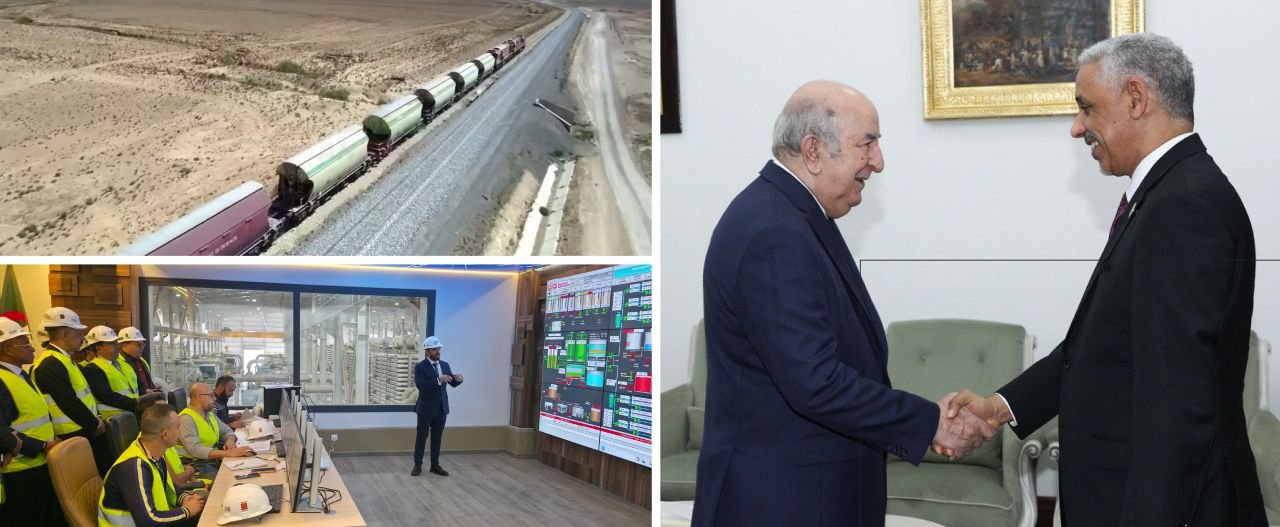
Algeria has put railway development at the heart of the country’s 2025 investment strategy and has identified the African Development Bank (AfDB) as a key international partner for new external financing initiatives. This decision was confirmed during AfDB President Dr. Sidi Ould Tarr’s official visit to Algeria on November 16-17, where he met with President Abdelmadjid Tebboune and senior government officials.
A core priority under the Finance Law 2025 is the construction of the Laguat-Gardaia-El Menia railway line, a project with a total length of 495 km and an estimated cost of USD 2.8 billion. The line represents the first phase of the planned Trans-Saharan Railway, a strategic north-south corridor that will eventually extend to Tamanrasset and connect with Niger. Algerian authorities say the new route will open up the country’s southern region and become an important logistics hub for landlocked Sahel countries, improving access to markets and reducing transport costs.
Expand railway to 10,000km by 2030
The La Guahua-Gardaia-El Menia line is part of Algeria’s national plan to double its rail network to 10,000 km by 2030, with the long-term goal to reach 15,000 km. The strategy aims to connect isolated regions, support industrial development and strengthen domestic processing of natural resources, especially in the south, where important mineral deposits are many and far from existing infrastructure.
Minister of Hydrocarbons and Mines Mohamed Al-Qab emphasized the importance of linking mining areas to railways to enable local value creation. “We can no longer accept raw materials to be exported in an unprocessed state,” he said, highlighting Algeria’s plans to increase domestic hydrocarbon conversion from 30% to 60% by 2035 and expand processing capacity for petrochemicals, hydrogen, fertilizers, tires and minerals.
The Trans-Saharan Railway is expected to play a key role in unearthing remote deposits of iron, zinc, gold and rare earths, enabling more efficient logistics for both domestic processing and export.
AfDB: Rail corridors at the heart of Africa’s industrial future
Dr. Ould Tarr underlined the alignment of Algeria’s industrial policy with the Bank’s strategic priorities and stressed the importance of transport corridors in strengthening mineral value chains across the continent. He cited recent findings that Africa has a competitive advantage in the production of battery precursor materials and said that “value localization, industrialization and mineral sovereignty are key pillars of Africa’s future.”
He called for concerted efforts among African countries to develop infrastructure that supports sustainable resource development, using the Trans-Saharan axis as a prime example.
Rapid execution and domestic production capacity
Algeria’s recent construction of 950 km of new railways in 24 months, making full use of the country’s resources and expertise, was highlighted during the visit as evidence of its strong execution capabilities. Said Said, Minister of the Interior, Local Government and Transport, together with Abdelkader Jehraoui, Minister of Public Works and Basic Infrastructure, noted that this capacity is essential for the promotion of large-scale north-south corridors and dedicated mining lines.
Dr. Ould Tarr praised the quality and ambition of the country’s projects, saying that Algeria’s ability to implement major rail and infrastructure projects makes it a “core partner in Africa’s transformation.”
Share: 


