


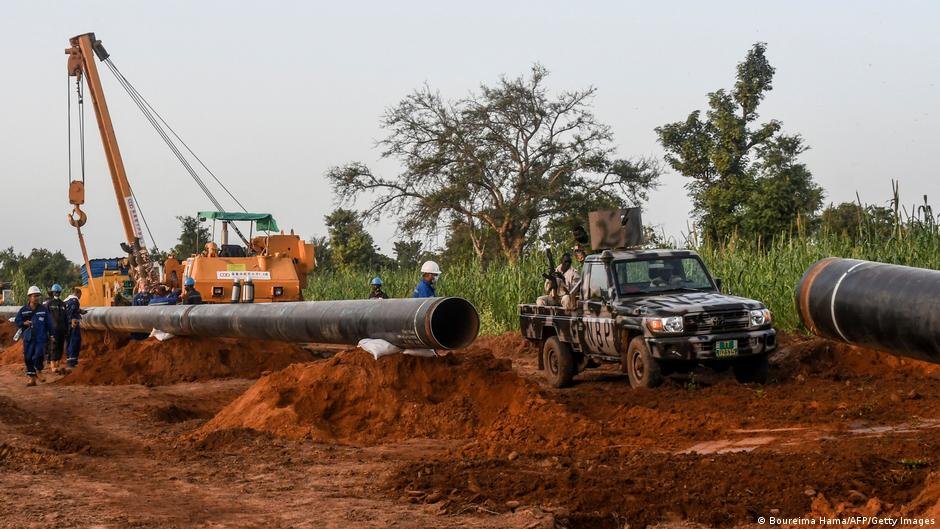
“America first” – that is the first impression that stands out from the data on so-called foreign direct investment (FDI) in Africa.
Since 2012, China has consistently led and continued to invest, although in some years U.S. companies have withdrawn more capital than they have moved into Africa. The numbers for 2023 paint a different picture. US companies have invested just under $8 billion (€6.8 billion) in Africa, almost twice as much as their Chinese competitors.
The dataset released in May by Johns Hopkins University’s China-Africa Research Initiative (CARI) does not yet reflect how the situation has evolved since then. This is because governments and the United Nations Conference on Trade and Development (UNCTAD) need time to evaluate the statistics and make an effective assessment.
Unadjusted figures for foreign direct investment can be highly misleading. In the current UNCTAD report, the Netherlands has emerged as Africa’s largest investor.
As a so-called “conduit” or transit country, the Netherlands is often at the center of complex financial networks through which capital flows from other countries.
Analysts around the world will be eagerly awaiting the new numbers. This is because economic competition between the US and China is increasing and there are several recent examples of potentially large investments in Africa.
America invests for profit, China invests strategically
Has the US really “overtaken” China as Africa’s largest investor, as recent media reports have claimed?
“Even when you look at the charts, you notice the fluctuations. It’s like a twitch,” said James Shikwati, founder and director of the Interregional Economic Network (IREN) in Kenya’s capital, Nairobi.
“America rises and falls, rises and falls, and that’s because it’s a purely private, profit-oriented approach. These are private companies, they’re not just giving money for charity,” Sheikwati told DW.
In contrast, Chinese FDI is ultimately supported by governments pursuing long-term strategic goals.
Shikwati said American companies rely on well-trained workers who can turn investments into profits. “So Africa benefits from highly trained Africans looking for jobs. And for the Chinese side, the average construction work is mostly practical skills and caters to such people. So you could say Africa wins on both sides.”
However, Africa has so far been unable to fully benefit from its abundance of critical raw materials. These raw materials are often exported unprocessed, with the actual value creation taking place in other parts of the world.
A little less than a year ago, the African Union (AU) announced its Green Goods Strategy, which stipulates a 10% export tariff. Its purpose is to give countries a share of the actual value of mineral resources or to encourage investors to process mineral resources directly in Africa.
This continent accounts for the majority of the world’s production of platinum, cobalt, tantalum and manganese. The mining sector has traditionally been an industry with particularly high levels of foreign direct investment.
Western companies are scaling back their activities, especially in politically sensitive mining countries. At the same time, China has become an indispensable player in many places through sustained investment.
China invests billions in African mining
“The experience in Africa shows that China is not afraid of political and economic instability,” Jimmy Mangliek, a lawyer and country director of NGO Resource Matters in the Democratic Republic of Congo, told DW. “China has been investing, so much of the mining sector in Africa, particularly in the Democratic Republic of the Congo, is now primarily controlled by Chinese companies.”
According to statistics from the US think tank Brookings Institution, China will invest nearly $8 billion in Africa in 2023 alone, including lithium projects in Zimbabwe and Mali.
However, these individual investments are only comparable to CARI’s FDI flows to a limited extent. This is because these flows reflect the balance of all capital movements by foreign investors. According to the data, particularly large private investments were made in copper projects in Botswana and the Democratic Republic of the Congo.
President Trump shifts focus from aid to trade with African countries
There are increasing signs that the United States is taking a more strategic, rather than purely profit-oriented, approach to Africa’s raw material resources.
In 2019, during U.S. President Donald Trump’s first term, the U.S. International Development Finance Corporation (DFC) was created, a government agency that brings together the previously separate areas of private investment and development financing.
The DFC’s website states bluntly that its purpose is to advance U.S. interests and “extend U.S. global leadership and counter China’s presence in strategic regions.”
When President Trump took office for his second term this spring, he halted numerous development aid projects and withdrew large amounts of funding from the development agency USAID.
“We’re moving from aid to trade,” President Trump told African leaders at the White House this summer. “Africa, like many other places, has huge economic potential. In many ways, in the long term, this will be far more effective, sustainable and beneficial than anything else we can do together.”
In the same appearance, President Trump vowed that the United States would treat Africa “much better than China or anyone else.”
As a sponsor of a fragile peace deal between the Democratic Republic of Congo and Rwanda, President Trump promised the U.S. economy preferential access to Congolese raw materials. But despite the peace deal, more than 400 civilians have been killed in recent escalation of fighting as the Rwandan-backed M23 rebel group continues its offensive in eastern Congo’s South Kivu province.
Battle for huge infrastructure projects
China’s current strength in the field of critical raw materials is also linked to the Belt and Road Initiative (BRI), a global infrastructure project consisting of ports, roads and railways, opening raw material transport routes in some regions for the first time.
“They tend to focus on cross-border infrastructure strategies,” said Sheikwati, the economist. “So even if they build a standard gauge railway in Kenya, their objective is not to actually get it to Nairobi and say thank you and congratulations. They want to take it to Congo. They want to take it to Sudan. They want to take it to the west coast of Africa.”
Former US President Joe Biden got Lobito Corridor funding back on track in his final weeks in office. The project, which could certainly compete with individual BRI measures, would connect Congo’s copperbelt with Angola’s Atlantic coast by road and rail.
The European Union is also supporting infrastructure projects in the Lobito Corridor under the Global Gateway Initiative. Angola has become an important partner for Europe, as evidenced by the recent EU-AU summit in Luanda.
This article has been translated from German
