


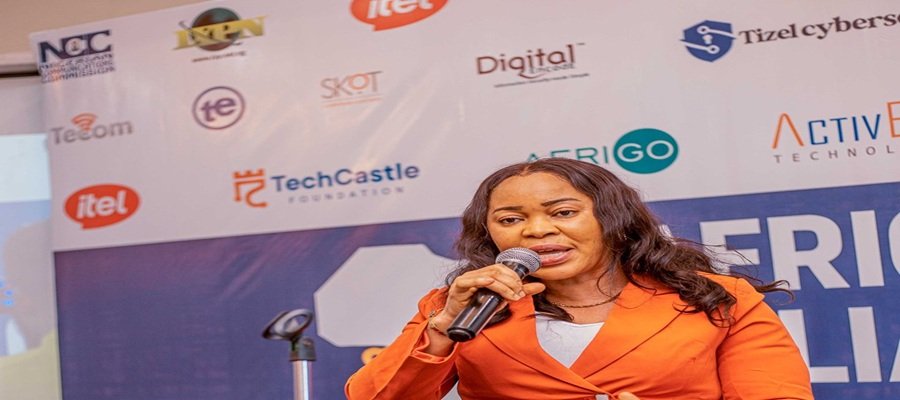
This concern took center stage at the Africa Tech Alliance Forum (AfriTech 5.0), where Happiness Obioha, Managing Director and CEO of Tizel Cybersecurity, made one of the event’s most convincing arguments for a new cybersecurity paradigm rooted in African intelligence services rather than foreign technology.
Speaking on the theme “Beyond the Firewall: The Case for Homegrown Cybersecurity Intelligence in Africa,” Mr. Obioha argued that cybersecurity risks in Africa cannot be effectively mitigated with imported solutions that are not designed for the continent’s unique digital realities.
She explained that Africa’s cyber environment is one defined by unique threat actors, infrastructure limitations, cultural nuances, and business patterns that are often incomprehensible to global security platforms.
According to her, in a world where cyber-attacks become more adaptive, persistent and sophisticated, it is no longer appropriate to rely solely on perimeter-based defenses such as firewalls.
Obioha argued that Africa’s reliance on one-size-fits-all global tools has created critical gaps in the continent’s ability to detect, interpret and respond to emerging threats, explaining that foreign cybersecurity systems often misread regional attack patterns or fail to anticipate unique regional vulnerabilities.
As a result, many organizations in Africa are operating with a false sense of security in the face of increasingly complex threats, from ransomware and financial fraud to targeted breaches of government infrastructure.
Tizel CEO emphasized that Africa’s long-term security lies in adopting an intelligence-driven approach based on local insights, indigenous expertise and continental research, noting that such solutions are built with an understanding of local behavioral patterns and digital environments, allowing for faster and more accurate threat detection.
In addition to improving security, he also emphasized that homegrown cybersecurity strengthens national sovereignty, reduces capital flight, expands technological capabilities and creates jobs in one of the world’s fastest growing sectors.
Obioha cited Tizel Cybersecurity as an example of what locally-based innovation can achieve, explaining that the company’s model integrates contextual intelligence, real-time monitoring, rapid incident response, and strict adherence to regulatory frameworks.
According to her, Tizel’s work with banks, carriers, government agencies, and small and medium-sized enterprises demonstrates the measurable impact of African-specific cybersecurity architectures.
Some of the achievements she highlighted include preventing large-scale ransomware attacks in the financial sector, significantly reducing network downtime at telecommunications carriers, and implementing effective real-time monitoring systems at government agencies.
She emphasized that Tizel’s success is based on a deep understanding of Africa’s digital ecosystem, which she explained is essential to providing cybersecurity that truly protects African institutions.
She said the region’s business culture, infrastructure diversity and evolving digital habits can only be accurately interpreted by experts working within the same environment.
Mr. Obioha urged African businesses and governments to take a more measured approach to securing their digital future, encouraging them to reconsider their cybersecurity postures, invest in indigenous intelligence-driven solutions, and build internal teams equipped to respond to emerging threats.
The survival and competitiveness of African businesses will increasingly depend on their ability to align security strategies with the realities of Africa’s rapidly evolving digital economy, she noted.
“Africa’s digital future is promising, but it must be secured with intelligence and innovation coming from within the continent,” she concluded.
