


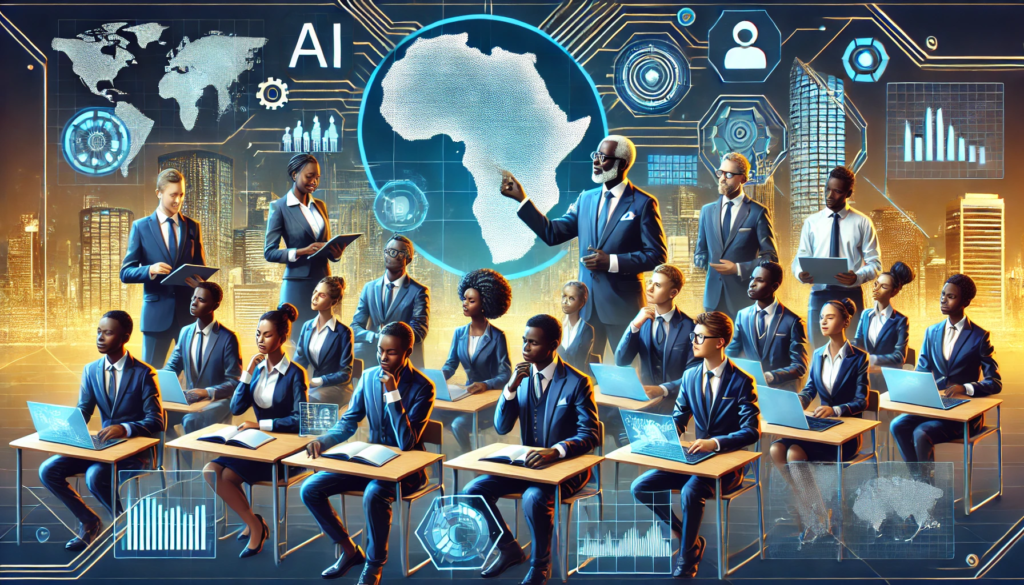
On a recent afternoon in Lagos, an MBA student preparing for a marketing strategy assignment entered some prompts into an artificial intelligence tool.
The software created sophisticated campaign plans within seconds that once might have taken days to assemble. He was impressed by her speed. The instructor became uneasy at the peace.
This quiet tension captures the broader changes currently unfolding across African business schools. Artificial intelligence (AI) is changing the way people work and the way knowledge is created, shared, and applied across industries.
In response, management schools across the continent are redesigning their curricula to focus on skills that are still difficult to replicate by machines, such as creativity, critical thinking and human judgment.
A BusinessDay survey of 12 of Africa’s more than 100 business schools showed that institutions have developed clear ethics and usage policies, including a focus on experiential learning, oral defense, presentations, and field-based projects using local data, to instill creativity and critical thinking in students amidst AI integration.
Africa is at a defining moment as AI reshapes industries, governance, and economies around the world. The continent has an opportunity not only to adopt emerging technologies, but also to shape them based on its realities, values and development priorities.
But education experts warn that without a carefully designed ethical and learning framework, the rapid adoption of AI could deepen inequalities or produce graduates trained in systems less suited to African markets.
Ogechi Adeola, vice-chancellor for research, innovation and enterprise at the University of Kigali, says AI is already embedded in Africa’s education ecosystem.
“The real question is how institutions design ethics, pedagogy, and assessment systems that ensure that AI enhances learning rather than diminishes it,” she says.
However, she stressed that over-reliance on AI tools risks weakening students’ ability to think independently. Adeola noted that management education exists to build problem solvers who can navigate uncertainty, a skill that cannot be outsourced to algorithms.
As a result, business schools are expanding their course offerings to explore how AI will transform marketing, finance, operations, and organizational leadership. This change will also necessitate deeper engagement with governance, ethical decision-making, and the social impact of automation.
Henry Ogundria, director of learning innovation at Lagos Business School, believes that AI can positively transform education if implemented carefully.
He says the technology can make learning more personalized, interactive and hands-on through advanced simulations.
“AI is not going to replace an MBA,” he explains. “This requires business education to focus on what humans do best: critical thinking, ethical judgment, and creative decision-making.”
Still, the transition is far from seamless. Across Africa, and particularly in Nigeria, educational institutions face structural constraints such as gaps in digital infrastructure, unequal access to technology, and limited teacher training.
There are also concerns that AI systems trained primarily on Western datasets may incorporate foreign business assumptions that do not reflect local realities.
“We often import models developed elsewhere,” Ogundurile says. “African markets operate differently, and education needs to reflect those differences.”
To address these risks, educators are calling for concerted reforms. Universities are introducing stricter guidelines governing the use of AI in teaching and assessment. Traditional exams are increasingly being supplemented by oral presentations, field research, and real-world problem-solving projects using local data.
Experts also emphasize the importance of embedding AI literacy across business sectors. Students must not only learn how to use AI tools, but also how to question, examine, and adapt their output.
Ethical issues such as algorithmic bias, data privacy, and turnover are increasingly being treated as core management subjects rather than something that experts add on.
Regulators are expected to play a central role. National education authorities and professional bodies are under pressure to establish minimum AI competency standards and encourage the development of African datasets and case studies.
Such a move could reduce reliance on general global models and enhance locally relevant research.
Despite the challenges, AI is enabling data-driven decision-making, advanced simulations, and around-the-clock personalized learning, accelerating the evolution of business education.
Some educational institutions have begun implementing AI-assisted education tools that allow instructors to create interactive learning experiences.
However, many schools still lack the infrastructure, funding, and research capacity to fully integrate technology. Analysts warn that without investment, Africa risks widening the gap in global competitiveness in management education.
For now, business schools across the continent are taking cautious but decisive moves. Their challenge is not just to teach students how to use artificial intelligence.
This is to ensure that graduates maintain their ability to think independently in an increasingly automated world.


