


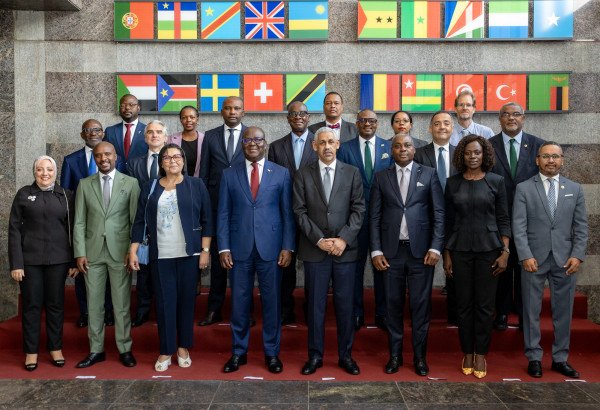
The African Development Bank Group (www.AfDB.org) on Tuesday launched a series of high-level meetings with African Development Banks and private sector financial partners to develop a bold and historic blueprint for a new African financial architecture aimed at closing the financing gap for the continent’s development needs.
Download document: https://apo-opa.co/4r8E8Do
At the invitation of Dr. Sidi Ould Tarr, President of the African Development Bank Group, more than 50 representatives from regional and continental banks and development finance institutions will gather over the next two days at the African Development Bank Group headquarters in Abidjan for talks that Dr. Ould Tarr described as crucial to the destiny of the African continent.
“As architects of Africa’s capital markets, you are the stewards of financial institutions and the catalysts of the continent’s future,” said Dr. Ould Tarr at the beginning of the first session with heads of African stock exchanges, private equity funds and venture capital funds.
The first-of-its-kind meeting between the World Bank and African Stock Exchanges aims to focus on reforming the way Africa mobilizes capital and explore the role of both stock exchanges in raising long-term financing. The CEO of the West African Regional Stock Exchange (BRVM), Dr Felix Ed Kossi Amenoumbe, welcomed the meeting and stressed the need for fundamental change.
“While there is a gap between funding needs and available resources, we need to consider the reforms needed to achieve the capitalization of Africa’s pension funds, as these funds were originally established to provide funding to governments,” Amenoumbe said.
Major financial institutions on the African continent participating in today’s meeting include the African Exchange Partnership Project (AELP), the Rwanda Stock Exchange, the Mozambique Stock Exchange, the Cape Verde Stock Exchange, the Nairobi Stock Exchange, the Tunis Stock Exchange, the West African Regional Stock Exchange (BRVM), the Central African Stock Exchange, the Casablanca Stock Exchange and the Ghana Stock Exchange.
“Capital markets are the foundation on which long-term, sustainable economic growth is built,” Dr. Urd Tarr said, adding, “By mobilizing patient capital, we can provide diverse sources of financing for our sovereigns and businesses, while at the same time providing a wide range of opportunities for investors, especially institutional investors.”
Since taking over the reins of the agency in September, we have increased access to predictable and affordable long-term financing by upholding Dr. Urd Tarr’s four key points (https://apo-opa.co/43FpwRX).
The main objective of the consultation is to enable the flow of funds into private equity and venture capital by strengthening Africa’s existing investment funds and expanding their lending capacity to small and medium-sized enterprises (SMEs), mid-market enterprises and emerging industry champions.
Small and medium-sized enterprises, which account for almost 90% of businesses and over 60% of employment on the continent, continue to have limited access to risk capital.
The conference discussed promoting sustainable finance, digitizing markets, attracting investment capital to African markets, and programs tailored to small and medium-sized enterprises.
The development of financial education among young people was also highlighted as a key focus of the approach developed by the continent’s stock exchanges, along with increasing the use of digitalization tools and fintech to enhance opportunities.
Donald Waweru Wangunyu, non-executive director of the Nairobi Stock Exchange, stressed the need for regional coordination to achieve “scale up, policy coordination and implementation of reforms”. We have good projects, but obstacles still exist,” he said.
Ms. Sonia Ben Fresi, Chairman of the Board of the Tunis Stock Exchange, highlighted the issue of regulatory consolidation and the need to update outdated regulations.
Through collaboration with fund managers, institutional investors, DFIs and regulators, the two-day meeting’s goal is to create a path for financial institutions to mobilize additional financing for Africa, allowing countries to avoid dependence on existing overseas development assistance.
Dr. Urd Tarr said the World Bank Group will take a comprehensive approach to capital market development, focusing on three key pillars:
– Supporting capital market regulators, stock exchanges and other intermediaries through technical assistance, institutional support projects and policy-based operations.
– Savings mobilization and market participant diversification to promote product liquidity and deeper markets for credit enhancement companies, institutional investors and other financial institutions.
– Research, training and policy dialogue to strengthen the capacity of African capital market actors.
The development of capital markets across Africa is a key priority and is embedded in the structure of the four cardinal strategic priorities. Development finance institutions have a particularly catalytic role.
“We will build it together. It will take the collective efforts of each of us,” Dr. Urd Tarr explained.
The talks will continue for a second day on Wednesday, with the participation of heads of African development finance institutions.
Distributed by APO Group on behalf of African Development Bank Group (AfDB).
contact:
amba mpoke big
Mansour Diouf
Communication/External relations department
Email: media@afdb.org
About the African Development Bank Group:
The African Development Bank Group is Africa’s leading development finance institution. The organization is made up of three different entities: the African Development Bank (AfDB), the African Development Fund (ADF) and the Nigerian Trust Fund (NTF). The Bank has offices in Japan in 41 African countries and contributes to the economic development and social progress of its 54 regional member countries. For more information, please visit www.AfDB.org.
