


For years, students at the Federal University in Lafia, Nigeria, have struggled to study after dark, with their academic routines held hostage to frequent power grid breakdowns. Even though the supply remained unreliable, the monthly electricity bill amounted to 25 million naira, or about $17,000.
Now, a bank of solar panels and battery storage systems is changing that calculus as part of the African Development Bank Group’s broader efforts to quietly reshape the economic structure of higher education across Nigeria.
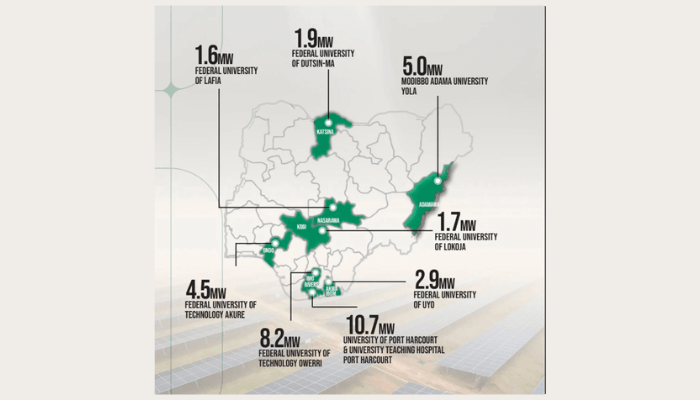
The third phase of the Energized Education Program, part of the $200 million Nigeria Electrification Project, will see the construction of solar hybrid power plants at eight federal universities, providing a combined capacity of 36.5 MW. This is enough to keep the campus running 24 hours a day, and the bank estimates it is equivalent to powering more than 30,000 homes in Nigeria annually.
The ambition of this program goes beyond just flipping a switch. By targeting universities and institutions, which the bank considers key hubs for human capital development, the initiative is betting that reliable electricity can trigger a knock-on effect on education, health care, research and workforce readiness in Africa’s most populous country.
Realize visible savings early

At the University of Port Harcourt, the 10.77 MW facility will begin pilot operations in December 2025, and the financial impact is already beginning to be felt. Monthly electricity expenditure was reduced from about N150 million to about N100 million, a reduction of about one-third even before the system was fully operationally integrated with the university’s teaching hospital.
Vice Chancellor of the University of Port Harcourt, Ounari Georgewill, said improving campus security and lighting are secondary but meaningful benefits. “Power supply used to be unstable and expensive,” he says. The university is committed to ensuring the long-term sustainability of the system, and this commitment is notable given that subsidized infrastructure projects in Nigeria have historically struggled to maintain and manage once initial funding dries up.
At Lafia, the savings will be channeled into research and institutional operations, said Shehu Abdul Rahman, Vice-Chancellor of the Federal University of Lafia, who said reliable power is “essential for meaningful academic and scientific research.”
Program managers are moving beyond the balance sheet to develop talent through the architecture of this initiative. A renewable energy workshop and training center co-located with the power plant provides students with hands-on technical experience.
Approximately 160 female STEM students began receiving dedicated technical training. This is a deliberate effort to expand the renewable energy workforce at a time when Nigeria is accelerating its clean energy ambitions.
Rahmat Abdullahi, a third-year computer science student at Lafia University, said the stable electricity extended productive learning time and made classroom concepts more applicable. “My STEM training has allowed me to apply more of what I learn in class in a practical way,” she said.
Longer Arc Phase III
The current phase of the program is expected to benefit more than 180,000 students and staff, install more than 5,300 smart meters and deploy more than 2,500 streetlights, while significantly reducing dependence on diesel, a cost that has long consumed university budgets, across Nigerian campuses.
The first phase was funded by the federal government and the second by the World Bank. The African Development Bank’s involvement in Phase III links the program to Mission 300, a joint initiative between the Bank and the World Bank that aims to provide 300 million more Africans with access to electricity by 2030.
The eight universities that will benefit span Nigeria’s geographic and political spectrum, from Port Harcourt in the oil-rich south to Modibo Adama University in Yola in the northeast, and are a sign that the government views energy infrastructure as an economic and political priority ahead of an election cycle that will test the public’s patience with chronic power shortages, analysts say.
Full operational integration across all eight campuses is expected as Phase III progresses through 2026.


