


As the global economy enters the age of artificial intelligence, hard truths are emerging beneath the hype about algorithms and automation. That is, energy, not software, will define the next tier of world power.
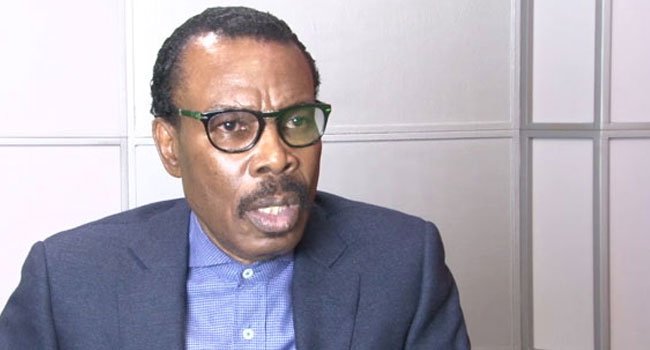
This was the central theme of Mr. Bismarck Lewein, Managing Director and Chief Executive Officer of Financial Derivatives Company Limited, who delivered the keynote address titled “Africa’s Energy Bank: Financing Africa’s Energy Future” at the 23rd Annual Arlette Adams Memorial Lecture Series in 2026.
According to him, the proposed African Energy Bank is more than just a multilateral financial institution. This is a strategic necessity in a world facing deepening structural energy imbalances. “The world has moved aggressively towards ‘moving away from fossil fuels,’ but energy demand hasn’t disappeared,” he says.
Lewane said all artificial intelligence queries consume power. As the adoption of AI accelerates globally, from data centers to autonomous systems, computing power demands are rapidly increasing, and with it, power consumption.
The transition away from hydrocarbons, driven by ESG obligations and net-zero commitments, is simultaneously limiting traditional fossil fuel financing, he said. However, renewable energy is not expanding fast enough to fill the supply gap.
The result is a structural imbalance in global energy markets, global in scope but particularly acute in Africa.
Regarding Africa’s energy paradox, Lewane noted that Africa accounts for about 18 percent of the world’s population but produces less than 2 percent of the world’s output. Although the continent has abundant natural gas, oil, solar, wind and water resources, it remains the least electrified region in the world.
He said Nigeria represents a paradox in its ambition to build a $1 trillion economy, with annual per capita electricity consumption of about 173 kilowatt hours, compared to more than 13,000 kilowatt hours in the United States.
Energy poverty directly leads to poor economic performance. Low consumption correlates with limited industrial productivity, suppressed manufacturing growth, and weak social indicators.
“Producing energy, consuming it efficiently and using it productively increases life expectancy and prosperity,” Lewane asserted. However, Nigeria’s power sector remains structurally constrained. The installed generation capacity exceeds the transmission capacity. Billions of dollars have been spent over decades on limited institutional reform. Infrastructure bottlenecks exist across power generation, transmission, and distribution.
He pointed out that all major leaps in global gross domestic product (GDP), from the agricultural revolution to coal-fired industrialization, through the oil age to the digital age, have been brought about by the energy revolution.
Each wave produced prosperity, he said, but also increased inequality, combined with strategic advances by countries that controlled resources. Mismanaged companies stagnated.
He explained: “Sixty years ago, Nigeria’s GDP per capita was comparable to China’s.” Today, the difference is stark. China, currently the world’s second-largest economy, has grown on the basis of energy-intensive industrialization and now consumes almost twice as much electricity as the United States. India, once economically aligned with Pakistan at the time of independence, ranks among the world’s top five economies, driven by policy continuity and resource discipline.
“Resources alone are not enough. Management determines the outcome,” Lewane stressed. It is against this background that the proposed African Energy Bank has assumed continental significance.
President Bola Ahmed Tinubu has urged African countries to finance their own energy ambitions, noting that Africa’s nearly $4 trillion in savings remains underutilized. Petroleum Minister Heineken Lokpovili said the bank is a way to fill the continent’s funding gap, particularly the development of natural gas as a transitional fuel.
Lewane drew historical parallels with the establishment of the African Development Bank in 1964. Ivory Coast hosted the institution, but deliberately avoided monopolizing the leadership, a diplomatic strategy to build confidence on the continent.
He expressed his caution, noting that the credibility of governance will determine whether the African Energy Bank will bring confidence or create geopolitical friction.
“This is not a match for rookies,” he warned. “It requires deep capital, organizational discipline and governance credibility.”
The funding gap is huge. The World Bank Group has committed approximately $100 billion to energy projects over the past decade. The European Investment Bank committed €168 billion to renewable energy and efficiency during the same period. The African Development Bank’s capital base exceeds $200 billion.
Against this backdrop, the proposed $5 billion capitalization for the African Energy Bank appears modest.
Lewane also highlighted the valuation disparity between the country’s oil champions. Saudi Aramco’s market value approaches $2 trillion. Petrobras is worth more than $100 billion. Despite being in business for decades, Nigeria’s NNPC Limited lags far behind.
Changes in policy are further compounding the challenges. Refinery assets sold to private investors in 2007 were later canceled, slowing reform momentum. A few years later, private capital stepped in through billions of dollars in investments, and the Dangote refinery in particular highlighted the cost of indecision.
Pipeline infrastructure remains underutilized, further constraining distribution even as production increases.
“The best time for reform was 30 years ago,” Lewane said. “The second best time is now.”
Liwane warned that any technological innovation increases total output but could increase inequality. Elevated Gini coefficients are often correlated with anxiety.
“Productivity without equity leads to anxiety,” he warned.
The African Energy Bank therefore needs to finance more than just upstream oil and gas projects. We need to invest in electricity grids, grid stability, distribution systems and inclusive access to ensure that energy expansion leads to industrial jobs, manufacturing growth and improved living standards.
Globally, oil accounts for approximately 30 percent of the energy mix, coal 26 percent, natural gas 24 percent, renewables 15 percent, and nuclear 5 percent. The cost of renewable energy is falling significantly, especially due to China’s scale and innovation. However, grid stability, storage, and transmission remain unresolved in many parts of Africa.
There are also sequence risks. Large central infrastructure investments could become stranded assets if the public electricity grid fails to modernize while households and businesses permanently migrate to off-grid solar power systems.
Pakistan’s recent power grid crisis, which triggered a mass migration to private solar power, offers lessons.
After all, Africa Energy Bank is more than just a financing vehicle. This is a test of Africa’s institutional maturity and strategic coherence.
Artificial intelligence, industrialization, data centers, modern healthcare, and the digital economy all rely on reliable electricity. Without electricity, Africa risks being left out in the next technological revolution.
This could lead to exponential growth for the continent. “The revolution cannot be reversed. The question is: will Africa drive the revolution or will it be left behind?” Lewane said.
Chairman, Board of Directors, Faculty of Engineering Charles Osezua said the Areto Adams Foundation was founded on the ideals of the late Chief Godwin Areto Adams. He said the main objectives include the education and empowerment of Nigerians in urban and rural centres.
Mr. Osesua said the main objective of the Foundation is to establish and endow professional chairs in resource management, oil and gas and other related fields in tertiary institutions in Nigeria.
