


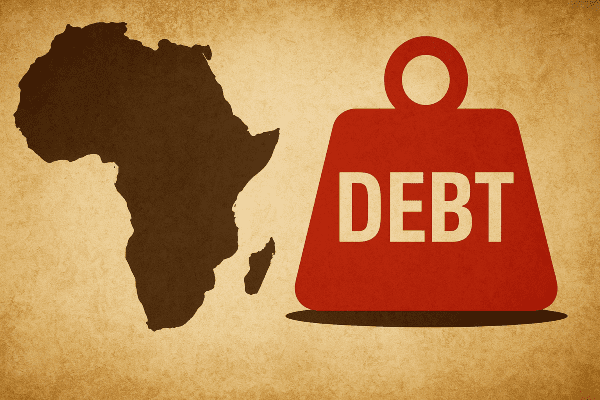
Africa’s multilateral financial institutions are developing early warning networks to detect and respond to sovereign debt crises before countries face chaotic restructuring processes like those experienced by Ghana and Zambia.
The African Alliance of Multilateral Financial Institutions (AAMFI), known as the Africa Club, has announced efforts to prevent protracted debt negotiations that have plagued several African countries in recent years. The system aims to identify early signs of financial problems and provide collective support before default occurs.
Samaira Zubair, Chairperson of Africa Club and Chief Executive Officer of Africa Finance Corporation (AFC), said the relationship between African lenders and borrowers is deep and long-standing. He stressed that the goal is to find solutions that avoid worsening tensions in the global financial system. Mr. Zubair was appointed as Africa Club President in February 2025, succeeding Benedict Olama, Founding Chairman of Afreximbank.
The move comes amid growing friction between African development finance institutions and international credit rating agencies over how African institutions should be treated in sovereign debt restructurings. Cairo-based African Export-Import Bank (Afreximbank) has had its credit rating downgraded by Fitch Ratings to BB+, classified as high-yield or junk status, following the bank’s involvement in Ghana’s debt restructuring.
Fitch on Wednesday downgraded Afreximbank’s long-term issuer default rating from BBB-minus and subsequently withdrew all of the agency’s ratings. The agency said the downgrade reflected a revision of Afreximbank’s policy significance risk from low to medium after the bank reached an agreement with Ghana for a US$750 million sovereign loan as part of the country’s broader restructuring program.
This rating action sparked intense criticism from African institutions. The African Union’s African Peer Review Mechanism (APRM) said Fitch’s classification of sovereign exposures to Ghana, South Sudan and Zambia as non-performing loans was legally inconsistent. The mechanism argued that member states that are shareholders of Afreximbank cannot be classified as defaulting on their obligations to the institutions they own.
Afreximbank ended its relationship with Fitch on January 24, saying the regulator’s approach to ratings no longer reflects its understanding of the bank’s founding agreement, mission and mission. The agency was established under a multilateral treaty signed by 53 African countries in 1993, which it claims grants priority creditor status.
African lenders have long advocated for creditor benefits similar to those offered by the International Monetary Fund (IMF) and World Bank, meaning that loans should be protected from losses during debt restructurings. However, international creditors and rating agencies dispute this classification, particularly because institutions like Afreximbank have private shareholders along with African governments.
This disagreement has significant economic implications. Moody’s Ratings downgraded Afreximbank to junk status, two notches above junk status, in July 2025. Bond market investors increasingly see Africa’s multilateral banks as taking on commercial risks rather than enjoying the protections afforded to traditional development institutions.
Both Ghana and Zambia went through lengthy debt restructuring processes that spanned many years and required multiple rounds of negotiations with diverse creditor groups. Ghana’s restructuring, which began in 2022 after the country defaulted on its external debt, required separate negotiations with Eurobond holders, bilateral creditors and African lenders.
The early warning system being developed by the African Club represents an attempt to create financial stabilization mechanisms before countries formally default on their debts. By intervening early with a coordinated support package, member institutions hope to prevent chaotic negotiations that could damage a credit’s reputation and lead to rating downgrades.
The Africa Club was launched in February 2024 in conjunction with the 37th African Union Summit held in Addis Ababa. Member institutions include Afreximbank, Trade and Development Bank Group, AFC, African Reinsurance Corporation, African Trade and Investment Development Insurance, Shelter African Development Bank, ZEP RE (PTA Reinsurance Company), East African Development Bank, African Solidarity Fund and African Export Development Fund.
Africa’s multilateral financial institutions collectively hold more than $65 billion in assets and attract equity investments primarily from African countries. These institutions were established by treaty to address deficiencies in the global financial architecture and to finance infrastructure, trade, and development across the continent.
Under Mr. Zubair’s leadership, the African Club has prioritized cross-border capital mobilization, the development of capital markets to increase liquidity, and the creation of mechanisms to prevent financial vulnerabilities. His agenda includes strengthening partnerships between member institutions, African governments, and global institutions to build a strong financial architecture.
The initiative faces skepticism from international creditors and rating agencies, who question whether Africa’s multilateral banks can maintain their preferential status while lending to debt-stricken member states at commercial rates. Ghana reportedly paid interest rates amounting to 9.55% on the Afreximbank loan in 2022, which is significantly higher than the concessional interest rates offered by traditional multilateral development banks.
According to the World Bank’s classification, 22 low-income countries in sub-Saharan Africa are currently in debt crisis or at high risk of debt crisis. African countries often face borrowing costs in excess of 10%, while G7 countries access financing at interest rates closer to 2-3%.
The African Club did not provide specific details about how the early warning system would work or what triggers would prompt coordinated intervention. Officials said they would focus on identifying distress signals before countries exhaust their stockpiles and face imminent default.
