


Photo: Africa Media Online / Ricardo Gangare
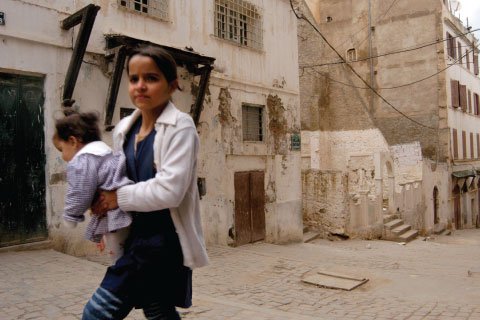
Millions of Africans live in slums, but they also prevent slum formation, and the rapid growth of African cities is exacerbating the problem. Africa faces the huge challenge of “improving the lives of those victimized by the formation of new slums,” says Joan Clos, executive director of the United Nations Human Settlements Program (UN-Habitat).
African housing ministers, who last met in Rabat, Morocco in September 2011, are well aware of this challenge. Gathering under the auspices of the African Council of Ministers on Housing and Urban Development (AMCHUD), they outlined new policies for housing and urban development across the continent, in line with the “Slum-Free Cities” initiative first adopted in 2005.
Some slum dwellers fear this is mostly an altercation. “I’m only interested in being kicked out of here and living in a more decent environment,” said Rashid Rashab, who lives in Casablanca’s Esekouira favela. “I’m not interested in the many meetings that our nation’s leaders attend.”
But in Rabat, ministers at least set a rough target. These include improving urban planning, increasing the availability of service land (for public buildings), developing industrial, agricultural and handicraft towns, and slowing the movement of people from rural to urban areas in search of employment opportunities.
crowding and illness
UN-Habitat estimates that in 2010, 200 million people in sub-Saharan Africa lived in slums, representing 61.7 percent of the region’s urban population, the highest proportion in the world. There were an additional 12 million slum dwellers in North Africa. This is just 13.3% of urban residents, the lowest proportion in the developing world.
According to a recent report from the International Federation of Red Cross and Red Crescent Societies, substandard housing and overcrowding, as well as a lack of adequate sanitation, potable water and electricity, are exacerbating the spread of disease and avoidable deaths. Slums contribute to lower life expectancy. In Mali, for example, more than 80 percent of the population lacks good housing and the average life expectancy is just 51 years, according to the United Nations Development Programme.
The situation in Mali mirrors that in much of sub-Saharan Africa. Gakou Salimata Fofana, Mali’s former Minister of Housing, Lands and Planning, called on Africa’s housing ministers to take urgent action. “We must take decisive action,” she said. “Otherwise, by 2020 there is a risk that around 6 million (Mali) urban people will still be living in informal settlements,” or almost double the current number.
Jugurta Ait El Hadj, an Algeria-based urban planner, believes African ministers are on the right track. “Such meetings are particularly useful in that they allow for the exchange of experiences. However, these meetings must be accompanied by concrete steps.”
There are many obstacles to realizing the dream of a slum-free city. Noureddine Moussa, Algeria’s Minister of Housing and Urban Development, said Africa’s urban expansion is limiting the ability of national and local governments to ensure security and provide basic social services such as health, education, water and sanitation.
climate change
Furthermore, El Hadji points out that climate change will interact with urbanization in unpredictable ways. In 2007, an assessment report by the Intergovernmental Panel on Climate Change, established by the World Meteorological Organization and the United Nations Environment Programme, warned that “urbanization and climate change may act synergistically to increase the burden of disease.”
Slum dwellers also face severe environmental challenges due to the poor quality of construction materials as most of the buildings and slums are located on remote land. Many slums are at risk of fire. For example, in September 2011, a leaking gasoline pipeline exploded in Nairobi’s densely populated Mukuru wa Njenga slum, killing more than 100 people.
Differences in country geography, climate, expertise, and financial resources impact efforts to implement urban development plans across the continent. In Rabat, Ministers suggested that these challenges can be addressed through effective cooperation and support from international partners, including the United Nations.
steady progress
I have good news. According to a 2010 UN-Habitat report, countries such as Egypt, Libya and Morocco have “almost halved the total number of urban slum dwellers, and Tunisia has completely eradicated slum dwellers.” Ghana, Senegal and Uganda have also made steady progress, reducing their slum populations by up to 20 percent. In Nigeria, the slum population decreased from 75% of the total urban population (1990) to 61.9% in 2010. In South Africa, the proportion fell from 46.2% to 28.7% over the same period.
Morocco’s urban development model continues to attract attention. In 2004, the government launched its own Slum-Free Cities program, creating an urban development strategy that ensures slum dwellers have decent housing with access to water, electricity, and sanitation. By 2011, approximately 100,000 new housing units had been built in different regions of the country. Overall, 37 of Morocco’s 83 cities were transformed, and the changes benefited more than 1.5 million people. These cities now boast street lighting, drainage systems, safe water, roads, sanitation, and other infrastructure. Also noteworthy is the development of the Bouregreg Valley (near Rabat) and other “green areas”.
At the third conference of African housing ministers, Fatala Oualalou, former Moroccan housing minister and current mayor of Rabat, linked the success of urbanization efforts to the effective implementation of the roadmap developed in Bamako, Mali in 2010, and argued that such conferences are indeed beneficial. The roadmap focuses on efficiency in land management, sustainable housing, urban transport, and sanitation, among others.
Moussa, Algeria’s Minister of Housing, points to other keys to success. These include efficient and equitable management of land, the establishment of appropriate land laws to ensure access for women and other vulnerable groups, and improving social conditions in housing projects. Schools, clinics, electricity and sanitation facilities are important, Moosa said. “You cannot plan for sustainable development without sustainable urbanization,” he argues. Urbanization should be controlled, he added, and efforts should be made to “reduce inequality between the rich and the poor by providing basic services to all.”
