


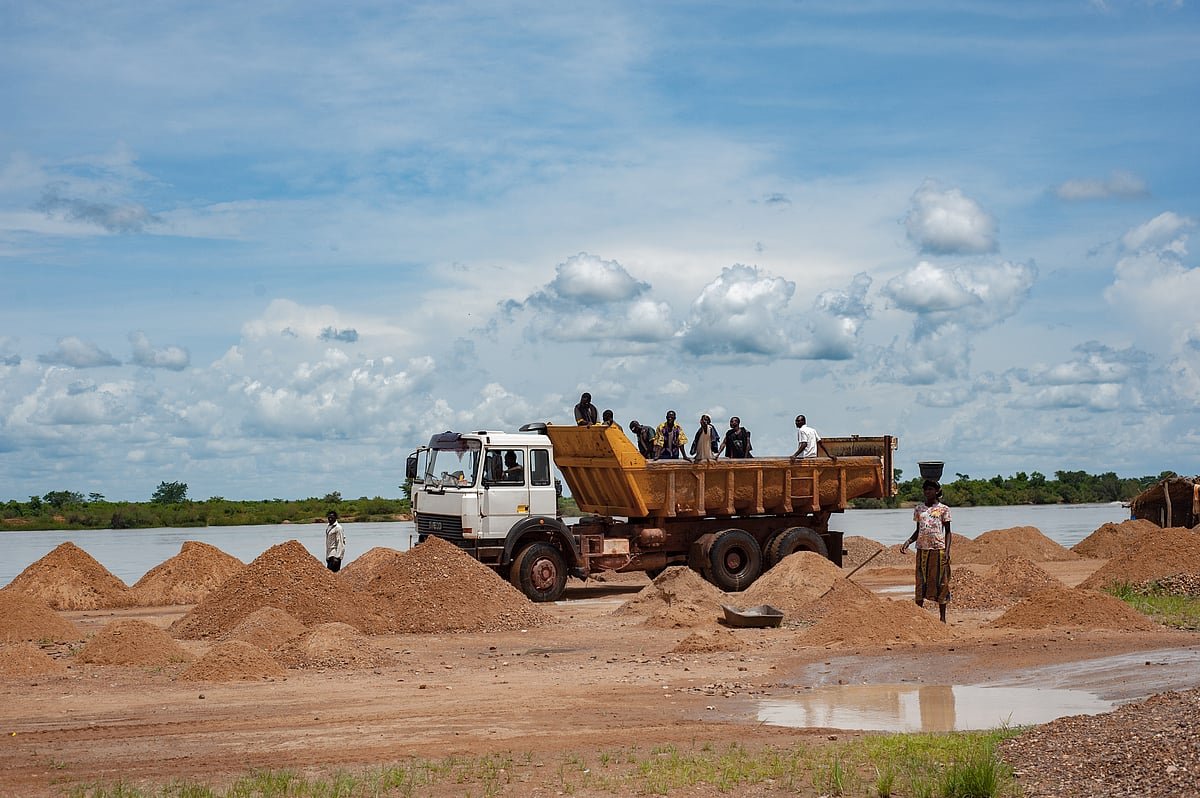
The sun is rising in Kenya’s Kajiado County, on the outskirts of Nairobi, and a truck rumbles across the dusty ground toward the riverbank. Young men usher drivers into the parking lot, each with a shovel in hand, and begin loading trucks with the most attractive piles of construction sand for which the area is famous.
The driver kills time with a snack and a mug of tea poured from a flask by a traveling salesman. He pays the young men about $10 for their labor and the landowners $40 to $50 for the sand. The drivers then begin their journey to deliver the sand to hardware stores, construction sites or informal sales points in Nairobi and its suburbs, paying county taxes and police bribes along the way.
Such sand mining sites are proliferating along many of Kenya’s river systems. They are contributing to the construction boom caused by urbanization and grand infrastructure plans.
However, Kenya has been singled out by the United Nations Environment Program as a country with unsustainable sand extraction. The industry is plagued by inadequate regulation, environmental degradation, and sometimes violent conflict.
We are peace and security researchers who have studied controversies surrounding infrastructure projects in sub-Saharan Africa. In a recent study, we investigated conflicts surrounding sand extraction and the sand commodity chain in Kenya. We mapped where industry interests are concentrated and examined how locally established governance mechanisms work to distribute benefits and harms.
We surveyed sites in seven counties in Kenya. In the west, we visited Homa Bay near Lake Victoria. We investigated the ruins of Nakuru and Kajiado on the outskirts of Nairobi. In the drier east, we visited Taita Taveta and Makueni, once hotspots of violent conflict between sand mining cartels. In arid regions, sand is essential for water storage and is used to create dams that increase groundwater storage. On the Kenyan coast, we investigated the archaeological sites of Kwale and Kilifi, which will help develop the city of Mombasa and its surroundings. We spoke to loaders, landowners, leaders of informal youth groups and cooperatives, transporters, intermediaries and managers.
We realized that this industry is orderly and unruly at the same time.
National regulations regarding sand extraction are rarely enforced in most counties. The stability of sand extraction and transport therefore depends on the complex informal rules that distribute the industry’s profits. The greatest profits in the sand industry are not made at the mine site, but at the top of the product chain. Sandoz supports many people at the community level.
We argue that getting the most out of Kenya’s sand industry does not lie in introducing top-down legislation. Rather, existing informal regulations need to be leveraged and harmonized within formal rules. This will go a long way in ensuring sustainable livelihoods and broad inclusion.
winners and losers
Studies of natural resource extraction across the Global South have demonstrated trends in natural resource removal and accumulation by powerful actors. They forcefully control extractive activities and value chains, leaving high social and ecological costs. This is a phenomenon known as extractivism.
Extractivism depletes ecosystems and deprives communities of the use of natural resources, fair access to them, and the opportunity to benefit from the wealth generated.
Does sand extraction in Kenya exhibit these characteristics? Not entirely.
Sand may be a little different from precious minerals like gemstones. It is bulky, low value, widespread in many countries, and accessible with basic tools. Sand is found in rivers, fields, private and communal lands.
At harvest sites, in many places loader groups and homegrown sand cooperatives are highly organized with rules, directories, and even external shareholders. These ensure a broader distribution of benefits at the local level. Loader group membership positions are coveted and bought at high prices by group organizers, and some groups and cooperatives are building economic power and attracting better transportation contracts. Large contractors dictate terms and conditions, driving down prices at harvest sites.
As a development mineral, sand is also supplied to concrete production, which is crucial for large-scale infrastructure and housing projects. These have the potential to promote economic growth.
But it is true that profits tend to flow from the source. Naturally, the biggest gains are made in urban markets. Truck drivers at extraction sites pay about $90 for a 12-ton truck full of sand, while the same load sells for up to $400 in Nairobi. Transportation costs, including taxes, bribes, fuel, and salaries, amount to about $100.
Landlords also accumulate income. However, this can be particularly controversial where land is contested against a background of colonial and post-colonial dispossession, as in the case of the Kedon site in Nakuru. At one point, when the landowner hired an excavator, local residents, fearing complete eviction from their source of livelihood, rioted and destroyed the rig.
County governments also benefit greatly from local taxes and have little incentive to control over-extraction from fragile lands.
Bribery in the sand business also takes advantage of informal situations. Police use regular dirt routes and charge a flat fee of $4 to $8 for every truck. Overloading can be managed by paying a “fee” at the weighbridge. Some drivers have found ways to store and sell sand without their bosses knowing.
Although ecological damage was not fully investigated in our study, we found evidence of it, especially in drier counties such as Taita Taveta and Makueni, where river sand is an essential vessel for water storage. Local communities are aware of the environmental costs of overextraction and are calling for stronger regulation of the industry.
what needs to happen
Making Kenya’s sand trade fair and sustainable requires effective collaboration between different tiers of governance.
This is unlikely. One notable exception was the strong and participatory management of sand in Makueni County, which also took decisive action against cartels and blocked exports outside the county until ecological recovery was ensured.
However, instead of introducing top-down legislation to govern the industry, leveraging existing informal regulations and harmonizing them within formal rules could go a long way in ensuring sustainable livelihoods and broad inclusion, as Makueni’s case has shown.
These discussions are important because Kenya, among many other countries in the Global South, is rapidly urbanizing and has a number of large infrastructure projects underway.
Some of the sites we investigated provided sand for the construction of standard gauge railways (built between 2014 and 2019). While many communities benefited from the project, it also exposed the unequal relationships between governments, companies, and communities that enable exploitative sand extraction.
Given that the rail line will extend to the Ugandan border, regulations that allow for broad local participation are essential to ensure confidence in Kenya’s governance system.
Kennedy Mkutu, Associate Professor of International Relations, USA International University; Jan Bachmann, Senior Lecturer, University of Gothenburg
This article is republished from The Conversation under a Creative Commons license. Read the original article.
