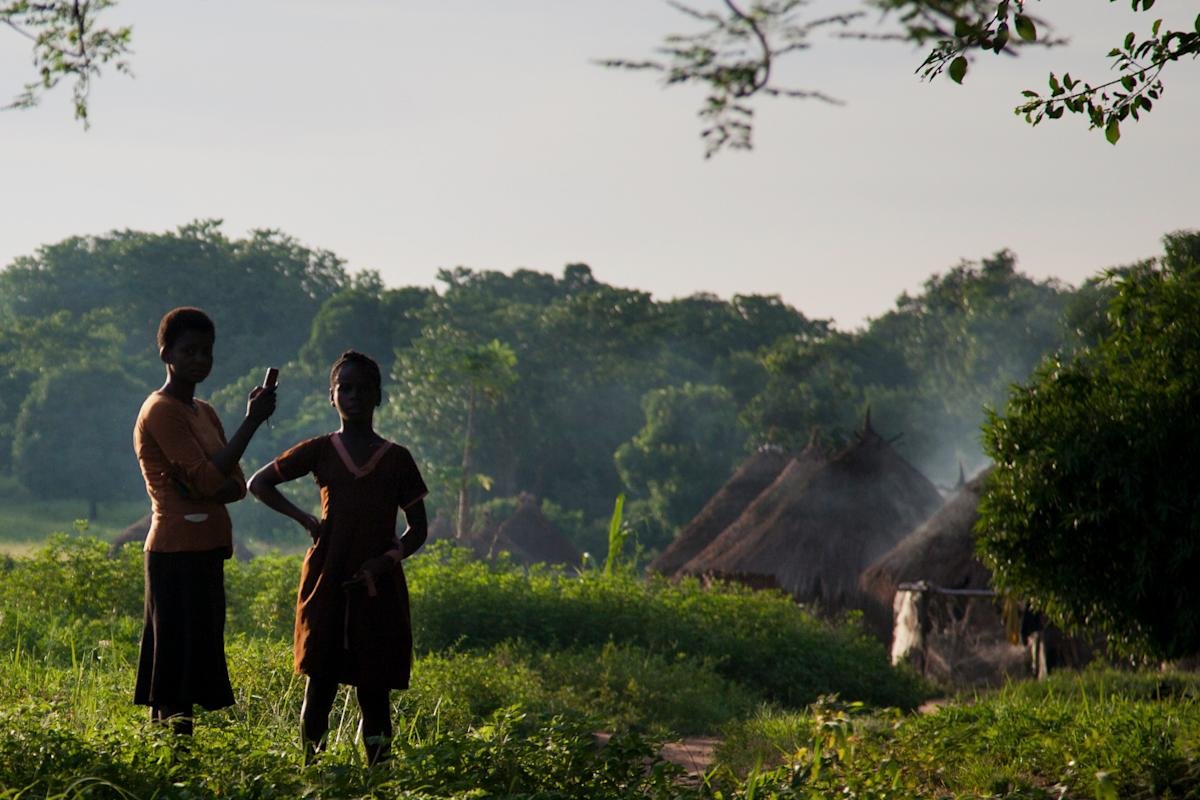
Young girls use mobile phones in rural Makurdi, Benue State. Photo: In Pictures Ltd/Corbis (via Getty Images) ·Christian Booth (via Getty Images)
Cardano chief Charles Hoskinson claims Africa has the potential to leapfrog the US and Europe in adopting blockchain technology and become “wealthier than the West.”
Hoskinson has a vision of using blockchain technology to rebuild the socio-economic infrastructure of African countries.
Speaking at the Financial Times’ Crypto and Digital Assets Summit, Cardano’s founder said there is “more demand than supply” for his company’s services in the world’s developing countries.
As of this writing, Cardano (ADA-USD) is priced at $0.53 and has a market cap of $18 billion.
Cardano sees the deep-rooted centralized infrastructure that underpins Western countries as an obstacle that African countries can avoid on their way to becoming Web3 giants.
Read more: Cryptocurrency: Stablecoin storm spreads after billions of Tethers are monetized
“DeFi certainly has great potential for developing countries, especially those that don’t yet have legacy infrastructure that hinders rapid innovation, and can make blockchain deployments smoother,” John O’Connor, head of Africa operations at IO Global, said in an interview with Yahoo Finance.
IO Global is the infrastructure research and development company behind the Cardano blockchain and was founded by Charles Hoskinson and Jeremy Wood.
Cardano sees opportunity for Africa’s young generation. They are adopting new technologies at a faster rate than the aging population in the north.
Instead of relying on traditional government systems that are centralized and can succumb to corruption, African countries could leverage automated blockchain protocols to unlock the untapped potential of millions of people.
Hoskinson added that in Cardano’s vision for Africa, code is king, and that “code transcends governments, and even if governments want to move code in a certain direction, they can’t.”
Speaking at a Financial Times event in London, he described the cycle of poverty that blockchain unleashes because its algorithms “don’t care who you are, where you are, whether you’re a farmer in Sengar or Bill Gates.”
Cardano blockchain algorithms enable smart contracts that provide financial inclusion to billions of people across the African continent.
Read more: Cryptocurrency live prices
Being able to prove your identity, educational qualifications, legitimate ownership of land, or access to a loan is a natural luxury for citizens of the United States and Europe.
In Africa, hundreds of millions of people are unbanked, without access to adequate credit, without conclusive evidence of eligibility, and without evidence of ownership of the land or homes they have lived in for generations. Because centralized government has failed them.
Cardano is on a mission to fix this poverty trap and leapfrog African countries to not only compete with the West, but also become the world leader in “AI and advanced robotics.”
In the past, the fate of billions of Africans was decided in the boardrooms of Western countries and in the golf resorts of the power elite. But Hoskinson has news for them: blockchain is “unaffected by the politics of the day and the geopolitics of big powers versus small states.”
Hoskinson explained that once Cardano’s protocol is installed, “it remains in place and the user owns the assets.” He added: “There is more demand than supply, and there are currently over 900 decentralized applications deployed in the Cardano ecosystem, many of which are involved in the GoveTech business, and people are seeing opportunities there.”
Read more: “The crypto lobby is dictating the terms in Washington.”
But if Africa’s social, economic, and governmental structures succumb to the power of blockchain, what will determine the fate of the billions of people living in Africa? How can citizens be sure that the encrypted protocols that guide their lives are not guided by bad actors?
Cardano’s John O’Connor said blockchain has been proven to be secure and is not susceptible to manipulation by powerful groups. He further added that “as long as 51% of the stake in its native ADA cryptocurrency is held by honest participants, the protocol is guaranteed to be secure, and this is achieved through random leader selection, in addition to other novel concepts.”
He further added, “Governance is an important step in Cardano’s roadmap. This roadmap has five stages: Foundation, Decentralization, Smart Contracts, Scaling, and Governance.” He described Cardano’s governance system that makes influential decisions regarding software updates, technical improvements, and funding decisions to ensure that “the blockchain remains democratic.”
Cardano enables a decentralized banking system that can issue small loans to people with no credit or transaction history. By tracking peer-to-peer transactions, blockchain builds an individual’s transaction history. O’Connor added: “When it comes to the unbanked in developing countries, there is a real problem that rural individuals lack access to mainstream financial services. DeFi (decentralized finance) is a great tool to help improve financial inclusion.”
See: What are the risks of investing in cryptocurrencies
Forgery of land ownership documents is a problem in Africa’s real estate market, and changes in government have made it extremely difficult to prove property claims made under previous governments or after civil wars.
According to O’Connor, Cardano plans to help eradicate the problem of land and real estate fraud by “storing real estate deeds on the blockchain, allowing users to access these documents using just their mobile phones, and ensuring that the documents are secure and cannot be tampered with.”
He added: “This could be of particular benefit to refugees who need to prove land ownership upon return. If these documents are stored on a digital ledger, they cannot be lost or tampered with thanks to blockchain security. Cardano has proven secure thanks to Ouroboros, a blockchain protocol we designed that features mathematically verifiable security against attackers.”
Cardano is not the only organization pushing for Africa’s future to be blockchain-based. Chris Cleverley, president of Tingo International Holdings, also spoke to Yahoo Finance and said that Africa’s crypto market will grow by more than 1,200% in 2021, making it the “fastest rate in the world.”
Watch: Steve Hanke: “Cryptocurrency is fiat currency on steroids”
Tingo seeks to provide much-needed credit to Africa’s unbanked people through microloans recorded on the blockchain through a pioneering SMS network that doesn’t even require an internet connection.
More than half of Africa’s population has access to a mobile phone, and Tingo’s new KamPay service will enable people to send and receive funds for products and needs through a decentralized and secure blockchain.
Wisely added that the blockchain service could use its SMS technology to reach millions of farmers across Africa, offering microloans for as little as US$2.
It wisely explains that blockchain “will play a major role in solving some of the world’s biggest challenges, including addressing food security and boosting economic development.” He added that this technology already exists and is “not a distant, vague, poorly understood concept or vision.”
Read more: Warren Buffett’s Bitcoin attacks cause crypto prices to fall
Cardano was slow to launch starter blocks, years behind first movers like rival Ethereum, but they believe building the Web3 world will not be a 100-meter sprint.
O’Connor said that because Cardano is evolving slowly, taking steps backed by peer-reviewed research, the blockchain is “now mature enough to support a blockchain solution that can scale to serve an entire population.”
It has been said that a day in cryptocurrency is equivalent to a year in traditional finance, and proponents of rival blockchains have accused Cardano of stalling development for what seemed like an eternity.
But to understand Cardano’s painstaking strategy of meticulous research and development, it’s easy to recall Abraham Lincoln’s famous quote: “Give me six hours to chop down a tree, and I’ll spend the first four sharpening the ax.”
Cardano was born in 2015, and its developer team has been sharpening its ax until recently, but now the proof-of-stake blockchain is starting to crack, and the first shot has landed in Africa.