


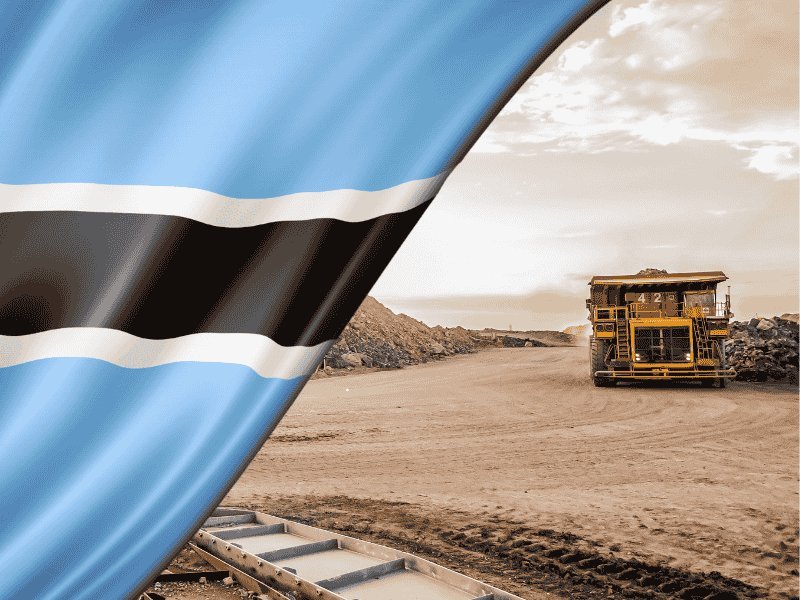
Botswana enters 2026 having established itself as a frontier market for coal bed methane (CBM) and critical minerals. The country has outlined a clear economic strategy for 2026, with the goal of achieving 3.1% annual GDP growth after a 1% contraction in 2025 due to a decline in diamond revenues. This means diversifying into important minerals and restarting industrial growth through CBM. After years of dependence on coal and electricity imports, 2026 will be a year centered around the execution of vital energy projects and new investments in critical minerals.
How CBM can redefine Botswana’s electricity landscape
CBM emerges as a cornerstone of Botswana’s power transformation in 2026. Australian junior Tlou Energy is at the heart of the country’s CBM development with its Lesedi power project. The project is designed to generate an initial 10 MW under a power purchase agreement with the national power company Botswana Electricity Authority, which will be expanded to 25 MW as resources are developed and grid capacity allows.
Another Australian junior, Botala Energy, is advancing the Thamaga CBM project with flow testing and a modular LNG scheme. The company has an offtake agreement with SCAW South Africa for 3.5 PJ of LNG per year, expandable to 4.7 PJ. Botala is targeting a final investment decision in the second half of 2026, with first production targeted for before 2027. The government also increased its proposed investment in Botala’s Thamaga project to BWP 35 million through the Botswana Mineral Development Company, strengthening its support for CBM value creation.
Botswana’s electricity grid is connected to the Southern African Power Pool (SAPP) and has export potential. As CBM-based generation grows beyond domestic demand, producers like Tlou and Botala may be able to monetize excess capacity through regional generation arrangements.
How transmission projects are reshaping electricity exports
Botswana, strategically located in the heart of southern Africa, has outlined plans to reduce electricity costs by 30% and transform the country into a net electricity exporter. Achieving this goal will depend on expanding transmission and generation capacity in 2026. Some initiatives are already underway.
Scheduled to become operational in 2026, utility company Jindal Energy’s Mamabula Energy Project is designed to supply up to 700MW, with plans to expand to 1,200MW, to meet both domestic demand and surplus power for cross-border export through SAPP. Botswana is also leveraging renewable energy to increase surplus electricity for regional export. Renewable energy company Scatec’s 120 MW Madinare solar power plant is scheduled to have its first 60 MW commissioned and the remaining 60 MW completed in 2026.
Botswana recognizes that power generation alone is not enough and is moving ahead with transmission upgrades, including the 400 kV Botswana-South Africa interconnector, the Pandamatenga-Victoria Falls 330/400 kV transmission line, and Phase 2 of the North West Grid Connection Project. These projects provide strategic export routes to regional markets and strengthen Botswana’s position as a major power hub.
Critical Minerals: Catalyst for Revenue Growth
As the rise of lab-grown diamonds poses unprecedented challenges for the country, Botswana is turning to alternative mineral opportunities to diversify its economy and tap new capital flows, particularly copper, nickel and cobalt. Several projects are underway towards 2026.
Mining group BHP has put up to $25 million into exploration funding for its Kitranya East and West copper project, aiming to take a 75% stake and test for a “Tier 1” copper-silver deposit. Botswana also has nickel and cobalt deposits in Selebi and Selkirk. The Export-Import Bank of the United States has expressed interest and issued interest notices of up to $150 million to support the redevelopment of these mines.
However, most investors remain cautious, largely due to a lack of data on potential resources. To fill these gaps, a newly launched national exploration company will explore 70% of Botswana, lowering barriers to entry and attracting private capital.
If implemented at scale, Botswana’s 2026 transformation could mark a structural shift away from diamond dependence, positioning CBM-led electricity exports and significant mineral development as the twin engines of a more resilient and regionally integrated economy.
