


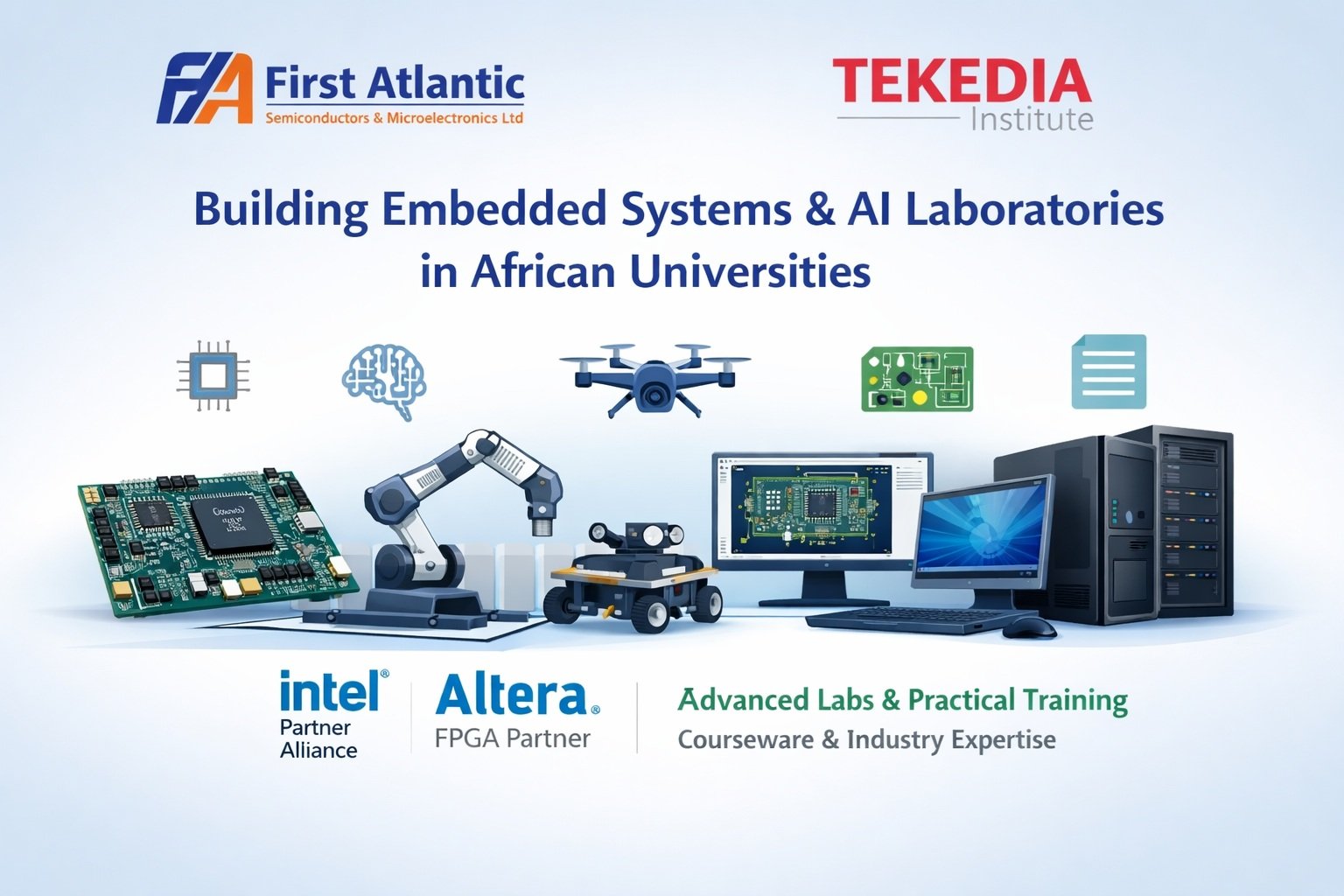
Around the world, the next wave of innovation won’t just come from software. It comes from intelligent machines, embedded systems, robotics, and AI integrated into physical devices. From self-driving cars and smart factories to intelligent healthcare devices and industrial IoT systems, the future of computing is increasingly embedded and physical.
For Africa to participate meaningfully in this new era, universities need to move beyond just teaching theoretical computing. Students must be able to design, prototype, and test real-world hardware systems powered by artificial intelligence. This requires a state-of-the-art laboratory that combines embedded systems engineering, semiconductor experimentation, robotics, and AI development. First Atlantic Semiconductors & Microelectronics Ltd (FASMICRO) is helping universities establish these laboratories.
As an Intel Technology Partner and an Altera FPGA Partner, FASMICRO works with universities and research institutions across the continent to design and implement cutting-edge embedded systems and artificial intelligence laboratories. These facilities allow students and researchers to build the technologies that power modern industry.
The Embedded Systems and AI Laboratory is a specialized facility where students can design and build computer systems that perform specialized functions within larger mechanical or electrical systems. In practice, this means that students can develop systems such as smart sensors, robotic platforms, AI-powered devices, IoT systems, autonomous machines, and edge computing solutions.
Labs implemented by FASMICRO typically integrate multiple functional modules.
The Embedded Systems Development module focuses on microcontroller programming, FPGA development, IoT devices, and sensor systems. Here, students learn how software interacts directly with hardware to create intelligent electronic systems. The Artificial Intelligence Development module allows students to design and deploy AI models, develop AI agents, and experiment with machine learning systems that can operate in real-world environments. The Physics AI and Robotics module allows students to build robotic systems, autonomous devices, drones, and edge AI machines that combine intelligence and mechanical systems. The PCB Design and Electronic Manufacturing module provides students with the tools to design and prototype electronic circuits using modern CAD systems. This includes PCB design, circuit manufacturing, soldering, and hardware debugging, giving students an understanding of the entire electronic product development lifecycle. Finally, the cloud AI infrastructure layer provides the computing resources needed to train machine learning models, manage AI workloads, and deploy AI systems.
But infrastructure alone is not enough. A key element of FASMICRO services is capacity building and academic improvement. In partnership with Tekedia Institute, the company is developing a complete courseware package to accompany each lab deployment. These include:
Structured training curriculum
• Laboratory manual
• Hardware design kit
• FPGA development resources
• AI experiment framework
• Operations manual for faculty and laboratory administrators.
The goal is not just to install equipment, but to create a sustainable ecosystem for education, research and innovation.
Through this partnership between Tekedia Institute and First Atlantic Semiconductors & Microelectronics Ltd, universities will have a complete solution including laboratory infrastructure, training programs, academic content and industry-tailored learning materials. This approach allows students to graduate with not only theoretical knowledge but also practical engineering abilities.
If you are a university or research institution representative, please contact info@fasmicro.com. We would be happy to schedule a Zoom session to discuss how FASMICRO and Tekedia Institute can work with your institution to empower and educate Africa’s next generation of technology leaders.
Short message – share with school administrators
The next wave of global innovation is moving from pure software to integrating intelligence into the physical world. From self-driving cars and smart factories to AI-powered medical devices, the future of computing is increasingly embedded and physical. For Africa to lead in this era, higher education must evolve beyond theoretical instruction. Students need a hands-on environment to design, prototype, and test hardware systems powered by artificial intelligence.
Intel and Altera’s FPGA partner First Atlantic Semiconductors & Microelectronics Ltd (FASMICRO) is filling this gap by helping universities establish cutting-edge embedded systems and AI laboratories. These specialized facilities integrate several important modules. Embedded systems development for FPGA and microcontroller programming. AI development module for deploying machine learning models. Physical AI and robotics for autonomous machines. PCB design and manufacturing for full-cycle hardware prototyping. Supported by a cloud AI infrastructure layer, these labs enable students to move intelligence from local machines to real-world mechanical systems.
Importantly, FASMICRO understands that infrastructure alone is not enough. In partnership with Tekedia Institute, all laboratory developments include comprehensive academic support. This ecosystem provides structured curriculum, laboratory manuals, hardware design kits, and faculty training to universities. This holistic approach ensures that the facility becomes a sustainable center for research and innovation, rather than just a room filled with equipment.
FASMICRO and Tekedia Institute provide turnkey solutions to African universities by combining cutting-edge hardware and industry-aligned learning materials. This partnership will ensure that the next generation of engineers graduates with the practical competencies needed to build the technologies of the future.
If you are a university or research institute representative ready to empower Africa’s future technology leaders, please contact us at info@fasmicro.com to schedule a consulting Zoom session.
—
Connect via LinkedIn | Facebook | X | TikTok | TikTok Instagram | YouTube
