


The digital technology sector is set to proliferate in many African countries over the coming decades. A June report from entrepreneurial network Endeavor found that the continent’s digital economy is currently worth $115 billion and is expected to reach $712 billion by 2050.
Such a change would be a sign of great change. Currently, less than a quarter of Africa’s population has access to the internet, compared to about half of the world’s population.
But a report from the Brookings Institution predicts that internet usage in sub-Saharan Africa could rise to nearly 80% by 2030, kickstarting a growth that could turn the continent into a “global power.” In most countries in the region, it is easier to access the internet through mobile phones than through fixed broadband, and the number of people using these mobile services has been steadily increasing since 2014, with 20 million new users coming online in 2020 alone.
Addressing the deepening digital divide
However, many citizens still lack the resources and skills needed to get online. UN Under-Secretary-General Amina J. Mohammed has warned that the widening digital divide will become the “new dimension of inequality” of the 21st century.
In addition to lacking the necessary infrastructure for access, the Internet itself also poses risks.
“We have seen digital technologies become vehicles for the spread of misinformation, hate speech, online child abuse and violent extremism,” Mohammed said in April 2021 at a United Nations event on digital cooperation and connectivity. She added that a “common effort” was needed to protect users and consumers and “connect everyone to a positive future.”
Some young African entrepreneurs are seeking to lead the way by improving access to both the technology and skills needed to reap the benefits of the Internet, including job opportunities in an increasingly global marketplace.
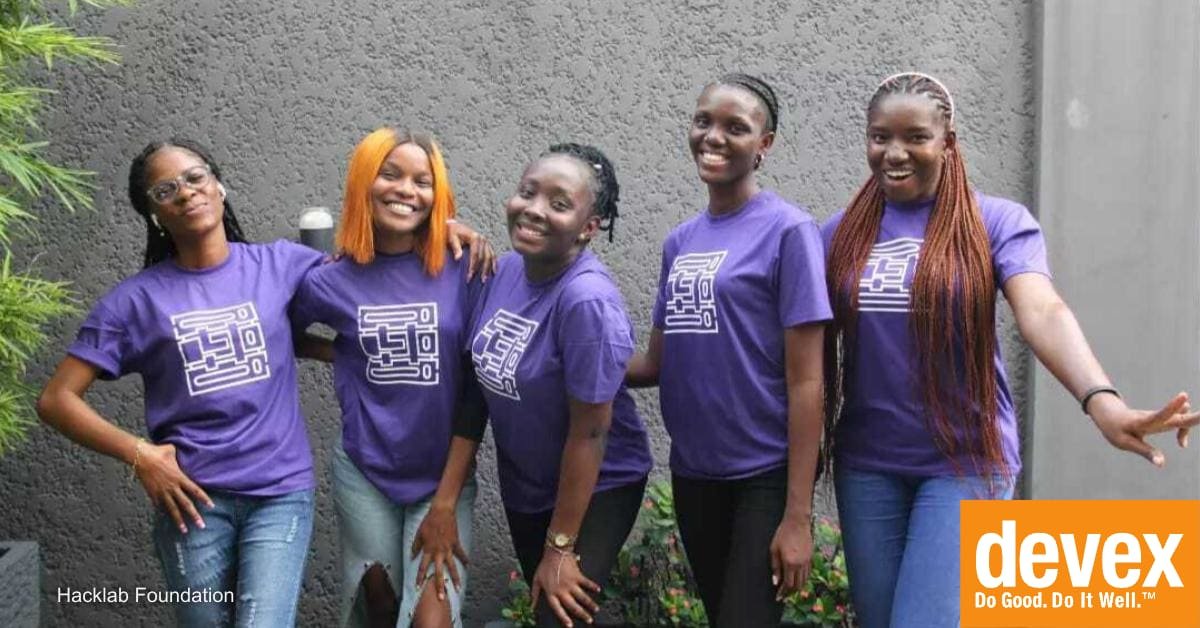
Ghanaian entrepreneur Foster Awintiti Akuuri founded Hacklab Foundation in 2015 while still a computer science student. In addition to its annual “hackathon,” which brings together technology industry and development experts to discuss problems that can be solved through technology in low- and middle-income countries, the nonprofit organization provides workshops and training to help young people enter the technology workforce.
Additional Hacklab initiatives are aimed at women who have already begun their careers in science and technology, providing access to networking and other opportunities to help accelerate career growth and encourage women to remain in fields with strong gender gaps. The organization also offers a program called Hacklab Junior for kids and teens, where they can participate in robotics competitions and take online coding lessons.
Akguli told Devex that he hopes to launch HackLab, which is based in Ghana’s capital Accra, in other countries. This year, HackLab events and workshops will be held in Nigeria, Kenya, Rwanda, Uganda and Zambia.
“Hack Lab Junior teaches kids how to code, build robots, and program robots and microcontroller boards, and from there they can apply these skills to other areas,” he said.
The program encourages participants to use what they’ve learned to build momentum for future opportunities, telling them to “put it into practice, build a solution, pitch it to us, win an award, get an internship opportunity, or get a job opportunity,” according to Akugri.
He argued that this type of education is important to address the skills gap, as most companies will soon be using some form of digital technology to support their operations. The International Finance Corporation estimates that more than 230 million jobs in sub-Saharan Africa will require digital skills by 2030.
“My motivation is driven by the expectation that Africa will become the world’s youngest and most populous country, and that there will be a global shift in demand for talent and labor from Africa to power the next (digital) revolution,” Akuuri said.
reach the unconnected
Hacklab currently focuses on a group of people who are already online or have some exposure to digital technology.
“We recognize the fact that the gap is widening, and we recognize that there is an even wider gap between all the people in training who have been introduced to these things and those who lack the infrastructure and resources to access fundamental knowledge,” Akguli said.
To expand access to its programs, one of the organization’s next projects is an Inclusion Bus, which functions like a mobile library by bringing information and communication technology (ICT) to remote community schools.
“It will be a ‘maker space’, an ICT lab, a library, and disadvantaged communities will be able to utilize the bus as a shared resource,” Mr Akguli said.
The plan is for clusters of six schools in Ghana in close proximity to each other to share buses on a weekly basis. The initial pilot is expected to last a year and is expected to reach around 1,000 children across the cluster, but Mr Akguli said he hoped this number would increase further with the addition of buses.
Reaching out to rural women in Nigeria
When Hafsa Jumare launched her startup CoAmana in 2018, she realized she needed to go the extra mile to ensure inclusivity. She said she left her job as a management consultant in Nigeria’s capital, Abuja, to do something more impactful in society, but found it difficult to reach the rural women she wanted to help.
The startup uses a mobile app, text messaging service, and call center to connect farmers and small business owners with market information and buyers. ComAmana acts as a one-stop shop for business owners to access financial services such as credit and insurance.
However, Jumare noticed early on that very few of CoAmana’s users were women (only 11%). “We realized there was a natural demand pattern[causing this]so we had to specifically tailor our strategy for women to change that. Currently, around 80% of our users are women,” she said.
Reaching more women required investment. “It takes a long time to build trust, and men tend to be more exposed to technology, so[these users]needed more training,” Jumare told Devex.
Rather than expecting women to start using the app on their own, CoAmana has added call center agents to answer questions about the app and its features, as well as field agents to directly educate rural women about the service.
The most important element in such a process, Jumare says, is “not to discount what already exists.” “We don’t say, ‘Hey, this is a new technology.’ We help support the supply chain networks that already exist and the relationships between farmers that have been built over thousands of years,” she said.
Jump on the digital skills train
Closing the digital divide doesn’t just mean access to technology. It is equally important to ensure that individuals, especially those living in remote areas, have the digital skills and literacy to take advantage of existing technology. Some development agencies have recognized this need, and new initiatives have sprung up in recent years.
Examples include the Digital Enquirer Kit launched by German development agency GIZ in January on a free learning app called atoingi, developed through a partnership between GIZ, the German Federal Ministry for Economic Cooperation and Development, and the Smart Africa Alliance, which aims to provide free access to digital learning in African countries. The training covers everything from identifying misinformation and using privacy settings to “tackling gender-based violence online.”
A larger effort is imaGen Ventures. imaGen Ventures organizes large-scale youth competitions in several low- and middle-income countries, encouraging participants to find solutions to social and environmental problems in their communities. We then connect these planned ventures with grants, seed funding, and mentorship opportunities. Since 2018, more than 15 million young people have been reached through these contests.
Another example is the Yoma digital marketplace, which launched in 2020 and connects young people in Nigeria, Burundi, and South Africa with training opportunities, including courses in data analysis, project management, and IT support.
Both initiatives are part of UNICEF’s Generation Unlimited. The platform, which describes itself as “the world’s first public-private youth partnership,” asks youth organizations what they need in terms of education and resources. We then combine those requests with public and private sector funding or expertise.
“This platform aims to find ways to give the 1.8 billion people on the planet today between the ages of 10 and 24 the right skills and training to thrive in the future, with a focus on digital and green jobs,” said Nadi Albino, Head of Partnerships at Generation Unlimited.
“The digital divide will eventually close because telcos are aggressive and want to expand as much as possible,” Albino added. “The question now is whether young people can most effectively use that platform for their own development and contribute productively to the communities in which they belong.”
Check out our Generation Why series to learn more about how digital spaces can ensure the rights of all young people are advanced and no one is left behind. Join the conversation with #DigitalRights and use the hashtag #DevexSeries.
Printing the article and sharing it with others is a violation of our Terms of Use and Copyright Policy. Please use the sharing options on the left side of the article. Devex Pro members can share up to 10 articles each month using the Pro sharing tool ( ).
