


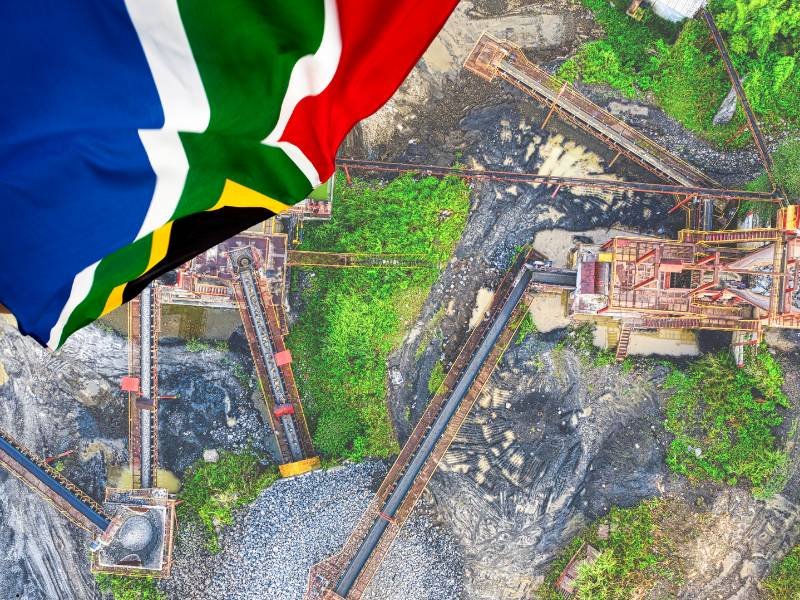
South Africa’s exploration spending fell from R6.2 billion in 2006 to R781 million in 2024.
Royalties in the mining sector fell from R16 billion to R10.6 billion.
With private sector participation, Transnet could transport 250 million tonnes of mining materials by 2030.
South Africa has announced ambitious plans to mobilize R2 trillion in investment over the next five years to expand its vital minerals sector, alongside extensive infrastructure and industrial development efforts. The strategy, announced by President Cyril Ramaphosa in the 2026 State of the Union address, aims to unlock the country’s mineral resources, including an estimated R40 trillion of untapped iron ore resources, while strengthening the role of mining as a driver of economic growth and employment.
Although the country ranks as the world’s largest producer of platinum group metals (PGMs), chromium and manganese, South Africa’s mining sector is currently operating at historic performance levels and below its full potential. According to the Minerals Council of South Africa, structural bottlenecks across logistics, energy and regulatory frameworks are holding back growth, highlighting the urgent need for deeper reforms and stronger public-private partnerships to restore competitiveness.
Collapse in exploration investment threatens long-term resilience
One of the most worrying trends is the sharp decline in mineral exploration investment, from R6.2 billion in 2006 to R781 million in 2024. According to the South African Minerals Council, this decline threatens the long-term sustainability of the country’s mining pipeline, making the market less attractive as an exploration destination.
The Government has set up a Junior Exploration Fund with a target capital of R400 million, with Anglo American mobilizing a further R600 million, but the Minerals Council is calling for broader structural reforms, regulatory certainty, improved access to geological data and a competitive investment framework to attract global exploration capital.
Structural constraints hurt sector performance
South Africa’s mining sector faces significant infrastructure challenges, leading to reduced production, investment and economic contribution. Minerals Council of South Africa CEO Mzila Mtenjene said the country was not globally competitive, particularly with regard to electricity prices, constrained rail and port operations, and serious deficiencies in water infrastructure. In particular, industrial tariffs have increased by more than 900% since 2008, increasing operating costs for project operators.
Logistics constraints also remain a major hurdle, with state-owned company Transnet’s rail traffic showing a sharp decline since 2017. Coal shipments to Richards Bay Coal Terminal decreased from 77 million tons in 2017 to 48.7 million tons in 2022, but there was a slight increase, reaching 57.7 million tons in 2025.
Logistical challenges have led to visible economic decline. The contribution of the mining sector to GDP decreased from R442.7 billion previously to R439.2 billion, and the sector’s share in national GDP fell from 6% to 5.8%. Direct mining employment also fell by 0.8%, from 473,484 to 469,765. Government royalty income plummeted from R16 billion to R10.6 billion, underscoring the broader fiscal impact of the sector’s poor performance.
Public-private partnerships: the key to achieving growth
The Minerals Council of South Africa has identified public-private cooperation as a “salvation” for the country’s mining sector, saying private capital and expertise are important tools to address logistics and infrastructure constraints. Efforts are already underway to further increase private participation, with more than 30 companies expressing interest in modernizing the country’s freight logistics sector.
In the energy sector, the government is working to stabilize supply while protecting industrial users from rising electricity prices. The country, through its Integrated Resource Plan (2025), envisions a gradual transition away from coal and renewable energy taking a larger share of the country’s energy mix. The government aims to reduce the share of coal from the current 93% to around 27% by 2039, while increasing the share of renewable energy to 40%. In addition to 34GW of wind and 25GW of solar, 5.2GW of new nuclear capacity will be added, replacing coal capacity.
The government is also considering rolling out 14,000km of new transmission lines to enhance power distribution, while a 35.6% electricity tariff cut for ferrochrome producers is expected to improve energy affordability and reduce operating costs for the energy-intensive mining sector.
The country’s R2 trillion investment drive represents a commitment to revitalize the mining sector, but investment alone will not be enough without parallel reforms to improve infrastructure reliability, regulatory efficiency and investor confidence. Strengthening public-private collaboration, accelerating logistics and energy reforms, and restoring exploration investment are essential to positioning South Africa as a globally competitive mining jurisdiction.
