


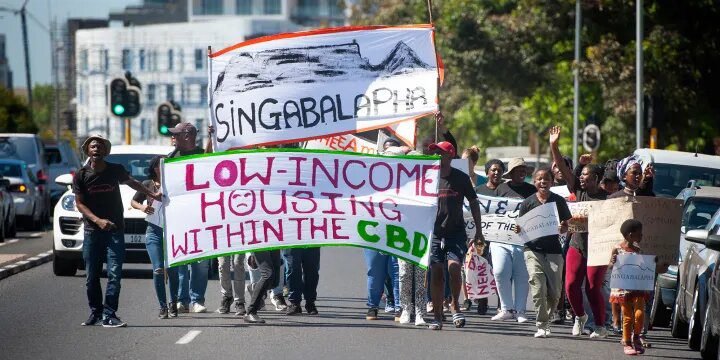
Despite the fall of apartheid in 1994, South Africa continues to struggle with an enduring legacy of racial segregation, particularly in the spatial layout of its cities. The apartheid regime’s policies, such as the Group Areas Act, forced non-white populations into residential areas far from economic centers, creating spatial divisions that continue to define the urban landscape to this day. Nowhere is this more evident than in Cape Town, one of the most spatially isolated cities in the world. The city’s ongoing housing crisis, exacerbated by a lack of political will and inadequate service delivery, is a stark reminder of how the legacy of spatial apartheid continues to shape the lives of millions of people.
There is no political will to end the crisis
When apartheid officially ended, there was hope that South Africa would embark on a journey to redress these spatial inequalities. Indeed, housing was declared a priority by the newly elected African National Congress (ANC) government, and the 1996 constitution made it clear that it was a constitutional obligation to address the “legacy of spatial apartheid.”
However, the reality was not so promising. In Cape Town, for example, no low-income housing project has been completed in the city center since 1994, and more than 600,000 people remain on the housing waiting list, according to the Department of Human Settlements. This failure to provide adequate housing perpetuates the same economic and racial divisions that perpetuated apartheid.
The root of Cape Town’s housing crisis is not just a question of inadequate service delivery, but also a question of political priorities. Cape Town’s ruling party, the Democratic Alliance (DA), prides itself on its superior governance compared to the ANC-led province, but its approach to housing in Cape Town tells a different story. Due to a lack of affordable housing in central Cape Town, many Black and communities of color continue to live far from economic opportunities and face long and expensive commutes. Meanwhile, soaring rental prices in the city center have been exacerbated by the rise of Airbnb as a lucrative rental model, making it increasingly difficult for even the emerging black middle class to find housing near their workplaces.
The Airbnb boom has been a double-edged sword for Cape Town. While it brings in tourism revenue, it drives up real estate prices and reduces the availability of long-term rental housing. There are more than 21,000 properties listed on Airbnb in Cape Town, more than in global tourist destinations like Barcelona (18,086) and Bangkok (20,823). These properties are mainly concentrated in desirable areas and serve the needs of tourists and the wealthy, while poorer residents are further pushed to the margins. This dynamic has transformed Cape Town into an increasingly unaffordable city for working-class people, reinforcing new forms of spatial apartheid. The recent taxi strike in Cape Town is another event that highlights these inequalities. People were stranded and walked long distances, highlighting not only the transportation crisis but also the spatial inequities that disproportionately affect those who need affordable transportation.
The crisis extends beyond housing affordability to how informal settlements and their residents are treated. For example, the forcible eviction of Bulelani Kolani from her home during the COVID-19 lockdown drew widespread attention to the City of Cape Town’s anti-land invasion tactics. Such actions reveal a deeper problem: the continued marginalization of poor communities and the failure to provide adequate alternative housing. Although the court condemned the city’s actions and ruled in favor of Colani, the case is just one example of how the rights of informal settlers are consistently violated in the pursuit of urban “development.”
Meanwhile, the Tafelberg incident highlights a broader debate over land use in Cape Town. Advocacy groups have long objected to prioritizing luxury developments over affordable housing in the city’s prime locations. These groups, like Ndifuna Ukwazi, are demanding that public land be used to address the housing crisis rather than being sold off for private profit. Despite these efforts, the city continues to sell valuable land to private developers, further deepening spatial inequality. The Supreme Court of Appeal’s decision to allow the sale of land in Tafelberg to private interests, which is now before the Constitutional Court, is a clear example of how cities and other branches of government prioritize capital over local communities.
Clearly, there is a clear lack of political will to confront spatial apartheid head-on. Change will require bold policies and significant investments in public infrastructure such as housing, transport, water and energy. More importantly, it requires challenging the interests of developers and wealthy property owners, a move many in power seem reluctant to take. Cape Town’s leadership’s reluctance to push for real change will only further delay the possibility of addressing deep economic and racial disparities.
Future direction
But change is still possible. Taking a cue from cities like Barcelona, which has completely banned Airbnb, could be a first step in addressing this challenge. Tighter regulation of short-term rentals like Airbnb could stabilize the housing market and create more affordable housing options.
Policies that prioritize the development of low-income housing in economically vibrant areas are also important. These changes will also require political leadership willing to invest in public works and infrastructure, creating the conditions for people to live closer to the cities where they work. In other words, support for comprehensive urban development policies that combine economically viable housing options with more affordable housing may make it possible to gradually narrow the spatial gap.
Supporting grassroots organizations like Ndifuna Ukwazi that advocate for inclusive urban development is another way to move forward. These organizations promote the use of public lands for public benefit rather than private gain. The work of organizations like this could lay the foundation for a more just urban future.
After all, Cape Town’s housing crisis is not just about bricks and mortar. It is about reversing the long legacy of apartheid, healing the economic and social wounds that still divide our cities, and creating an urban landscape where all residents, regardless of race or class, can thrive. Cape Town’s future depends on dismantling spatial apartheid, not just by building more housing, but by fundamentally rethinking how urban development should serve everyone, not just a privileged few.
Cape Town’s housing crisis is a human rights issue that requires urgent and meaningful action. Leaders must face the uncomfortable reality that the city’s current trajectory is not sustainable. The legacy of apartheid cannot be ignored or allowed to continue in new and subtle forms. South African cities must become places of opportunity and inclusion for everyone, not just those who can afford it. Only then can we begin to heal the wounds of the past and build a more just and equitable future.
