



The Chadian government will receive a US$170 million grant from the World Bank for the Chad Connectivity and Integration Project (CCIP), which aims to complete the country’s section of the Trans-Saharan Road (TSR), an estimated 9,900km route linking Algeria, Tunisia, Mali, Niger, Chad and Nigeria.
The plan focuses on paving a 55km route between Liwalig and Rig in central-western Chad on the border with Niger, which will also help facilitate traffic flow between the capital N’Djamena and the provinces of Lac, Kanem and Hajar Ramis, which surround Lake Chad.
The 580km Chad section of the TSR consists of the N’Djamena-Masage-Masakori-Ngourri-Bor-Liwa-Rig-Rig-Daboua-Niger border section, most of which is paved or under construction with funding from various donors. Weak networks and the deteriorating state of road infrastructure are obstacles to agricultural productivity and market access.
Source: Project Information Document, December 2024
The scope of CCIP’s work includes the construction of a 12km access road linking the TSR with Bor, the capital of Lac province, and the spot improvement of approximately 50km of rural roads that will be prioritized to support the opening of agricultural and pastoral areas and provide residents with suitable evacuation routes in the event of climate change.
The project also considers improving the navigability of Lake Chad, which is expected to facilitate the shift of traffic from roads to the lake, leading to lower emissions and transportation costs.
In conjunction with the paving of the Liwa-Rig-Rig road, the improved navigability of the lake is expected to provide connectivity to key regional corridors via Niamey in Niger and Ouagadougou in Burkina Faso. Chad will also gain new access to the maritime gateways of Cotonou in Benin, Lagos in Nigeria and Lomé in Togo, in addition to Cameroon’s Douala port, which is Chad’s main port for international trade.
Works under the Lake Chad component include carrying out a feasibility study on the modernization of transportation in the lake and the Chali and Logon rivers, marking waterways for ease of navigation, dredging of shallow waters (high points) and sustainable removal of invasive plants. Based on the results of the feasibility study, the project may finance the construction of landing facilities such as small berths, ramps, small yards, storage facilities and passenger shelters in selected areas.
CCIP will also support the modernization of customs administration and other border services through the renovation and equipment of selected border crossings. To facilitate exports, the scheme will finance the rehabilitation/construction and equipment of energy efficient border crossing facilities. It will also finance the construction of a modern vehicle inspection center in N’Djamena.
In addition, the plan will finance the construction of energy-efficient solar-powered commercial and agricultural logistics facilities, including warehouses and markets in Bor, Bagasora and other regions.
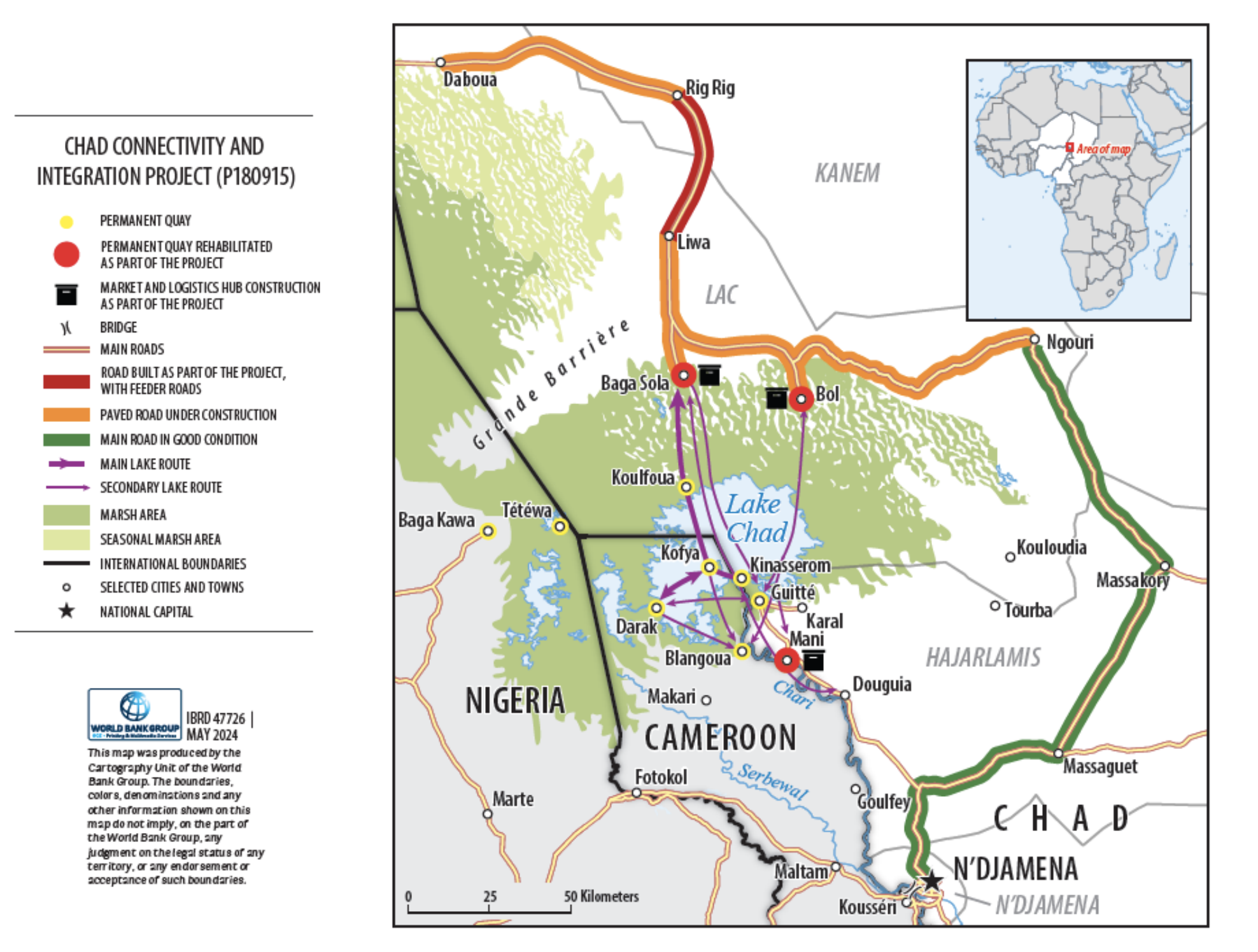
Source: Project Information Document, December 2024
The population of CCIP’s broader area of influence is estimated to be just over 3 million people across five regions, 89% of whom live in rural areas.
The project will be implemented by the Ministry of Infrastructure, Territorial Access and Road Maintenance (MIDER) and the Ministry of Transport, Civil Aviation and National Meteorology (MTACM). The plan was approved by the World Bank on February 18, with an overall completion date of February 27, 2031.
The Chadian government is also considering building a road to connect Libya with neighboring North African countries Egypt. In late February, an Egyptian government delegation met with President Mahamat Deby to discuss trade cooperation. The Head of State emphasized the importance of the proposed 1,730 km Egypt-Libya-Chad road, which would run from the main city of Abecheh in central-eastern Chad, north through Amjaras and through Libya to Egypt.
According to the Chadian government, the route is crucial for strengthening economic and social ties with Egypt and will facilitate the transport of goods and people across the Sahel region. It is hoped that this will give Chad access to Egyptian ports and connectivity to the Maghreb region, turning the country into a commercial center linked to the Red Sea.
The Egypt-Libya-Chad road is divided into three sections, with the first 400 km section in Egypt, starting east of the border town of Al Awaynat and ending at the Kufra crossing. The construction work is being carried out by a local company.
The second section is 390km long, stretching from the Kufra region in southeastern Libya to the border with Chad. In September 2024, a memorandum of understanding (MoU) was signed between Egypt’s Arab Contractors Company and the Libyan Development and Rehabilitation Fund, and spatial and environmental studies and initial route design began.
The results of these studies will be submitted to the Libyan authorities for approval, after which a formal agreement between the three governments will be finalized to begin work on this plan.
According to the Libya Fund, the proposed route is a commercial desert road for transit trade linking Libya, Chad and Egypt and reaching the Red Sea. This is the first phase of the project, and future phases will include the construction of Libya’s first commercial transport route.
The fund said the plan will contribute to increasing the flow of maritime imports to landlocked African countries to the south of the country via Libya’s ports on the Mediterranean coast.
The final section of the Egypt-Libya-Chad road covers 930 km inside Chad, running from the border with Libya to the city of Amjaras and ending in the city of Abecheh. Chadian authorities signed a memorandum of understanding with Arab Contractors Company in mid-December 2024 and began carrying out preliminary designs as well as surveying and environmental studies.

Source: Libya Development and Reconstruction Fund
Top photo: Algerian roads (Source: UNCTAD)
