


The opening of Algeria’s Western Mines Railway is Africa’s first heavy-haul line designed to operate in extreme desert conditions, and is a milestone not only for the country but for the entire continent. The 950-kilometre-long trunk line, built mainly by Chinese companies in cooperation with Algerian state agencies, will be able to transport up to 50 million tonnes of iron ore a year, as well as provide passenger services.
But this one project reflects a broader trend. Over the past two decades, China has become Africa’s largest foreign infrastructure builder, surpassing traditional Western countries in both investment and the scale of completed projects. China-built roads, ports, power plants, airports and government districts form the new “backbone” of Africa’s economy. Algeria’s railways are just one element of this fundamental transformation.
Algeria: Heavy goods railway crossing the Sahara Desert
The Western Mining Railway connects the southwestern region of Algeria with the national railway network. The construction, carried out by China Railway Construction General Corporation in partnership with Algerian state-owned enterprises, is the largest infrastructure project ever undertaken by a Chinese company in the country.
For Algeria, railways serve multiple strategic purposes. This opens access to rich iron ore and other mineral deposits, allowing industrial development. It also reduces long-distance transportation costs and creates new job opportunities. Additionally, the line will help integrate sparsely populated desert regions into the country’s broader economic framework.
For China, the project forms part of a broader strategy to expand its influence in North Africa, a region that provides direct access to the Mediterranean Sea and a key route to Europe.
Ethiopia – Djibouti: East Africa’s electrical artery
Source: www.railway-technology.com
The Addis Ababa-Djibouti Railway is the continent’s first fully electrified border line, with more than 90% of Ethiopia’s external trade passing through the Port of Djibouti.
Before railroads, it could take days or even a week to transport freight. Transport now takes just 10 to 12 hours, dramatically improving logistics, reducing export costs and encouraging the development of industrial parks along the route.
In fact, China has built more than just railways, it has established a fully integrated economic corridor that links industry, energy, and trade into a connected system.
Kenya: Standard gauge as the foundation for growth
The Mombasa-Nairobi Railway has emerged as a symbol of a new era in Kenya’s transport infrastructure. It connected East Africa’s largest port with the African interior, and also laid the foundation for future network expansion deep into the continent.
Logistics hubs, warehouses, industrial zones, and residential areas are beginning to form along railway lines, reflecting China’s characteristic approach of infrastructure first and economic activity later.
Nigeria: reviving Africa’s largest economy
Chinese companies are playing a key role in modernizing Nigeria’s railway network, including the Abuja-Kaduna and Lagos-Ibadan lines. For a country of over 200 million people, these upgrades have important economic and social implications.
The development of rail infrastructure reduces pressure on road networks, increases transport safety and supports the creation of a more integrated national market.
Ports: forming Africa’s maritime gateway
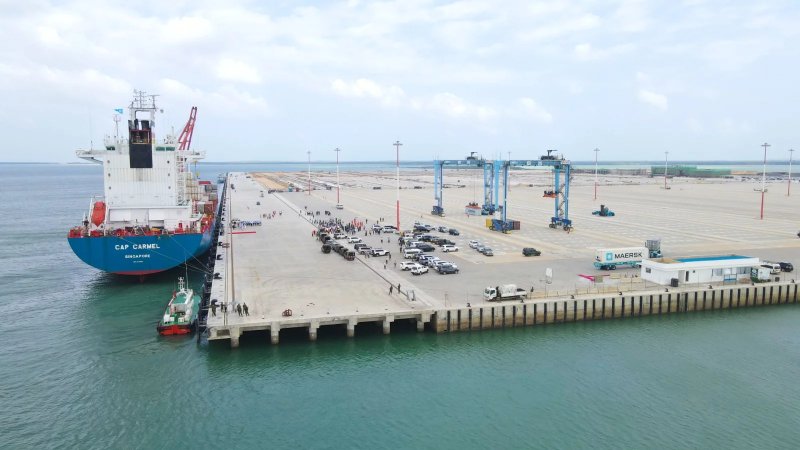
China is aggressively building and modernizing ports along Africa’s coastline, from the Red Sea to the Atlantic Ocean, turning ports into important nodes in global supply chains.
These ports will help African countries increase exports of raw materials and finished goods, attract industrial investment, and develop ship repair, logistics, and warehousing infrastructure. In the case of China, it builds a network of strategically placed hubs along major maritime routes.
Energy: the basis of industrialization
Chinese companies are building hundreds of energy facilities across Africa, including hydroelectric, thermal, solar and wind farms.
These projects brought electricity to millions of homes for the first time and enabled governments to establish industrial zones and processing enterprises. Energy development is often integrated with transportation corridors to create coordinated infrastructure networks that connect power, industry, and trade.
Urban infrastructure: the new capital and national symbol

Source: Xinhua News Agency
Chinese companies are building government districts, parliament buildings, stadiums, exhibition halls and entire new metropolitan areas across Africa. These projects serve as visible symbols of modernization while strengthening Beijing’s political presence.
In many African capitals, Chinese-built developments now define the emerging architectural landscape.
Financial model: financing, contractors, influence
A feature of China’s approach in Africa is the integration of financing and construction. A Chinese bank will provide the loan and a Chinese company will win the contract to execute the project.
This model has sparked discussion about potential debt dependence. Yet, for many African countries, there are few alternative sources of funding on a comparable scale.
Why is China betting on Africa?
China’s engagement in Africa is driven by several strategic objectives.
1. Ensure access to natural resources.
2. Exploit a rapidly growing consumer market.
3. Building political alliances in international organizations.
4. Expand and strengthen the Belt and Road Initiative as a global project.
Taken together, these factors make Africa an important arena for China’s long-term economic and geopolitical influence.
Algerian railways reflecting a new phase
China previously focused on building individual facilities in Africa, but is now developing an integrated infrastructure system. Algeria’s heavy goods railways embody this change.
It is not just a line for transporting ore. It will serve as the backbone for future industrial clusters, new urban developments, energy projects and logistics hubs.
conclusion
News.AZ
