


Greece’s Erica Mediterranean Electric Interconnection (Erica) has attracted interest from consultancies for its study of the Egypt-Greece (GREGY) electricity interconnection project, which aims to connect Egypt’s electricity grid to Europe via Greece.
The €4.2 billion (US$4.7 billion) project is being promoted by Erica, a subsidiary of Greece’s Koperuzos Group, and involves the construction of a 950km long, 500kV bidirectional submarine cable with a capacity of 3GW.
The cable will connect Egypt and mainland Greece (Attica) directly, without any intermediate stops, and will be powered by a 9.5GW renewable energy project built and operated by Egypt’s Koperuzos Group.
Erica is appealing for interest in a desk study of the plan to determine the optimal routing of the submarine cable, comprehensive cost-benefit and technical analysis, all of which are considered essential for the rapid implementation of the project.
The deadline for expressions of interest is May 31st. Documentation can be found here and here.
Source: Koperuzos Group
In late April, the European Bank for Reconstruction and Development (EBRD) agreed to partially fund the desk research and analysis through a grant agreement.
Approximately one-third of the electricity transmitted by the GREGY cable will be consumed in Greece and one-third will be exported to neighboring EU countries, aiming to reduce natural gas consumption by 4.5 billion cubic meters per year. A further third will be used to produce green hydrogen in Greece, with most of it to be exported to neighboring EU countries.
The plan aims to transform Greece into a clean energy hub for the Eastern Mediterranean region and southeastern Europe, as well as strengthen security of supply in Egypt. The project is also in line with the Egyptian government’s policy to establish the country as a regional energy hub in the Eastern Mediterranean.
The GREGY project has been under development since 2008 and was recently added to the EU’s list of projects of common/mutual interest (PCI/PMI). It is also the flagship infrastructure scheme of the EU Global Gateway.
The plan has gained momentum in the wake of Russia’s invasion of Ukraine in February 2022 and the EU’s decision to completely end its dependence on Russian energy. According to the European Commission, Russia’s dependence on energy imports poses serious security and economic risks for the EU, as Russia “continues to use existing energy supplies as a weapon to threaten the EU’s stability and prosperity.”
In early May, the European Commission presented the REPowerEU Roadmap to the European Parliament. The roadmap aims to further the EU’s independence from Russian energy by phasing out gas, nuclear and oil imports to reduce the risk of weaponization of energy supplies and prevent Russia from receiving revenues from the EU.
Other interconnection projects scheduled to connect the European and North African grids include the 600MW Tunisia-Italy ELMED, the 2GW Egypt-Crete-Greece EuroAfrica interconnector, and the 3.6GW Morocco-UK Xlinks project.
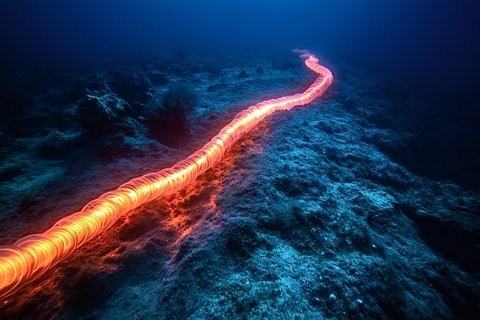
Photo above: Rendering of the underwater cable (© Oleh Bilovus | Dreamstime.com)
