


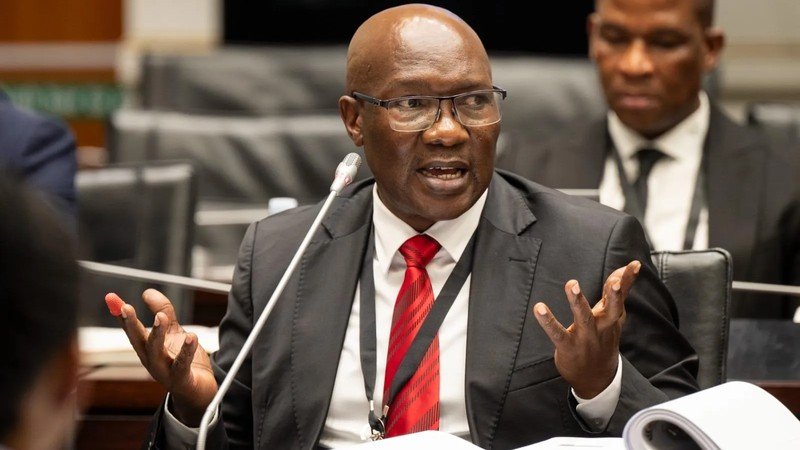
Criminal Intelligence Director-General Dumisani Khumalo on Friday dismissed allegations that he was involved in a state capture plot when he was arrested along with six colleagues over the appointment of officials in his department last year.
Testifying before the special committee Mr Khumalo said he was only implementing the recommendations from the Zondo commission for his department.
“But in terms of me being involved in the capture of this state, that’s a big no,” he said.
Mr Khumalo was responding to ANC MP Khusela Sangoni-Diko, who said that the head of the Anti-Corruption Investigation Directorate (IDAC), Andrea Johnson, had testified that the case brought against Brigadier General Dineo Mokwele was not a pure labor issue as his appointment to senior positions was allegedly part of a state capture.
Prime Minister Johnson told the select committee investigating the allegations against KwaZulu-Natal Police Commissioner Nhlanhla Mkhwanazi that he considered the cumulative effect of the charges by National Colored Congress leader and MP Fadiel Adams to amount to state capture.
“They grouped them together to achieve a specific objective in order to satisfy Brigadier General Mokwele by giving her a post for which she was neither qualified nor had the necessary experience, because she needed to occupy a strategic position and the defendants were indebted to her for their future needs,” she said.
Mr Johnson was responding to Mr Mkhwanazi, who accused IDAC of turning the appointment into a major corruption issue when it arrested Mr Khumalo and six other suspects.
Mr Khumalo said the charges related to his arrest were that he was part of a selection committee that received already profiled applications from the human resources department and proceeded with the selection process.
“Ultimately, a recommendation was made to the committee, and the committee reviewed our steps, right or wrong, until it made its recommendation.”
He insisted that the charges had nothing to do with state capture.
“The only witnesses there are the two candidates who were not selected, in the form of complaint statements or proceedings at SAPS. There is nothing else to speak of fraud or corruption,” Mr Khumalo said.
He also said he agreed with Mkhwanazi that his arrest was a project to disrupt the work of the Political Killings Team (PKTT) and the reforms he was implementing in his department.
Previously responding to EFF leader Julius Malema, Khumalo told the Select Committee that when he was arrested, he reflected on the investments he had made in his integrity over the past 34 years.
“The campaign targeted both PKTT and me because I am the head of the department and PKTT,” he said.
Mr Khumalo was arrested by junior IDAC officers at the airport in the absence of senior investigators.
Looking back on the time of his arrest, he said, “Junior police officers were called to come. I was the only one who wasn’t called, and I was arrested at the airport.”
In his testimony, Mr Khumalo said his decision to carry out a counter-intelligence operation in Gauteng last year was the cause of his and PKTT’s problems, after the senior provincial prosecutor in the murder case of Ferenging engineer Armand Swartz wrote to provincial police and the national commissioner highlighting the threats facing law enforcement agencies and investigators.
He had brought in a highly specialized team from PKTT to assist the Gauteng Provincial Organized Crime Unit with its investigations, as well as a combat unit of task teams and a special task force for suppression operations, recognizing that provincial personnel were working for organized crime outside of official hours.
“PKTT has suffered in the past for providing that support, giving the false impression that PKTT was deviating from its mandate to investigate the cartel, when in reality the local team could not be trusted and was only sent to neutralize internal threats and provide security,” Khumalo said.
(email protected)
