


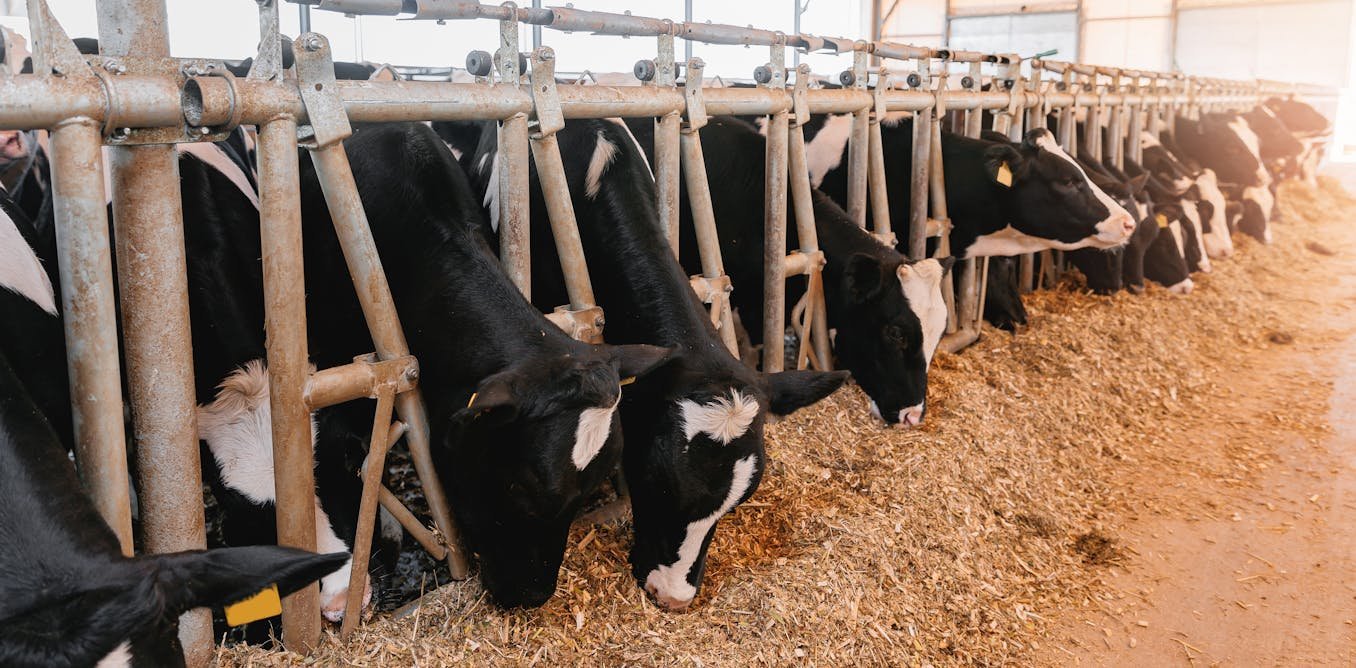
In sub-Saharan Africa, pastoralism is the main form of livestock production, with cows, goats, and sheep roaming freely on grasslands and grazing at will. It has been a source of livelihood for centuries, if not thousands of years.
But now, industrialized mass livestock farming, or factory farming, is receiving increasing funding from development banks.
This is a problem because factory farming is an emissions-intensive livestock production method. Once the money is poured into this, the transition to climate-friendly agriculture will be costly.
Read more: Food trade regimes harm people and planet: how the G20 can drive improvements
Financing industrial animal agriculture has locked African countries into massive greenhouse gas emissions (known as carbon lock-in) for decades. This is because regulations, technology and markets in each country are beginning to evolve around industrial animal production.
Farmers take on debt to purchase the expensive machinery and materials needed for industrial livestock farming, such as antibiotics. Companies are increasing control over farms and consumer preferences are shifting to more meat and dairy products. These are difficult patterns to reverse.
I’m an interdisciplinary researcher who studies how food systems are financed, how industrial livestock impacts the environment, and what this means for countries’ climate futures. In a recent study, I examined 55 livestock projects in low-income countries in sub-Saharan Africa that were funded between 2018 and 2024 by three development banks: the World Bank, the African Development Bank, and the International Finance Corporation.
Read more: Farming that combines crops, animals and trees is better for the environment and people – evidence from Ghana and Malawi
My research shows that 22 of these projects are related to the industrialization of livestock farming. Multilateral development banks have invested a total of more than US$1 billion in livestock industrialization in sub-Saharan Africa from 2018 to 2024.
This is roughly equivalent to the funding for strengthening traditional pastoral institutions (US$1.8 billion) during the same period. In other words, multilateral development banks are now financing and promoting industrial livestock in low-income countries.
My research shows that development banks in sub-Saharan Africa should step back from funding industrial livestock expansion. This will help sub-Saharan Africa avoid long-term greenhouse gas lock-in, which exacerbates climate change.
Instead, these funds should be directed to supporting pastoral or small-scale agriculture. These systems have much lower greenhouse gas emissions and are better for the environment. It is also important for local people’s food security and food sovereignty (having enough food without relying on imports).
Rebuilding Africa’s food system
A multibillion-dollar industrial livestock effort by the World Bank, African Development Bank, and International Finance Corporation is reshaping the region’s food system.
Industrial livestock farming requires the intensive rearing of large numbers of livestock. It is based on intensive animal husbandry operations carried out in large, high-density facilities. It also has a modern slaughterhouse capable of slaughtering thousands of animals every day and robotic milking equipment for cows.
This reflects factory farming systems in rich countries, rather than focusing on producing food that meets the needs of local people.
Read more: The environmental, social and public health damage of Europe’s reliance on factory farming
Industrial livestock production is also one of the causes of climate change, accounting for 12% to 19.6% of global greenhouse gas emissions. These include the methane emissions produced when livestock cut through the air as they digest their food. Carbon dioxide is also released when forests are cleared to plant forage crops. When microorganisms break down nitrogen in animal waste, nitrous oxide is released into the atmosphere.
Read more: Looking forward to a future without factory farming
Industrial livestock farming can provide small farmers with the processing facilities they have long sought. However, this is primarily done to enable farmers to produce food that can be sold on export markets, rather than food that meets local nutritional needs.
Another way in which development finance reshapes food systems is that it often plays a catalytic role. If development banks continue to promote industrial livestock systems, private investors will soon follow suit. This could cause a chain reaction and eventually replace traditional systems completely.
what needs to happen next
The good news is that greenhouse gas lock-in has not yet taken hold in sub-Saharan Africa. This is because industrialized livestock farming has just begun. Livestock production remains primarily based on pastoral and smallholder farming.
Civil society groups have launched campaigns to defund factory farming, among other things. They are calling on multilateral development banks to stop funding high-emission systems.
Read more: Africa’s smallholder farmers are using great ideas to adapt to climate change: G20 countries need to fund the effort
The G20 Sustainable Finance Working Group also made clear at its 2025 meeting that new projects need to be designed to reduce greenhouse gas emissions. The G20 said the funds should be used in innovative ways to combat global warming.
This increased international pressure means that multilateral development banks need to reassess their investments in industrial livestock production.
Read more: What does it take to make Africa food secure? G20 group points to trade, resilient supply chains and sustainable agriculture
There is still time for multilateral development banks to change course. They can direct funds to climate-smart alternatives such as agroecological systems (nature-based farming systems where animals graze freely).
Plant-based foods such as beans, grains, nuts, and seeds are examples of low-emission, nutritious foods that can be used in agriculture. New lab-grown and fermented meats should also be supported to meet growing protein demands.
Read more: 33 million women grow food on land in sub-Saharan Africa. Green farming can increase their income — study
It is important to secure funding to strengthen the pastoral system. My research shows that the World Bank alone invested US$807 million in pastoral development projects during the research period. These include building drought-resistant water systems for livestock and restoring pasture and rangelands. They also created livestock market facilities and provided veterinary services.
Pastoral agriculture has supported dryland communities in Africa for generations without harming the environment. It is important to maintain this. Other development banks can also learn from the World Bank’s approach.
