


Provided by Gates Foundation
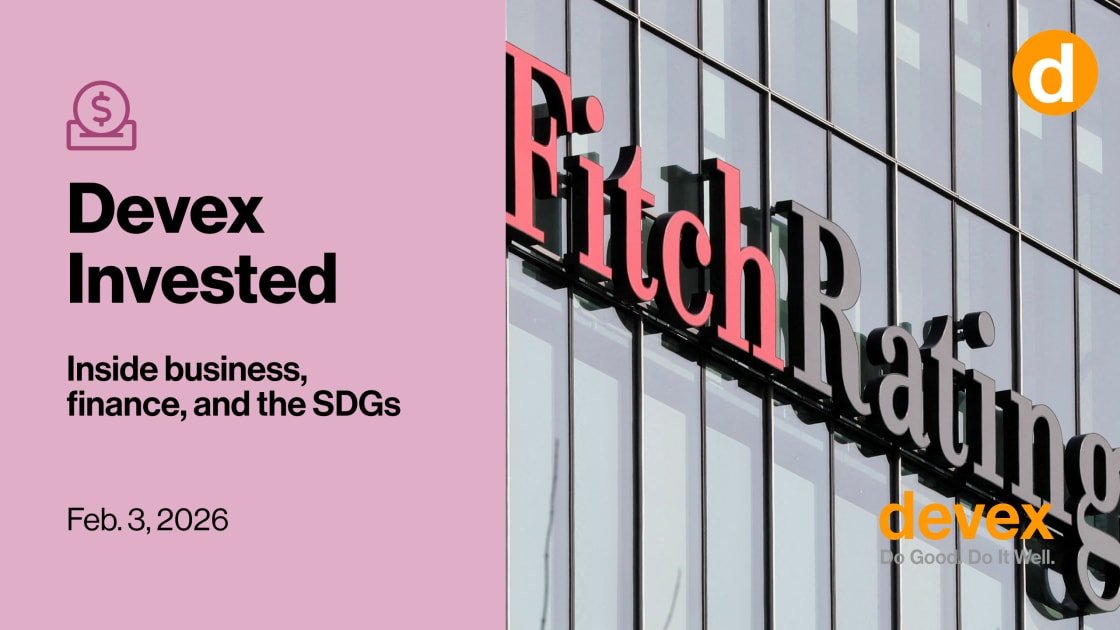
At first glance, the fallout between African Export-Import Bank and Fitch Ratings may seem like a niche battle between a lender and a rating agency. it’s not.
This hiatus, which was quickly followed by a downgrade of Afreximbank to junk status by Fitch, ignited a much larger debate that had long been smoldering within development finance. Who decides what qualifies as a multilateral development bank and what protections that label actually comes with?
At the heart of the dispute is the concept of priority creditor status. This means that even if countries restructure their debt, MDBs will be paid off first. Afreximbank maintains it falls into that category, but Fitch is not convinced, writes my colleague Ayeenat Murthy.
The dispute came into sharper focus after Ghana defaulted on its sovereign debt in 2022, raising questions about how about $750 million in debt to Afreximbank would be treated. Ghana and the bank later reached an agreement on the debt, but the terms were not made public. Whether Afreximbank chose flexibility or a concessionary position was a question with real implications for investors, African institutions, and the global debt structure. Reports suggested that Afreximbank may have accepted some concessions, which for some critics reinforced doubts that the bank was indeed enjoying creditor preferential treatment.
“It’s up to Afreximbank to figure out how to work with Ghana to ensure that Ghana repays,” said Hannah Ryder, CEO of Development Reimagined. He has expressed widespread dissatisfaction among African financial institutions with the way international rating agencies assess risk.
Some argue that Afreximbank’s situation is somewhat murky. “It’s not clear-cut. You can make arguments from either side,” said Chris Humphrey, senior research fellow at ODI Global.
But this rift represents a larger, long-term problem. “MDBs are unregulated…there are no external standards to refer to. Ultimately, the real ambiguity lies in this informal preferential creditor treatment system,” Humphrey said.
Meanwhile, S&P last week assigned an A/A-1 rating with a positive outlook to African Finance Corporation, an MDB aimed at bridging Africa’s infrastructure gap with private investment. S&P cited its strong liquidity and asset quality, but pointed to concentrated ownership of Nigerian stocks as a key risk. The future outlook depends on AFC’s success in diversifying its sovereign shareholder base and increasing its capital.
Read: Afreximbank cuts ties with Fitch, exposing fault lines in global finance (Pro)
ICYMI: Afreximbank ratings clash puts small development banks in the spotlight (Pro)
+ Experience Devex Pro with a 15-day free trial, explore expert analysis, unlock hidden funding opportunities, connect with key people at exclusive events, and access a wealth of knowledge you won’t find anywhere else. Check out some of the content exclusive to Pro readers.
DFC’s Africa Plan
The U.S. International Development Finance Corporation is expanding its footprint on the African continent, announcing last week a new regional managing director based in Kenya. Seram Demissy was named for the role.
Also last week, DFC CEO Ben Black spoke about DFC’s plans for the continent at an African Business Council event attended by my colleague Adva Saldinger. He cited the expansion of the cap on contingent liabilities for government agencies from $60 billion to $205 billion, suggesting that he expects investments on the continent to continue to match current rates. Approximately $10.8 billion of DFC’s current portfolio is on the continent. He said energy, critical minerals and information and communication technology were key sectors.
“(U.S.) President (Donald) has given us an important mission as the international investment arm of the U.S. government. Investments in the DFC must deliver outcomes for Americans and serve as a powerful tool to ensure economic opportunity and regional stability at our core,” Black said. “This approach is simply a return to the first principles of America’s economic national strategy and brings us to Africa at a pivotal moment.”
Black said the continent has significant reserves of critical minerals and argued that the United States is presenting a better model for how to finance Africa’s growth “based on transparency and private sector leadership.”
DFC will look to invest in large projects (perhaps $500 million), but some smaller projects may also receive investment, he said. “We want to structure investments that can transform and improve the economic trajectory of the entire region, while advancing America’s strategic interests abroad.”
Black also revealed that he has a personal connection to the continent, saying, “My wife and I spent our honeymoon there.”
Meanwhile, this week we published our Power 50 list of key individuals who are transforming development as we know it, and taking the top spot was Ben Black. Check out the complete list to see who else made them.
ICYMI: U.S. Development Finance Corporation reauthorization gains momentum
Explore: Devex Power 50
sovereign wealth
Efforts to restrict exports of raw minerals are becoming a defining feature of Africa’s investment landscape, signaling changing rules of engagement for mining companies, financiers and governments.
Last year alone, Zimbabwe restricted exports of raw lithium and said it would consider restricting exports of chromium. Botswana required mining companies to sell 24% of new mineral rights to local investors. Ghana banned mining in all forest reserves by reversing regulations in 2022. Malawi has temporarily banned the export of all raw minerals. And the Democratic Republic of the Congo has banned cobalt exports.
The intent is clear. Moving beyond raw extraction to processing, employment and industrial capacity. For governments with limited fiscal space, export controls are emerging as one of the few tools to influence how and where capital is deployed.
“For countries with limited fiscal space and weak bargaining power, these bans are a way to force dialogue with mining companies,” said Thomas Scarfield of the Natural Resources Governance Institute. The conversation is increasingly focused on downstream investments such as refineries, power supply and long-term commitments, rather than short-term extraction.
In market-powerful countries like the Democratic Republic of the Congo, which produces more than 75% of the world’s cobalt, export controls are already changing price trends and increasing government oversight.
For investors who want to think beyond extraction, the message is that access to minerals is becoming more closely tied to initiatives around processing, power and partnerships, which could redefine where development and commercial capital meet.
If you find the conversation about minerals new and overwhelming, stay tuned for Devex Pro commentary articles coming in the coming weeks. We live in a world of minerals. You’ll need to understand what that means.
Read: Inside Africa’s high-stakes quest for mineral sovereignty (Pro)
cool investment
As climate stress and food insecurity intensify, cold chain infrastructure is moving from a niche agritech to a core investment theme, with implications for food security, greenhouse gas emissions, and smallholder farmer incomes. A cold chain is a network of refrigerated warehouse hubs, refrigerated transportation, and monitoring systems that help keep food cool as it moves through the supply chain from farm to consumer.
In some parts of sub-Saharan Africa, up to 40% of food spoils before reaching consumers. This is mainly due to the lack of cold storage and refrigerated transportation. This loss is more than just a financial blow. It’s also a climate issue. The Food and Agriculture Organization of the United Nations estimates that if a country had food loss and waste, it would rank as the third largest emitter of greenhouse gases in the world.
What is changing is the investment model. Countries such as Kenya, Nigeria and Rwanda are beginning to cut losses while avoiding dependence on diesel with solar-powered cold rooms, pay-as-you-go refrigerated transport, and data-enabled monitoring systems. “Could you imagine having 40% more food for a growing planet without doing anything to increase production?” Rusmir Music, head of global cooling at the International Finance Corporation, tells Devex contributor Catherine Davison.
Its appeal to investors lies in its scale and ripple effects. According to IFC and the United Nations Environment Programme, demand for sustainable cooling in developing countries is expected to reach $600 billion annually by 2050. Blended finance from institutions such as IFC and the African Development Bank is helping to reduce the risk of early adoption, but governments are increasingly viewing cold chain as strategic infrastructure, not just private sector logistics.
“Cold chain is critical infrastructure,” says Toby Peters from the University of Birmingham. “It’s as important as water pipes and electrical wires.” The question for development and private capital is how quickly and how systematically that change in thinking will lead to an investable pipeline.
Read: How the global cold chain revolution can strengthen food security
+ For more content like this, sign up for Devex Dish, a weekly newsletter about transforming the global food system.
What’s your next job?
Director of Project Economics
Asian Infrastructure Investment Bank
Beijing, China
Look for another job→
what we are reading
The World Bank opens a new Caribbean office in Jamaica. (National News)
Multilateral development banks are trying to fill the financing gap in Africa. (semaphore)
Study finds that China is shifting from being a funder to Africa and becoming a debt collector. (Bloomberg)
Adva Saldinger contributed to this edition of Devex Invested.
Printing the article and sharing it with others is a violation of our Terms of Use and Copyright Policy. Please use the sharing options on the left side of the article. Devex Pro members can share up to 10 articles each month using the Pro sharing tool ( ).
