


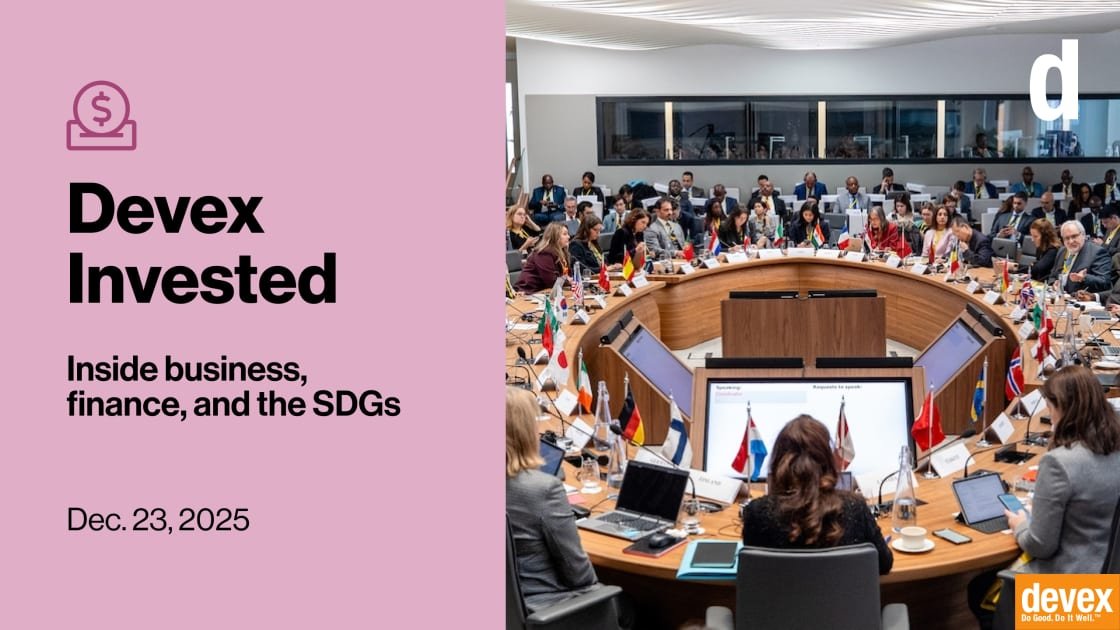
Provided by Asian Infrastructure Investment Bank
It has been a busy year filled with many upheavals in global development, but I would like to end with some positive news. Despite cuts in aid from major donors this year, the African Development Bank last week raised a record $11 billion to replenish the African Development Fund, the continent’s concessional lending arm to 37 low-income countries.
This 17th replenishment is the largest amount raised in the fund’s history, surpassing the previous $8.9 billion.
While the headline numbers themselves are flashy, the way they work tells a deeper story about the seismic shifts in development finance.
• Financial innovation: A major shift in governance will allow ADFs to borrow in the capital markets. The fund could raise an additional $5 billion every three years by issuing bonds, a model similar to the World Bank’s International Development Association.
• Shifting east: As traditional donors such as the United States cut contributions, new partners are filling the gap. The Arab and African Economic Development Bank (BADEA) has pledged $800 million, and the OPEC International Development Fund has pledged $2 billion.
• African ownership: African countries pledged $182.7 million, a five-fold increase from the previous cycle, with 19 countries contributing for the first time.
“Our partners have chosen ambition over cuts and investment over inertia,” said AfDB President Sidi Ould Tarr.
Although the $11 billion is short of the bank’s original goal of $25 billion, it is a victory against a backdrop of foreign aid cuts and a sign that the world’s multilateral development banks are still working together.
Meanwhile, the European Bank for Reconstruction and Development (EBRD) confirmed last week that its major shareholders, including the United States, had committed to a capital increase of 4 billion euros ($4.7 billion), raising the bank’s total capital base to 34 billion euros. The US commitment will allow the bank to proceed with plans to double its annual investment in the rebuilding Ukraine to 3 billion euros. Beyond Ukraine, the EBRD is leveraging this enhanced financial strength to expand its geographic reach, recently approving its first investment in sub-Saharan Africa (a €30 million loan to modernize Benin’s national electricity grid), alongside a $100 million new trade facility in Iraq.
Read: African Development Bank’s concessional lending arm raises record $11 billion
Note to readers: This will be the final edition of Devex Invested this year, as the Devex team takes some time off to recharge so we can head into the new year ready to bring you all the coverage you rely on. It will be back in your inbox on January 6th.
a packed calendar
The U.S. International Development Finance Corporation had a busy December after a slow year that saw a sharp decline in new business and prolonged Congressional deliberations over its mandate.
The DFC Modernization and Reauthorization Act of 2025, officially signed into law as part of the must-pass National Defense Authorization Act, will more than triple the DFC’s investment capacity, unlock more equity potential, and allow it to operate in more locations through 2031 with some limitations. The agency’s CEO, Ben Black, also officially took office at the White House, and DFC announced several investments.
“DFC is America’s international trade team, and it is an honor to lead this agency on behalf of America’s greatest economic president. Our investments will advance America’s foreign policy, advance our allies, and secure historic benefits for American taxpayers,” Black said at the ceremony.
DFC also signed letters of interest with the Democratic Republic of the Congo and Rwanda to deepen partnerships to “promote economic growth, strengthen supply chain resilience, and enhance mutual security and prosperity.” One of those letters was a proposal for equity investment in an important mineral extraction project, and the other was to support the reconstruction operations and transfer of a railway connecting to Angola’s Lobito Atlantic Railway.
Speaking of Lobito, DFC last week held a signing ceremony for a $553 million loan to Lobito Atlantic Railway, which will fund the rehabilitation and operation of Lobito’s port and railway in Angola.
DFC is also home to the U.S.-Ukraine Recovery Investment Fund, which announced at last week’s board meeting that the fund will be fully operational and begin the due diligence process for its first investment next year.
ICYMI: U.S. Development Finance Corporation reauthorization gains momentum
Related: AGOA, the Lobito Corridor, and the Future of U.S.-Africa Engagement (Pro)
+ Start your 15-day Devex Pro trial today and get instant access to in-depth analysis, insider information, important fundraising data, access to exclusive events, and more. Discover the benefits of having Devex Pro.
Lessons from Saudi Arabia
As global aid budgets tighten, this year the role of national development banks and development finance institutions, which can mobilize domestic resources, is receiving increased attention.
Mr. Adva recently spoke with Stephen Groff, president of the Saudi National Development Fund and a veteran of the Asian Development Bank and the Organization for Economic Co-operation and Development, to learn about his efforts to help consolidate and expand Saudi Arabia’s development funds and how other countries can learn from his experience.
He offered three recommendations for countries considering investing in their own development banks and funds:
• Ensure that institutions are not just established, but have a long-term strategic vision that is aligned with clear national objectives. Otherwise, institutions may end up spending too much time “searching for purpose.”
• Bring in outside expertise. Mr. Groff is one example of this at NDF. External experts can help introduce global best practices, build local capacity, and then exit.
• Public development institutions sometimes have a “checkered history” and need to invest in governance and modern financial systems to avoid their outdated reputations and persuade international partners to co-invest.
quick reflexes
What’s your next job?
Climate Infrastructure Specialist – Africa
green climate fund
South Korea
Please find more work.
Under President Ajay Banga, the World Bank launched a new corporate scorecard and later launched a results unit. This is an effort to ensure that approximately $90 billion in annual spending has a meaningful impact. But in an opinion piece for Devex, Avnish Gungadrudoss and Thomas O’Brien warn that these efforts risk becoming “isomorphic imitation” unless incentives fundamentally change.
Instilio co-founder Gungadouldoss and former World Bank director O’Brien argue that although the bank has improved its strategic clarity and data systems, its culture remains dangerously tied to “volume pressure” and success is measured by execution rather than quality. They write that unless institutions connect metrics to how they evaluate, promote, and reward staff, new scorecards will remain passive reporting tools rather than truly impactful.
According to the authors, the path to durability lies in pulling two specific levers: reforming internal human resources structures and revolutionizing the use of trust funds. They propose conditioning the bank’s roughly $18 billion in trust fund assets on externally verified results, effectively forcing teams to compete for grant financing based on results rather than deal size.
Beyond the misconception that accountability must wait until data systems are perfect, the authors argue that banks can immediately emulate models such as global partnerships for results-based approaches. They conclude that changing these economic and professional incentives is the only way to transform “results reflexivity” from a slogan to an enduring norm.
Opinion: Incentives are key for ‘responsiveness’ to become the norm at the World Bank
what we are reading
DFC, Critical Minerals and Peace in the DRC. (Global Development Center)
The driving forces behind the “America First” foreign aid policy. (Devex Pro)
Weathering the storm: Millennium Challenge Corporation’s turnaround is underway. (Devex Pro)
Printing the article and sharing it with others is a violation of our Terms of Use and Copyright Policy. Please use the sharing options on the left side of the article. Devex Pro members can share up to 10 articles each month using the Pro sharing tool ( ).
