


Technology has always shaped the evolution of society – how we work, communicate and build. But construction, one of humanity’s oldest and most important industries, is one of the slowest to embrace change. While sectors such as finance and manufacturing are becoming increasingly digital, construction remains highly dependent on manual methods and traditional systems.
The COVID-19 pandemic, as well as previous disruptions such as Ebola and monkeypox, have exposed vulnerabilities in these systems. Projects ground to a halt, supply chains collapsed, and teams struggled to collaborate remotely. That moment got me thinking. Digital construction is not a futuristic idea, but a reality that is already reshaping the way the world is built. Africa also needs to catch up.
With over 1.2 billion people and the world’s youngest population, Africa holds immense potential. Almost 70 percent of the country’s population is under the age of 30, making it a tech-savvy and innovation-driven generation. Properly equipped, we can usher in a digital awakening that redefines how Africa designs, builds, and maintains its built environment.
At the heart of digital construction is rethinking every stage of project delivery, from concept to design to maintenance, through the intelligent use of technology. It’s not just automation. It’s about insight, connectivity, and efficiency.
Artificial intelligence (AI) is already rewriting the project management rulebook. Identify patterns, predict risks, optimize designs, and transform raw data into actionable intelligence. With AI, project teams move from responding to problems to predicting and preventing them.
Reduce cost, time and uncertainty.
Virtual reality (VR) has made design collaboration more immersive and accessible. Engineers, architects, and clients can now step into a digital environment to review layouts, conduct remote site tours, and fine-tune details before laying a single foundation. This is a leap forward that replaces guesswork with experience and strengthens project collaboration.
Drones have become an integral part of modern architecture. Provides a safe aerial perspective for surveying, monitoring, and mapping. By obtaining accurate field data and real-time progress updates, drones enable faster reporting, enhance safety, and reduce costly field errors.
Equally transformative is 3D printing, which challenges long-held notions of speed and affordability. Around the world, builders are experimenting with creating digitally created home prototypes in less than a day. Across Africa, early adopters of this technology are exploring how they can meet the continent’s growing need for sustainable, low-cost housing without displacing critical workforces.
Robotics is improving precision and safety on construction sites. From automated welding and assembly to material handling and inspection, robots can perform complex and dangerous tasks across the board. It also reduces waste and resource usage and strengthens the industry’s transition to sustainability.
Beyond individual projects, digital technologies are redefining the structures and cities we live in. Smart buildings use sensors and analytics to intelligently control energy, comfort, and security. The aim is not to fill buildings with gadgets, but to make buildings responsive, designed for people and powered by data.
The same principle applies to urban development. Smart cities integrate transportation, public works, and environmental systems to create more efficient, livable, and resilient spaces. The model provides a framework for tackling challenges that have long hindered growth for many African cities, such as congestion, flooding and waste management.
One of the most promising tools in this evolution is the digital twin. A digital twin is a dynamic virtual model that reflects the real-world performance of an asset, such as a bridge, a building, or an entire city district. This allows engineers to simulate scenarios, predict maintenance needs, and optimize lifecycle performance long before problems occur.
Even the much-discussed metaverse is starting to impact the built environment. Developers are exploring virtual land ownership, immersive design collaboration, and digital real estate transactions. The boundaries between physical and digital spaces continue to blur, opening up new opportunities for creativity and commerce.
Africa is currently at a pivotal moment. Digital transformation in the construction industry is not a choice, but a necessity. The question is how quickly and boldly the continent will act. By investing in digital skills, enabling policies and innovation-driven partnerships, Africa can move from being a consumer of global technology to a producer.
The future of construction is digital. For Africa, the time to build its future is now.

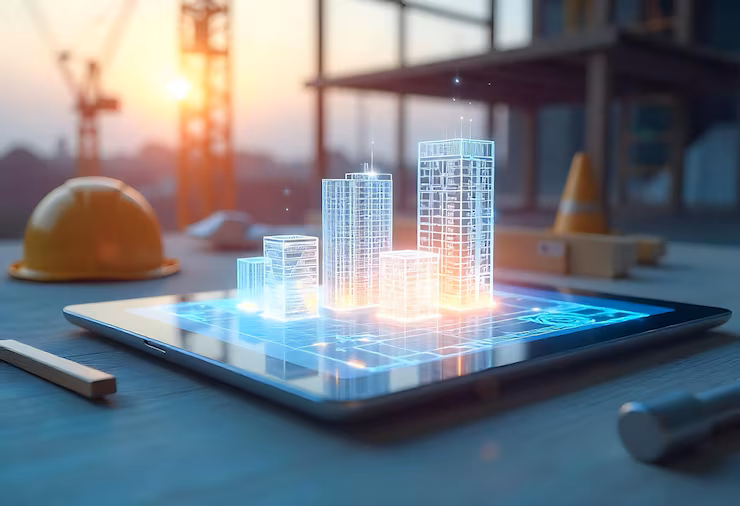
Photo above: Digital Blueprint motion tablet with floating plan (Source: freepik)
