


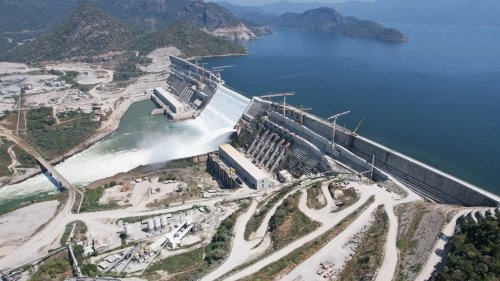
Photo credit: Webbuild
Ethiopia has completed construction of the Grand Ethiopian Renaissance Dam (GERD), a US$4.2 billion hydropower project on the Nile’s largest tributary, which has long been a source of tension with downstream countries Sudan and Egypt. The dam is scheduled to be officially completed in September and will eventually generate more than 5,000MW of electricity, making it Africa’s largest hydroelectric power facility.
Construction on the dam began in 2011. Its huge reservoir (almost the size of Greater London) will be full in 2023. Power generation will begin on a limited basis in 2022, with output more than doubling over the last year after two more turbines came online, bringing total generation capacity to 1,550MW.
GERD is located on the Blue Nile River and accounts for approximately 85% of the total flow of the Nile River. Egypt, which relies almost entirely on rivers for fresh water, has warned that dams could threaten water supplies. Cairo has accused Ethiopia of avoiding a binding agreement on dam management, including how much water is released downstream during droughts.
In what appeared to be an effort to ease tensions, Ethiopian Prime Minister Abiy Ahmed said he had invited Egypt and Sudan to the dam’s inauguration ceremony. He said gastroesophageal reflux disease was not a threat but a “common opportunity” for regional development. But Egypt reiterated its opposition, accusing Ethiopia of lacking the political will to reach a comprehensive agreement on water sharing.
Ethiopia’s currently installed power generation capacity is 5,657MW, approximately 90% of which comes from hydropower. The government aims to more than triple this to 17,500MW by 2030, using a mix of hydro, wind, geothermal, thermal and biomass projects. This includes the Coixa hydroelectric dam on the Omo River, which will add 1,800MW when completed.
In addition to meeting domestic demand, Ethiopia sees the GERD as a cornerstone of its ambitions to become a regional electricity export hub. It has been supplying electricity to Kenya, Djibouti and Sudan for several years, and has recently started exporting to Tanzania. In a sign of growing demand, Kenya recently requested that imports from Ethiopia be doubled to 400MW, citing increased industrial activity.
Beyond its size, GERD has demonstrated that Ethiopia can mobilize domestic resources to finance strategic national projects without any foreign financing. More than US$170 million (23.6 billion Birr) was raised directly from Ethiopians and the diaspora through bonds, donations and community campaigns, and an additional US$610.2 million (84.4 billion Birr) for local labor. Deputy Director Ms Fikrute Tamir called the dam a “living victory”, a dam “funded, built and protected by Ethiopians themselves”. In a region that is often reliant on external financing for large-scale projects, the GERD is now an important asset as well as an example of how African countries can pursue key development goals through collective and regionally-led financing models.
“X Post”, Prime Minister’s Office – Ethiopia, July 3, 2025
“X Post”, Egyptian Ministry of Water Resources and Irrigation, July 4, 2025
