


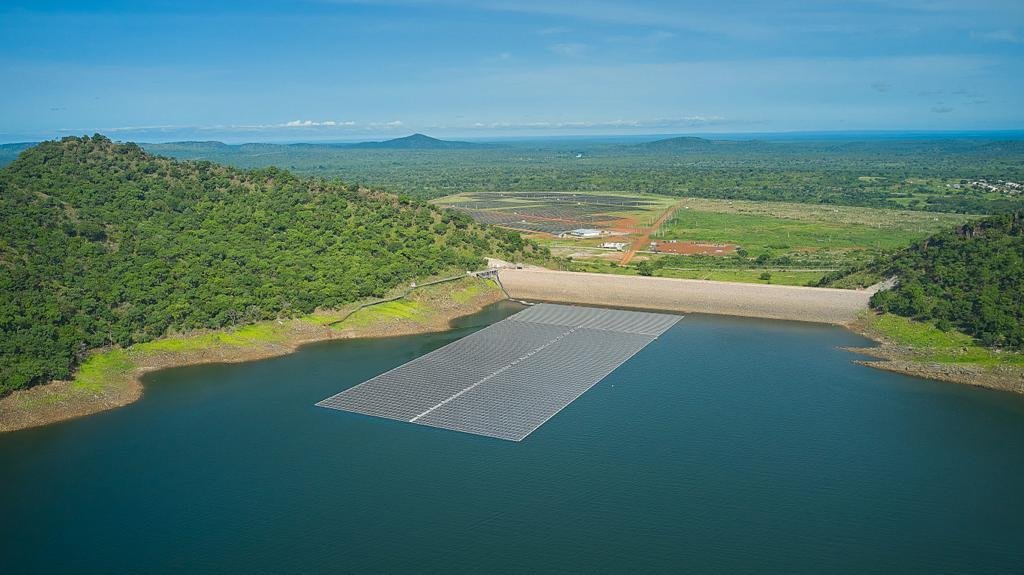
Environmental scientists Iestyn Woolway and Alona Armstrong from Climate, Water and Energy analyzed how much energy could be produced by floating solar panels on just 10% of the water surface in one million bodies of water around the world. They found that Ethiopia and Rwanda could generate more energy than their current national energy needs with floating energy systems alone.
How floating solar power generation works
Also known as floating solar power systems, these are solar panels mounted on structures that float on bodies of water such as lakes, reservoirs, and ponds.
Floating solar panel systems use pontoons or rafts to keep solar panels afloat. These floating structures are fixed or tethered to the edge of a body of water to ensure stability. The system can be designed to withstand varying water levels and weather conditions such as storms.
Approximately 5 million square kilometers of the Earth’s surface area (3.7% of the Earth’s surface not covered by ice) is occupied by lakes and reservoirs. Solar panel systems can be floated on many of these surfaces.
Similar to solar panels attached to buildings or the ground, floating systems use solar cells to convert sunlight into electricity. The electricity generated is sent to the grid or used locally. Being on the water allows floating solar panels to maintain their temperature, generate more power and have a longer lifespan than land-based solar panels.
Floating solar panel systems are used in countries where there is not much land available, but large and numerous bodies of water. Ghana recently installed Africa’s largest floating solar panel system on one of its reservoirs.
new research
We used a tool called the Global Solar Energy Estimator to calculate the amount of energy that solar panels can produce in more than 1 million bodies of water around the world. We collected data on sunlight and temperature, as well as specific details about solar panels. We used satellite images of bodies of water to consider which parts of bodies of water could be covered by solar panels.
We did not include waters that are dry and frozen for more than six months of the year, located within protected areas, or located more than 10 km from population centers. We also limited the size of the floating solar power system considering potential technical and environmental constraints.
Our research shows that Rwanda and Ethiopia could generate far more energy from these systems than they currently use. Rwanda has the potential to generate 237% of its current total energy needs and Ethiopia 129%. Chad currently has the potential to generate 73% of its energy needs from floating solar power systems alone. Mali, Madagascar, Malawi, Uganda, Democratic Republic of the Congo and Togo could generate between 15% and 58% of their total energy needs from floating solar panels.
It also found that there are 1,977 bodies of water across Africa that can be used to float solar panel systems. This would save land needed for land-based solar panels.
Floating solar panels also help reduce water evaporation from lakes and reservoirs. This will benefit water-scarce countries in Africa.
Another benefit is that the panels can shade the water, reducing harmful algae blooms (mats of toxic bacteria) that grow on the water’s surface and destroy water quality and aquatic life. This improves water body conditions and reduces water treatment costs.
Floating solar panel systems can also be installed in rural, remote or off-grid areas that previously lacked regular electricity supply.
Issues to be addressed
If African countries want to take full advantage of floating solar panel systems, the following issues need to be addressed:
Grid connectivity and infrastructure: Many regions in sub-Saharan Africa have limited or unreliable grid connectivity. For these countries to make the most of the power generated by floating solar panel systems, they need to improve their power grids. If expanding a centralized grid is too expensive, off-grid solutions such as mini-grids near bodies of water should be developed.
Regulatory and policy support: Governments should encourage the development of floating solar panel projects, including incentives, subsidies, and streamlined permitting processes. It is also necessary to establish strict regulations such as environmental standards and safety standards.
Environmental considerations: A thorough environmental impact assessment should be conducted to avoid potential negative impacts on aquatic ecosystems and water quality.
Social considerations: It is very important to engage with and gain support from the local community. It is important to consider how local communities use water bodies. The aim is to ensure that everyone benefits from energy produced in an equitable manner, and to avoid ‘green grabbing’, where nature is sold off to build green energy systems, to the detriment of indigenous peoples.
Many countries have large bodies of water, abundant sunlight, and serious problems with water evaporation and algae growth. Floating solar panel systems can address these environmental issues and produce low-carbon energy at the same time.
The potential benefits are promising. However, further research is needed to understand the environmental impact and optimize design and implementation. This includes studying long-term impacts on aquatic ecosystems and water management practices.
Solar energy generation minimizes greenhouse gas emissions compared to traditional energy sources such as coal and natural gas. This helps fight climate change and reduce air pollution. By harnessing solar power, countries can reduce their dependence on imported fossil fuels and increase energy security and economic stability.
Solar energy has also become increasingly affordable. The world aims to achieve net zero, eliminating all carbon gas emissions by 2050. Floating solar panel systems can contribute to achieving this goal.
Estin Woolway Reader and NERC Independent Researcher. bangor university and alona armstrong Professor of Energy and Environmental Sciences. lancaster university In England.
This article is republished from The Conversation under a Creative Commons license. Read the original article.
Photo: Floating solar power plant, Ghana (Source: Bui Power Authority)
