


Africa’s Sahel region, home to some of the world’s poorest, most politically unstable and conflict-prone countries, is once again in crisis.
The July 26 military occupation of Niger has turned the region into a veritable “coup belt” across Africa’s periphery, with many Sahel countries now ruled by unelected military rulers. In recent years, the Sahel has also become a major playground for violent armed groups, from Boko Haram and Islamic State West Africa Province (ISWAP) to Jamaat Nusrat al-Islam wal Muslimeen (JNIM). The region currently accounts for a whopping 43 percent of the world’s terrorism deaths, according to the Global Terrorism Index compiled by the Australia-based Institute for Economics and Peace (IEP).
Across the Sahel, from Niger and Mali to Burkina Faso and Chad, widespread corruption, extreme poverty, widespread unemployment, and the perceived inability of Western partners and international organizations to bring stability and security to the region are turning local populations against Western-allied governments, fueling popular support for coups, and increasing the recruiting capacity of armed groups.
But beyond chronic insecurity and economic instability, there was one factor that contributed significantly to military regimes’ rise to power across the region. It was a rise in anti-French sentiment.
Memories of French colonialism, characterized by brutal military operations, forced labor, widespread repression, cultural erasure, racism and forced migration, remain vivid in the Sahel.
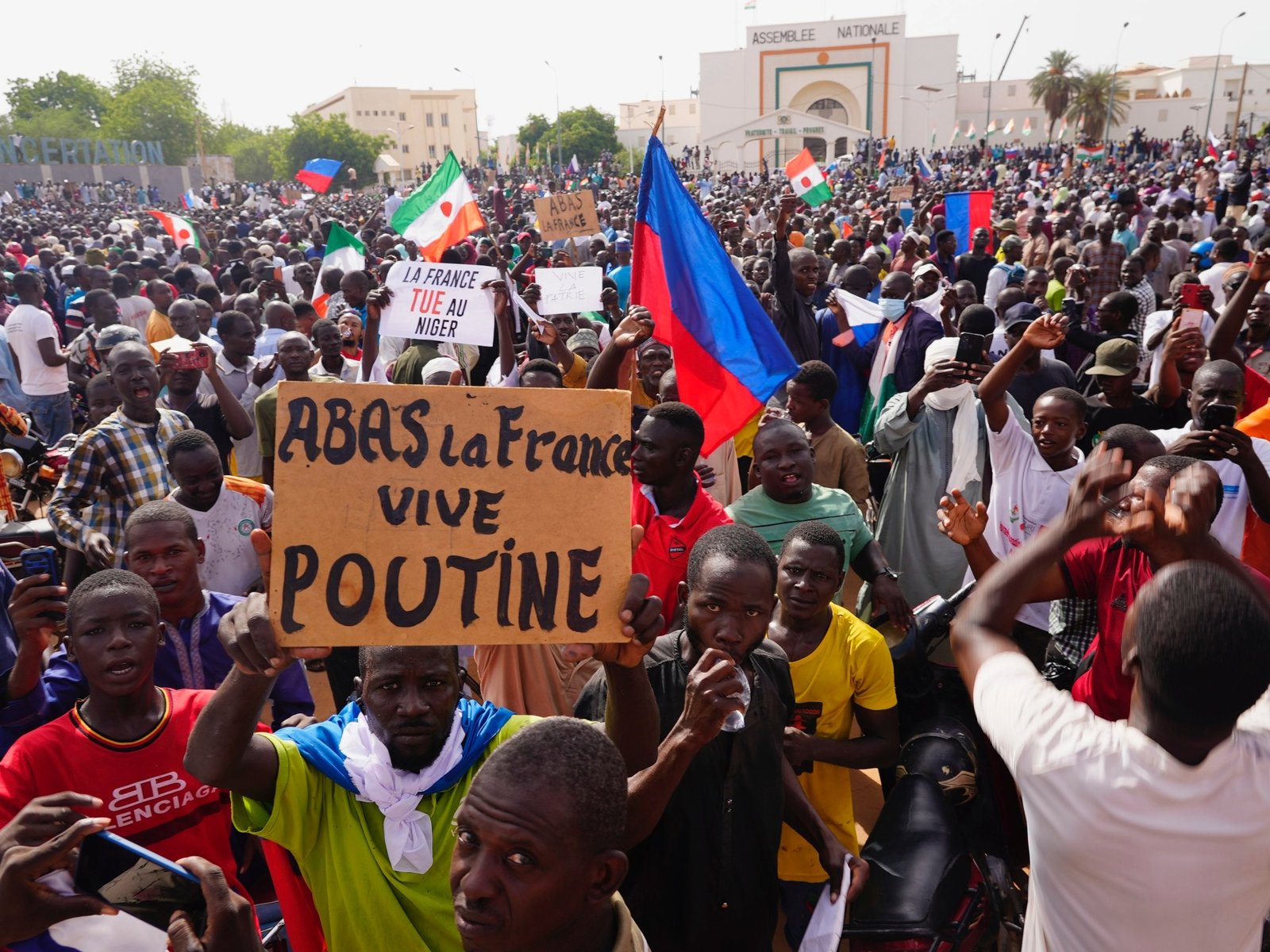
France’s recent misfortunes, disappointments and outright failures in Africa, coupled with suspicions rooted in its colonial history, have made the people of the Sahel wary of their former colonial power and all its actions in the region. Insurrectionists in many countries have successfully capitalized on this growing hostility and presented themselves to the public as anti-colonial heroes resisting neo-colonial France and its corrupt local government agents. This is why the masses in Mali, Burkina Faso, Chad, and most recently Niger welcomed military rule with anti-French chants.
It all started in 2012, when Mali’s government requested France’s help in resolving the rapidly worsening security crisis in its reactionary north, where Tuareg rebels and fighters allied with al-Qaeda in the Islamic Maghreb (AQIM) had seized vast swathes of territory. France sent thousands of troops and, with help from neighboring Chad, routed the fighters from the capital, Bamako.
In 2014, France, with support from the Malian government, moved to expand counter-terrorism operations in the region. The operation, which later became known as Operation Barkhane, sent 5,100 troops to five Sahel countries, making it the largest and most expensive overseas operation in modern history.
However, despite the heavy economic and human costs, Operation Balkan failed to bring the desired results. The problems in Mali and the surrounding region are far from over. Instead, armed groups began to expand in strength and influence. Attacks on civilians have become commonplace, and the security situation has worsened across the Sahel. As a result, local residents began to blame France for their chronic problems and became increasingly suspicious of their former colonial power’s intentions in the area.
In 2020, months of street protests over deteriorating security and corruption allegations led to a military coup that overthrew the pro-French government. Relations between Mali and Paris rapidly deteriorated, and Mali’s new ruler turned to Russian mercenaries from the Wagner Group for assistance in the ongoing security crisis.
After two years of heightened tensions, relations between France and Mali’s “interim” government, which has refused to hold elections as promised after a coup, have reached a breaking point. On January 31, 2022, Mali expelled the French ambassador. By that time up to 1,000 Russian mercenaries were stationed in Mali. Days later, thousands of anti-French demonstrators took to the streets waving Russian flags and celebrated the ouster by burning cuttings of French President Emmanuel Macron.
That same year, France announced its decision to withdraw troops from Mali and move some troops to neighboring Niger as part of a new Africa strategy.
As we now know, this did little to improve France’s position in the region. A coup d’état soon occurred in Niger, and with public opinion firmly opposed to France, the Puscists quickly blamed France for many of the country’s problems and accused France of “destabilizing the country.”
France’s misguided approach to the region’s ever-increasing security crisis was a key reason why France rapidly lost influence and respect in the Sahel, and is now widely seen as nothing more than a neo-colonial villain.
Rather than seeking to identify and address the root causes of conflict by strengthening state institutions and encouraging good governance, Paris sought to resolve security problems in the Sahel countries solely through military force. This emphasis on military affairs did not even lead to decisive victories on the ground, fueling conflict and rapidly turning public opinion against France.
Apart from rebels in Mali, Niger and elsewhere, Russia is the biggest beneficiary of France’s many failures in the Sahel. Moscow has long sought to improve relations with Africa and remove Western domination of the continent. And France has had its long-awaited opening due to recent accidents there.
When it became clear that France would not be able to end terrorism in the Sahel with large-scale military operations, Russia unleashed a well-oiled propaganda machine on Francophone Africa and did everything in its power to fuel the growing anti-French sentiment in the region. Meanwhile, Wagner entered the Sahel promising to carry out the important task that France and the West had failed to fulfill: ending the rule of armed groups and ensuring the safety of local populations.
Currently, Russia, through Wagner, is working hard overall to fight insurgents, build relationships with military governments, and establish itself as the dominant external power in this highly strategic region. This is bad news both for the West, which cannot afford to lose the Sahel to Russia, and for the region’s people, who have already suffered from Wagner’s senseless brutality and are beginning to realize the downside of accepting Russian “aid.”
There is no doubt that France is at a disadvantage in the Sahel, but if it plays its remaining cards correctly, it still has a chance to recover. To return to the region as a top player, Paris must first win the hearts of the locals.
To do so, we will need to reexamine ourselves and confront the legacy of colonialism. It will also need to admit its recent mistakes, learn from its military and political failures, and, most importantly, begin to approach the Sahel countries as equal, independent security partners rather than former colonies in need of French guidance. Part of this would be to recognize the power that Nigeria holds as the Sahel’s leading economy and to work with it on an equal footing to achieve political, economic and security objectives across the region. Such partnerships can also help bridge the trust gap between Anglophone and Francophone West Africa.
To take back the Sahel, France must also be prepared to actively participate in the narrative war with Russia. While working to cleanse its image, it should also embark on an evidence-based campaign to expose the many war crimes and human rights violations committed by Wagner in Africa and beyond.
Unless France takes these steps and forges a new and stronger partnership with the countries of the Sahel, it will remain an almost insignificant power, serving no purpose other than providing easy legitimacy to the region’s rebels.
The views expressed in this article are the author’s own and do not necessarily reflect the editorial stance of Al Jazeera.
