


Ghana has strengthened its position as West Africa’s leading green construction market following the successful completion of a three-year capacity development program led by the International Finance Corporation (IFC), demonstrating growing commercial and investment opportunities in sustainable construction.
IFC’s Design for Efficiency (DfGE) program, funded by the Swiss Secretariat for Economic Affairs (SECO), has helped build a pipeline of trained professionals, modernize academic curricula, and accelerate the adoption of green building standards by the private sector across the country.
Since its launch in 2022, the program has embedded green building design in five universities, professional associations, and technical institutes, trained 254 students and industry professionals, and prepared 30 certified trainers to deliver the curriculum. It also attracted more than 870 participants through workshops, awareness programs, and a national design competition.
IFC officials said the results place Ghana as one of the best-performing DfGE participants globally, alongside Colombia, Peru, Indonesia and South Africa, and reflect that the market is increasingly poised to scale up low-carbon construction.
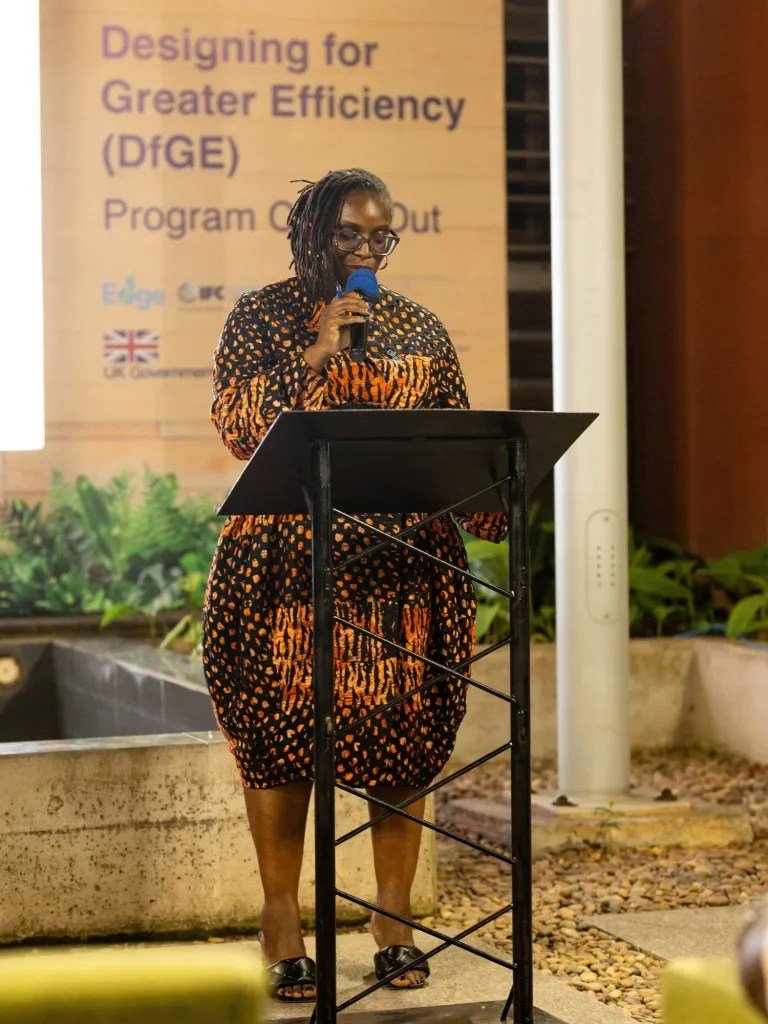
Speaking at the program’s closing ceremony in Accra, IFC Senior Country Officer Yewande Giwa said Ghana’s progress demonstrates the commercial viability of climate-smart buildings. He said the skills developed through the program will support innovation, job creation and long-term growth as demand for energy-efficient and climate-resilient buildings increases.
Its momentum is already reflected in market penetration. IFC announced that Ghana has over 1 million square meters of EDGE-certified green built area, the most in West Africa, with over 81 residential, commercial and public sector projects certified.

According to IFC Ghana Green Building Lead Paul Okran, this milestone shows that sustainability is moving from policy aspiration to market reality. He said the EDGE certification helped developers demonstrate that green buildings were financially viable while reducing operating costs, strengthening investor confidence in the sector.
The DfGE program also focused on inclusion, with more than a quarter of participants being women, highlighting the gradual changes in the traditionally male-dominated construction industry.
On behalf of SECO, Magdalena Wust said the Swiss support was aimed at equipping Ghanaian workers with the practical skills needed to deliver low-carbon buildings at scale, adding that the impact of the program extends beyond its formal termination.
Government officials say the initiative is consistent with Ghana’s broader development priorities. Kenneth Gilbert Adjei, Minister of Labour, Housing and Water Resources, noted that buildings account for a significant proportion of energy use and emissions, warning that rapid urbanization has made sustainable construction a business and policy imperative.
He said the government will continue to scale up climate-resilient housing and infrastructure in collaboration with development partners, academia and the private sector, noting that the program is fundamental to the long-term transformation of Ghana’s built environment.
With DfGE online courses remaining accessible beyond the life of the program and the EDGE certification gaining traction among developers, IFC says Ghana now has a strong ecosystem to attract climate-smart investment and support the growth of a competitive, low-carbon construction industry.
read more
