


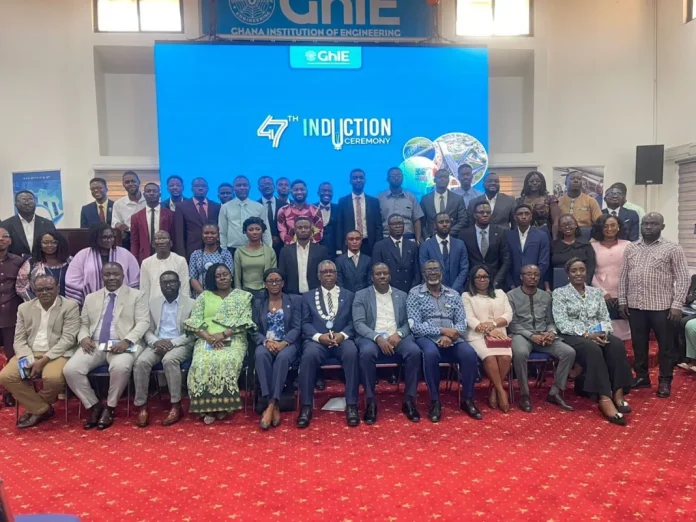
Ludwig Annan Hesse, Chairman of the Ghana Institute of Engineering, reminded the newly inducted engineers that by taking the oath of full membership they are taking a solemn oath to God and country to put the well-being of society above all else and to practice engineering with competence, responsibility and integrity.
He said engineering decisions directly impact public safety, national development and the wise use of scarce national resources and must be guided by the highest standards of professionalism and ethical conduct. Mr. Hesse spoke at the 47th induction ceremony of the Ghana University of Technology under the theme “Engineering Our Future Do It Well Do It Right” held in Accra on December 16, 2025. At this ceremony, a total of 183 engineers were inducted into full membership.
As part of the ceremony, distinguished Hall of Fame inductees were recognized for excellence in their respective fields. They included Clara Minta Ofosu in chemical/mining engineering, Godfred Addai in civil engineering, Sellom Kwame Tsikata in electrical/electronic engineering and James Afful in mechanical engineering.
Addressing broader national concerns, the GhIE Chairman called on the Government to ensure that the resetting agenda for the provision of infrastructure and related services strictly follows due process as outlined in the Public Finance Management Public Investment Management Regulations 2020, also known as Legislative Instrument 2411.
He stressed that infrastructure projects must strictly follow the entire lifecycle, from pre-feasibility and feasibility to design, procurement, construction, operation and maintenance, warning that cutting corners at any stage will inevitably lead to cost overruns, substandard results and project abandonment. The emphasis on due process reflects long-standing concerns about project management practices that have resulted in unfinished infrastructure across Ghana.
Mr. Hesse called on the Ministry of Finance to provide project preparation funds to enable ministries to conduct appropriate feasibility studies to justify proposed investments. He stressed that only projects that successfully exceed feasibility criteria should be included in public investment plans, noting that feasibility must remain a non-negotiable requirement for public investments.
He said at the ceremony that no public investment project should be allowed to participate in the public investment plan unless it successfully passes the feasibility criteria. The call highlights persistent challenges in public investment management in Ghana, with projects sometimes proceeding without proper technical and financial analysis, contributing to budget overruns and implementation delays.
He further emphasized the need for sufficient time and budget for preliminary design to clearly define the scope, cost and technical requirements of the project, especially the design and construction contract. He said if the project is based on the employer’s design, sufficient time must be allowed for detailed design and accurate costing to prevent disputes during implementation.
GhIE Membership Committee Chairman Michael Ankama Beko advised the inductees to remain active and active members of the association, dedicating themselves to continuous professional development and lifelong learning by contributing their expertise to committees and activities.
He cautioned people against engaging in engineering work for which they are not competent or qualified and urged them to use their engineering stamps responsibly. Above all, he said, people should shoulder the title of Ing with pride, dignity, humility and a strong sense of professional responsibility. Engineering stamps have legal and professional meaning as they certify that the design and specifications meet the required technical standards.
GhIE Executive Director Enyonam Kpekpena, former President Kwabena Bempong and President-elect Sofia Abena Tijani all urged the newly appointed engineers to prioritize public safety, sustainability and ethical practices in all their work.
They also encouraged active participation in the activities of the institution, including participation in chapters, technical departments, committees and programs, stressing that active engagement is key to shaping the future of engineering in Ghana. “The institute looks forward to your active participation, innovative ideas, and impact in your respective fields,” said Tijani.
May you proudly bear the title Ing and may you continue your lifelong pursuit of excellence. Congratulations and I wish you a fulfilling and successful professional life, she said. This statement reflects the association’s focus on building a vibrant professional community, not just credentialing.
The Ghana Institute of Technology was established in 1968 to take over the Ghana Professional Engineers Group. The body has powers under the Engineering Councils Act 2011 and the Professional Bodies Registration Order 1973. It regulates the activities of engineers and engineering companies in Ghana, sets standards for the engineering sector, and organizes professional examinations for engineers.
Membership categories include fellows, members, associate members, graduate student members, affiliates and student members. The institution operates through a technical department covering civil, mechanical, electrical, chemical, mining, agricultural and other engineering fields. Each department maintains professional standards, organizes technical sessions, and supports members in their respective areas of expertise.
The 47th induction ceremony marks the continuation of the association’s role in recognizing engineering professionals who meet established standards of competency. Candidates undergo rigorous testing and professional assessment before receiving formal membership, ensuring that only qualified practitioners can use the protected title of Professional Engineer.
Hesse’s request for stricter compliance with public investment management regulations comes as the Mahama government prepares to implement a reset agenda focused on infrastructure development, economic transformation and improved service delivery. This reset includes initiatives such as the 24-hour economy program, the Big Push infrastructure strategy, and a comprehensive review of ongoing projects.
The Public Finance Management Public Investment Management Regulations 2020 established mandatory requirements for the identification, preparation, evaluation, selection, approval, budgeting, implementation, monitoring and evaluation of public investment projects. This regulation aims to ensure value for money, transparency and accountability in public investment spending.
Under this regulation, ministries are required to carry out a feasibility study, including technical, economic, financial, social and environmental aspects, before a project is approved for inclusion in the budget. Projects that fail feasibility tests should be rejected or sent back for redesign, rather than proceeding based on political considerations or claims of urgency.
The Ministry of Finance has a Public Investment Management Department that is responsible for coordinating public investment plans, reviewing project proposals, maintaining public investment plans, and monitoring implementation. The department works with MDA to strengthen project preparation and evaluation capacity across the government.
Ghana faces persistent challenges with incomplete infrastructure projects across roads, water systems, schools, health facilities and other sectors. The Comptroller’s Office’s report frequently cited weak project feasibility studies, inadequate budgeting, poor procurement practices, and weak oversight as contributing factors to project failures.
Engineering professionals play a critical role in infrastructure planning, design, and oversight. Engineers’ professional judgment and technical integrity serve as safeguards against substandard construction and noncompliance with specifications. However, professional standards can be compromised if political pressure overrides technical recommendations or if the procurement process prioritizes lowest cost over technical capability.
GhIE’s insistence on strict compliance with public investment management regulations reflects its mission to protect the public interest through professional standards. Engineers are committed to putting public safety and welfare above personal or commercial considerations, placing ethical obligations that extend beyond contractual relationships.
Induction ceremonies provide newly qualified engineers with an opportunity to reinforce these professional values. GhIE aims to shape the professional culture and maintain standards as the engineering profession grows by emphasizing ethical behavior, continuous learning and active professional engagement during induction.
As Ghana pursues infrastructure development and economic transformation under the Reset Agenda, the quality of engineering services will have a significant impact on outcomes. A well-designed project based on proper feasibility studies and executed to specifications will provide value for money and effectively serve the community. Poorly conceived and executed projects waste resources without achieving the intended benefits.
The 183 engineers inducted at the ceremony join thousands of active professional engineers working across Ghana in the public service, private sector, consulting, construction companies, manufacturing and other sectors. Their contribution to national development depends not only on their technical ability but also on their professional ethics and commitment to standards.
