


Outlook for the global building materials market
The global building materials market is at the center of the world’s urban transformation. As countries compete to expand housing, modernize infrastructure, and meet sustainability goals, building materials have become more than just structural components, they have become strategic enablers for economic growth, environmental responsibility, and technological innovation.
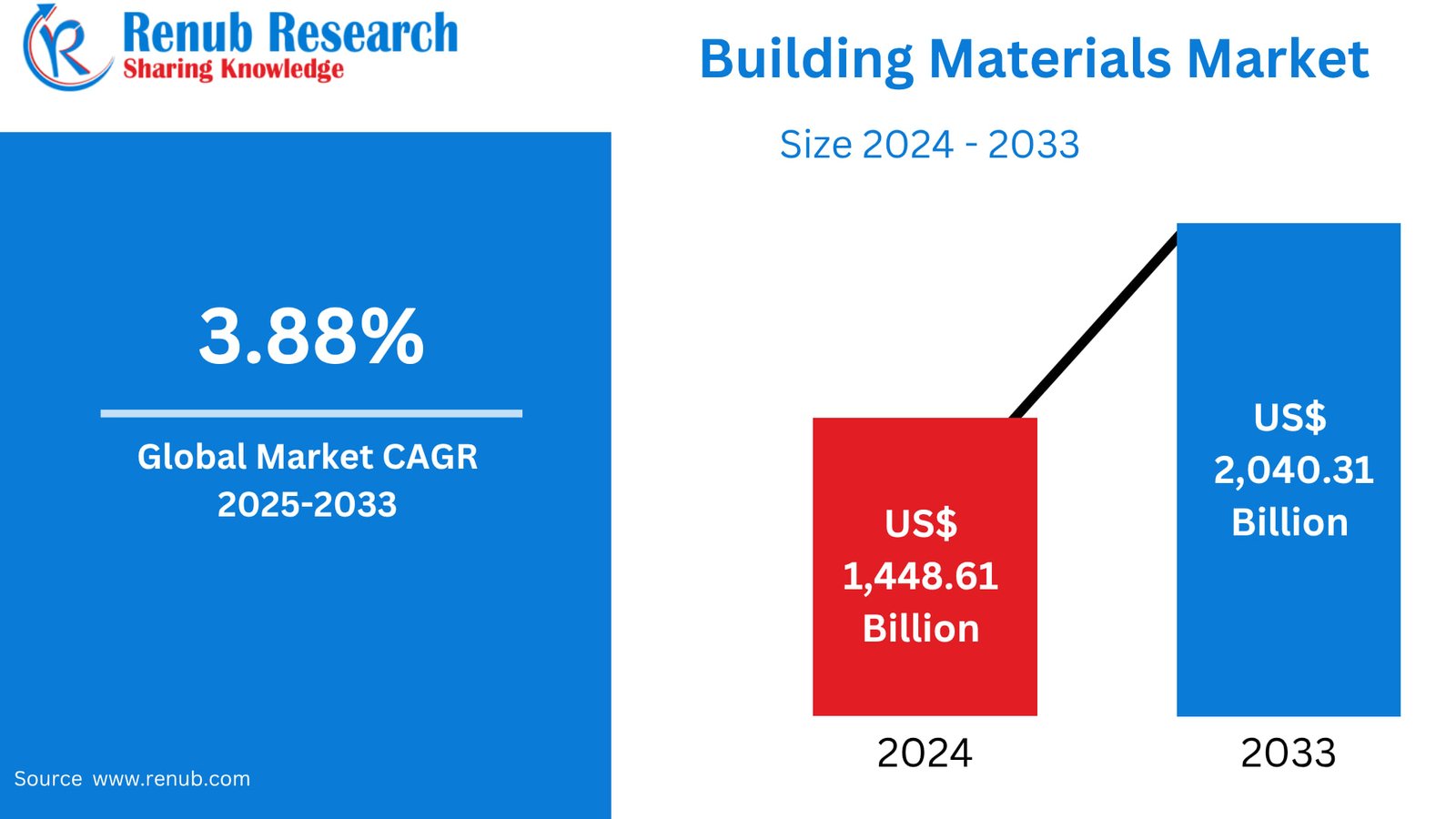
According to Renub Research, the global building materials market is expected to grow at a CAGR of 3.88% from 2025 to 2033, reaching USD 2,403.1 billion by 2033, from USD 1,448.61 billion in 2024. This steady expansion reflects the growing demand for building materials driven by rapid urbanization, large-scale infrastructure projects, and increased adoption of green building practices in both developed and emerging countries. economy.
Download free sample report
Building materials include a wide range of products, from traditional materials such as cement, aggregate, brick, metal and wood, to advanced and sustainable alternatives such as low carbon cement, recycled aggregate, engineered composites and insulated panels. The market is undergoing a fundamental shift towards smarter, greener construction as governments implement stricter environmental regulations and developers adopt energy-efficient designs.
Key growth drivers of the global building materials market
1. Rapid urbanization and infrastructure development
Urbanization remains the strongest driver of demand for building materials around the world. More than half of the world’s population currently lives in urban areas, and by 2050, nearly 70% of the world’s population is expected to live in cities. This demographic shift is creating enormous demand for housing, commercial facilities, transportation networks, and public infrastructure.
Emerging countries in Asia, Africa and Latin America are investing heavily in highways, railways, airports, ports and smart cities. These projects require huge quantities of cement, steel, aggregates, bricks and prefabricated components, ensuring long-term demand stability for the building materials industry.
Government-supported infrastructure projects such as transport corridors, urban renewal projects, and industrial zones are further enhancing material consumption across value chains.
2. Growing demand for sustainable and green building materials
Environmental sustainability is now a core requirement rather than a design choice. Developers, architects and governments are increasingly turning to environmentally friendly materials to reduce carbon emissions and improve energy efficiency.
Materials such as recycled concrete, bamboo, low-carbon cement, fly ash bricks, insulated panels, and energy-efficient glass are being rapidly adopted. Green certifications such as LEED, BREEAM, and EDGE are accelerating the use of sustainable construction materials around the world.
In May 2025, the Department for Promotion of Industry and Intra-Trade of India (DPIIT) launched CemHack for Green Infra, a national-level initiative to foster innovation in sustainable cement and infrastructure materials. Programs like this highlight how governments are actively encouraging industry-wide transformation towards greener alternatives.
3. Technological progress in construction methods
Innovations in construction technology are reshaping the production and use of materials. Technologies such as modular construction, prefabrication, 3D printing, and digital construction management are changing the way buildings are designed and assembled.
These construction methods require lightweight, high-performance, precision-engineered materials, driving demand for advanced composites, engineered wood, and smart insulation systems. Automation and digitization reduce material waste, increase efficiency, and shorten overall project schedules.
In May 2024, Buildots launched AI-powered delay prediction capabilities to help construction teams identify schedule risks early and improve material planning. Such digital tools are increasing the efficiency of construction and increasing the demand for innovative and compatible materials.
Challenges facing the global building materials market
Fluctuations in raw material prices
The building materials industry is highly sensitive to price fluctuations in cement, steel, sand, and aggregates. Global supply chain disruptions, geopolitical conflicts, and energy price fluctuations often cause sudden cost increases, squeezing manufacturers’ margins and increasing construction costs.
For long-term infrastructure projects, unpredictable material prices complicate budgeting and project planning, creating persistent challenges for developers and contractors.
Environmental regulations and carbon emissions
Materials such as cement and steel are among the largest contributors to global carbon emissions. As climate regulations tighten, manufacturers are under increasing pressure to invest in clean technologies, carbon capture and alternative fuels.
While large companies can absorb these costs, small and medium-sized manufacturers often struggle with compliance, creating barriers to entry and reshaping industry competition. Recycling obligations and waste management regulations also complicate supply chain operations.
Market analysis by type
aggregate market
Aggregates such as sand, gravel, and crushed stone form the basis of nearly every construction project. Demand is increasing due to increased investment in roads, bridges and urban infrastructure.
The use of recycled aggregates is rapidly expanding as governments promote the reuse of construction waste to reduce environmental impact. Mega infrastructure projects around the world continue to drive sustained growth in the sector.
cement market
Cement remains the backbone of world construction. Growth is strongest in developing countries, where investment in housing and infrastructure is accelerating. At the same time, developed markets are focusing on renovations, renovations and sustainable upgrades.
Innovations such as blended cement and low-carbon cement are gaining momentum as the industry works to reduce emissions while maintaining performance.
Brick, metal and other materials
While traditional brick remains popular in residential construction, metals such as steel and aluminum predominate in high-rise, industrial, and commercial projects. The “other” category, such as glass, composites and insulation, is expanding rapidly due to the shift to energy-efficient buildings and smart infrastructure.
Market analysis by application
Housing building materials market
Population growth, urban migration, and increased home ownership rates are driving housing construction around the world. Demand for cement, brick, roofing, flooring, drywall, plumbing fixtures, and insulation is strong.
Low-cost housing programs in emerging countries and renovation activity in developed markets are sustaining long-term demand. The green housing trend is also increasing the adoption of solar tiles, insulation blocks, and eco-friendly finishes.
commercial building materials market
Commercial construction, such as offices, retail centers, hospitals, hotels, and institutions, is growing alongside urbanization and economic expansion. These projects require high-performance, durable, and energy-efficient materials.
Post-pandemic construction has accelerated demand for antimicrobial surfaces, improved ventilation systems, and smart building components, with commercial projects becoming a key growth driver for advanced materials.
Industrial building materials market
Factories, warehouses, data centers, and logistics hubs require durable materials that can withstand heavy use. Growth in e-commerce and manufacturing reshoring is driving industrial construction, particularly in Asia and North America.
Country-level market insights
US building materials market
The United States remains one of the world’s largest and most diverse building materials markets. Federal and state investments in transportation, renewable energy, and housing infrastructure keep demand strong.
In March 2023, CEMEX announced a US$250 million investment to expand its cement plant in New Braunfels, Texas, doubling production capacity to meet increasing construction demand. Sustainability, modular construction and smart homes are shaping future materials choices across the country.
German building materials market
Germany leads Europe in sustainable construction and energy-efficient retrofitting. Strict building codes and climate policies are driving demand for eco-cement, insulation, energy-efficient windows and precision engineered materials.
In January 2024, Heidelberg Materials introduced evoBuild, a global brand of low-carbon and circular products, reinforcing Germany’s role as a leader in sustainable building innovation.
Indian building materials market
India’s construction boom is supported by rapid urbanization and government programs such as the Smart Cities Mission and the Pradhan Mantri Awas Yojana. Demand for cement, bricks, aggregates and steel remains strong from urban to rural areas.
In February 2025, Shree Cement launched Banger Marble Cement, a premium product designed for fair-faced concrete and architectural applications, highlighting the market’s shift towards high-performance materials.
Saudi Arabia building materials market
Saudi Arabia’s Vision 2030 is transforming construction sites. Megaprojects such as NEOM and The Line are creating unprecedented demand for cement, glass, steel and prefabricated materials.
In December 2024, Al Jouf Cement Company approved the construction of a green cement factory in support of NEOM, demonstrating Saudi Arabia’s commitment to sustainable building solutions.
Market segmentation
By type
aggregate
cement
brick
metal
others
By use
Residential
commercial
industrial
By geography
North America: USA, Canada
Europe: Germany, France, Italy, Spain, United Kingdom, Belgium, Netherlands, Türkiye
Asia Pacific: China, Japan, India, South Korea, ASEAN, Australia, New Zealand
Latin America: Brazil, Mexico, Argentina
Middle East and Africa: Saudi Arabia, UAE, South Africa
Key players in the global building materials market
Leading companies are competing on sustainability, scale and innovation. The major players are:
Cemex
Boral Limited
Lafarge Holcim
Dickerhoff AG
Buzzi Unicem SpA
CSR limited
CRH company
Aditya Birla Group
Ambuja Cements
USG Corporation
Each company is analyzed based on its overview, key leadership, recent developments, SWOT analysis, and revenue performance, highlighting its strategic position in the rapidly evolving market.
final thoughts
The global building materials market is entering a new era defined by sustainability, technology and urban transformation. As construction sites transition to energy-efficient, low-carbon solutions, manufacturers that invest in innovation, digitalization and green materials will lead the next phase of growth.
Steady demand from infrastructure, residential and commercial projects around the world has kept the industry resilient despite regulatory and cost pressures. By 2033, building materials will not only shape skylines, but also determine how the world responsibly builds its future.
