


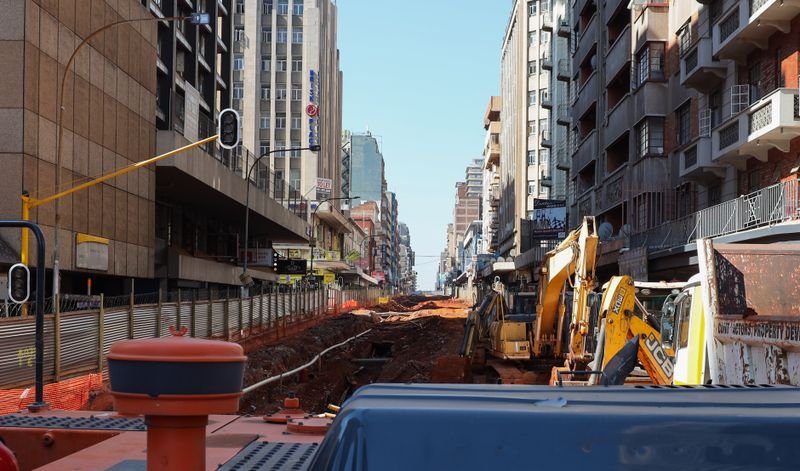
Over the past 15 years, the government has consistently neglected spending on infrastructure projects, sending South Africa into a brutal spiral of low economic growth, a deep-rooted employment crisis and a declining overall quality of life.
The poor quality of infrastructure is felt in all sectors of the economy. Potholes make it difficult to connect producers to markets, workers to jobs, and students to schools. Breakdowns in rail infrastructure are hampering exports of coal, iron ore and other minerals.
The lack of expansion of SA’s high-voltage transmission lines in the Western Cape, Eastern Cape and Northern Cape makes it difficult to connect new renewable energy produced by private operators to the national grid.
The Government of National Unity (GNU), with support from the state treasury, is trying to reverse this situation by reviving investment in new infrastructure projects and making it easier to partner with the private sector on large-scale projects.
The idea behind this is that improved infrastructure investment has the potential to create jobs and this is one of GNU’s priorities. Positive employment impacts are seen through labor-intensive sectors such as construction. Treasury estimates that for every R1 million spent on construction projects, three or more jobs are created for individuals whose highest qualification is a graduate qualification.
By comparison, a similar investment in mining would only create one job for someone with a matric certificate.
Governments want to accelerate infrastructure projects, but lack the funds, skills and capacity to lead such projects. Therefore, support is needed from the private sector, and the private sector needs incentives from governments so that it can support infrastructure development goals.
Read more on Daily Maverick: A bird’s eye view of Enoch Godongwana’s economic policies
Coming into the Treasury, the same was done through the 2024 Medium-Term Budget Policy Statement.
infrastructure reform
The Treasury Department is working on regulatory reforms to make it easier for private capital to invest in public infrastructure, and is also providing incentives to do so. A credit guarantee instrument will be launched with support from the World Bank to reduce risks for infrastructure projects undertaken and financed by private companies.
How it works is that private sector players use debt to finance huge infrastructure projects and will likely take the same approach when embarking on state-led projects. To provide an incentive to undertake such projects, private sector actors want to share debt risk with the government.
Under the long-established Renewable Energy Independent Power Producer Procurement Programme, the Government has launched a scheme to guarantee up to 100% of the debt undertaken by Eskom and the private sector to deploy infrastructure to supply renewable energy to the national grid.
If you are unable to repay your debt, the government (taxpayers) will intervene and force you to repay your debt. This exposed public finances to huge risks, piling up contingent liabilities on the country’s financial books and exposing South Africa to further downgrades by credit rating agencies.
The new credit guarantee instrument, expected to be operational by the end of next year, will shift risk from national treasury books to the World Bank’s Multilateral Investment Guarantee Agency. The agency typically insures investments in developing countries against political risk.
Treasury Secretary Duncan Peters said transmission infrastructure projects would be first in line to receive new credit instruments, with water and transport projects to follow if successful.
“This reform will bring more money to infrastructure spending, leverage private sector balance sheets, improve infrastructure spending outcomes, and provide a pipeline of projects.”
Industry commits to reform
There is no lack of funding from the private sector, nor is there a lack of will to plan and successfully execute projects. This is underlined by Mr Peters who said that while 70% of public infrastructure investment is carried out by the private sector, the government is responsible for only 30%, split evenly between state-owned enterprises (Eskom and Transnet) and local authorities. The problem has long been a lack of bankable projects of any size, meaning there are no projects that can secure debt, make profits, and deliver returns to investors.
The key question is whether the Treasury’s new approach to supporting infrastructure projects will change the game and revive much-needed investment. After all, the government has been cutting spending on infrastructure projects since 2016 and redirecting funds to free higher education to offset low revenues. South Africa’s gross fixed capital formation (a measure of investment, including new infrastructure projects) should be 30% of GDP as envisaged in the National Development Plan, but remains at around 16%.
Busisiwe Mavuso, CEO of Business Leadership South Africa, was skeptical of Treasury reform, saying the private sector had been disappointed and hurt in the past by government’s unfulfilled promises to accelerate infrastructure projects. However, she was reassured by the Treasury’s willingness to seek support in this area.
Sisa Kobas, an analyst with NinetyOne’s fixed income team, expects financing for infrastructure projects to increase as the Treasury will work on credit guarantee instruments and some projects will be funded from the budget through infrastructure bonds, bilateral loans and concessional funds.
Credit guarantees and concessional financing could make investments even more attractive, especially in infrastructure-intensive industries such as transportation and logistics, said a research team from consulting firm Cursum led by Peter Attard-Montalto, MD, PhD. However, interventions have not gone far enough.
“There is a lack of detail regarding risk-aversion strategies specific to South Africa’s infrastructure. Strategies such as long-term guarantees, government-backed minimum income commitments, and enhanced insurance products are likely to reduce risk and attract private capital more effectively,” the Kulsum team said. DM
This article first appeared in Daily Maverick 168, a weekly newspaper available nationwide for R35.
