


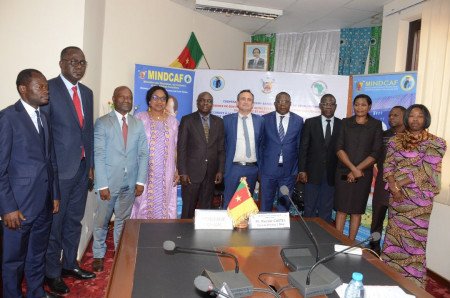
(Business in Cameroon) – The Government of Cameroon and the African Development Bank (AfDB) have strengthened their partnership on the Central Plain Development Plan, worth more than CFA Francs 21 billion. This new cooperation follows a recent review meeting held at the Ministry of National Property, Surveying and Land Tenure (MINDCAF) in Yaoundé.
The session, chaired by the Ministry’s Secretary General on behalf of Minister Henri Aibe Aisi, assessed progress on one of the country’s most important agricultural modernization projects.
According to the ministry, the Central Plains Project aims to develop more than 1 million hectares of land with the aim of improving access to land, rural infrastructure and agricultural support services. These include irrigation systems, access roads and technical supervision. Previous studies and field missions, including those conducted by the AfDB, have helped define project boundaries, the structure of land development activities, and the sequence of interventions.
In discussions with the AfDB delegation, MINDCAF reiterated its role in ensuring land availability, ensuring compliance with land tenure rights, and protecting national land assets. The project includes legally securing plots, compensating affected local communities, and developing land for large-scale agricultural investors. The first operational phase will cover 400,000 hectares along the Bachenga-Ntui-Yoko-Tibati-Ngaoundere corridor, a strategic axis identified for early mobilization.
Funding arrangements formed a key part of the exchange as partners considered their funding needs in the coming stages and the expected role of the AfDB and other potential funders. Estimates related to the Agropark component were also discussed. The broader objective is to establish an enabling environment for industrial-scale agricultural, livestock and fishing activities, supported by the governance mechanisms necessary for long-term investment.
The Ministry emphasized the importance of durable land governance frameworks to prevent conflicts, speed up land allocation and ensure the sustainability of development projects. Criteria governing the eligibility of land acquirers were highlighted, as well as MINDCAF’s responsibility to issue title deeds through concessions or enphyteutic leases. This project requires coordinated action not only by local governments, but also by ministries in areas such as agriculture, environment, livestock, and public works.
At the end of the meeting, stakeholders agreed that next steps should include finalizing technical and social studies, securing the legal status of the targeted parcels, preparing an implementation schedule, and establishing a shared financing plan. Participation of local residents is part of the approach to ensure the social acceptability and long-term viability of the project.
Marcy Fouseau
