


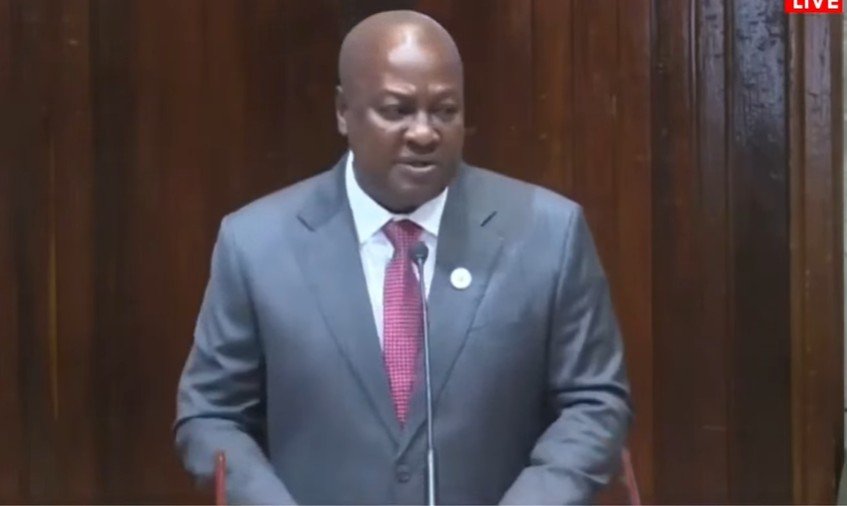
President John Dramani Mahama has called on African countries to give indigenous companies a central role in the mining and extractive sectors as part of efforts to drive economic transformation and sustainable development.
Speaking to Zambian parliamentarians on Thursday, February 5, President Mahama said Africa needs greater control over its natural resources, rather than allowing outside speculators to profit from it.
“To achieve economic transformation, Africa must unashamedly exploit its comparative advantage in natural resources. To build prosperity for its people, Africa must exercise greater sovereignty over its natural resources. The days of distributing large-scale concessions to speculators, who in turn reap huge profits, must end.”
He stressed that the continent already has the capacity to manage its resources locally and that indigenous companies need to be empowered to fully participate in extractive industries.
“We have the know-how, technology and capital and indigenous businesses need to be encouraged to participate in the extractive and mining sector,” he said.
President Mahama stressed the importance of strengthening the local private sector to play a leadership role in key areas of the economy.
“We must support the indigenous private sector to reach the highest heights of the economy. In Ghana, the mining and extractive sector plays an important role in the economy,” he explained.
He noted that Ghana, like Zambia and many other African countries, produces important minerals such as gold, bauxite and manganese, but adds little value to them locally.
“Like Zambia and other African countries, we are a source of important minerals such as gold, bauxite and manganese. However, little value is added to these minerals locally. We are changing that narrative,” he said.
President Mahama highlighted reforms in Ghana’s gold sector, noting that a Gold Commission was established in April last year with sole authority for gold exports from the country.
“Ghana established the Gold Commission in April last year to manage and regulate our gold exports. The Gold Commission was given the sole authority to export gold from Ghana,” he said.
He disclosed that exports from the artisanal and small-scale mining sector have increased significantly since the establishment of the Board.
“Since the establishment of the Board, gold exports from the artisanal and small-scale mining sector have increased from 63 tonnes to 104 tonnes in 10 months. And the best part is that these 104 tonnes have generated foreign exchange inflows of over $10 billion to Ghana,” he added.
President Mahama also spoke about efforts to process minerals locally rather than exporting raw materials.
“The Gold Commission recently signed an agreement with a local gold refinery to refine about one tonne of gold per week, rather than exporting raw material ore. We also aim to start local processing of manganese and bauxite, instead of exporting raw material ore,” he said.
On mineral royalties, he said Ghana had replaced the flat fee system with a sliding scale mechanism to better align revenues with world prices.
“We have also replaced the flat rate royalty system for minerals with a sliding scale system from 5% to 12% depending on the international market price of minerals,” he said.
He also cited continent-wide efforts to mobilize Africa’s resources for development, citing the World Africa Investment Summit launched in Dubai.
“This week in Dubai, I attended the launch of the World Africa Investment Summit, an initiative led by former African Development Bank President Akin Adesina and several collaborators to find new ways to leverage the continent’s natural resources to raise more affordable finance to support Africa’s economic transformation. This is an exciting initiative and has the potential to unlock enormous financial resources for Africa’s development,” he said.
President Mahama also emphasized the need for Africa to take back control of its financial resources, noting that much of the continent’s foreign exchange reserves are held overseas with little benefit.
“As the African Union Champion for African Financial Institutions, I am leading advocacy efforts to repatriate some of Africa’s vast foreign exchange reserves and invest them in African financial institutions.The vast majority of our foreign exchange reserves are in colonial-era structures held by Western financial institutions, and in most cases do not earn interest,” he said.
He added that repatriating even a portion of these reserves could have a transformative impact.
“If 30% of African countries’ foreign exchange reserves were repatriated and invested in African financial institutions such as the African Development Bank, it would create huge wealth that could fuel rapid infrastructure and economic growth,” he said.
Disclaimer: The views, comments, opinions, contributions and statements made by readers and contributors on this platform do not necessarily represent the views or policies of Multimedia Group Limited.
Disclaimer: The views, comments, opinions, contributions and statements made by readers and contributors on this platform do not necessarily represent the views or policies of Multimedia Group Limited.
