


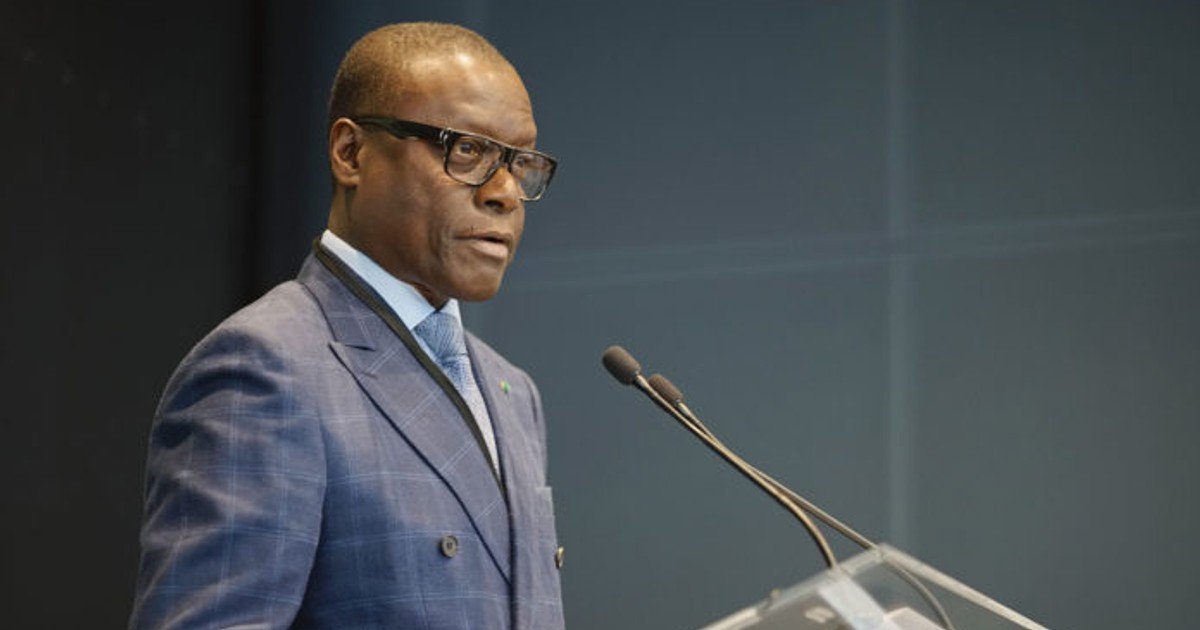
A pioneering Senegalese engineer, architect, and businessman, Atepa not only influenced Senegal’s physical architecture, but was also a strong supporter of sustainable urban development, African-centered design, and economic independence.
Born on June 30, 1947 in Ziguinchor, southern Senegal, Pierre Goudiaby Attepa’s story is one of perseverance, talent, and purpose.
Atepa received a scholarship to study in the United States and attended Rensselaer Polytechnic Institute in New York, which he highlighted in an exclusive interview with Business Insider Africa on the sidelines of the FII Senegal 2025 Investment Forum.
“As far as architecture goes, I was lucky enough to study at one of the greatest architecture schools in upstate New York, Rensselaer Polytechnic Institute. I graduated in 1973. I was very fortunate,” he said.
His passion for building architectural masterpieces then grew even stronger, and he soon began the construction of the BCEAO headquarters, the tallest building in Senegal, in a competition.

But his frustration with this milestone, he says, is the fact that it remains Senegal’s tallest building more than 50 years later.
“I started by winning an international competition for the Central Bank of West Africa… It was a 22-storey building, and at the time the tallest building in Dubai was 10 storeys high, but the problem is that 50 years later it is still the tallest building in Dakar, and Dubai now has a 200-storey building… This shows that Africa is regressing,” he said.
To alleviate this problem, in parallel with Africa’s persistent architectural setbacks, Pierre Goudiaby Atepa has chosen to undertake a very ambitious project, the details of which will be revealed in due course, he said.
For Senegal’s master architect, Africa’s future will be built with vision and collaboration, not just steel and cement.
He says his life’s work is to “make Africa great again” by using indigenous creativity and design to solve Africa’s unique problems, rather than copying other countries.
“I am passionate about the development of the continent,” he said
“And one of the things I’m trying to do now is go beyond architecture. You know, architects are trained to put pieces together, and most of the time people put pieces together that have nothing to do with each other, but they put them together,” he added.
“This is why I paint myself today as an architect of African development who wants to make Africa great again.”
Mr. Atepa revealed that among his current efforts, he is building entirely new towns across Africa using innovative financial mechanisms that reduce or eliminate the need for large government expenditures.
“But of course now we’re building new cities. We’ve developed the concept of building new cities that don’t cost a dime.”
One of his most ambitious initiatives is building a new capital for Gabon, which he hails as a national transformation effort.
“We are working on the new capital of Gabon, which has been chosen for this huge project that will bring confidence in the country from the Gabonese people.”
Atepa said similar plans were underway in “a couple of other African countries”, including Sierra Leone’s new administrative capital.
“We are also building a new administrative capital for Sierra Leone and are working to replicate this in two or three other African countries.”
He explained how well-managed land development projects can create wealth and significantly increase property values without the need for external borrowing.
“Today, if you acquire a piece of land, it’s probably worth $1 a square meter, and if you decide to put new administrative capital there, it goes from $1 to $10 to $300 a square meter. If you manage that, you’ll get at least $20 billion over 20 years. That’s not a big deal. So we’re working on it.”
Some of the works of Pierre Gudiaby Atepa
After returning to Senegal, Atepa founded an engineering and architecture firm called Groupe Atepa, which has since created and provided consultancy on major projects across the continent.
One of his most famous works is the Renaissance Monument to the Afrikaines in Dakar. Unveiled in 2010, it is a giant 49-metre-tall bronze statue representing Africa’s resilience and rebirth.

He is also responsible for Portes du Troisièmes Millenaires (Gate of the Third Millennium), a monument to African resilience and hope that was opened in 2001.

Another outstanding architectural achievement by Pierre Goudiaby Atepa, demonstrating his continuing influence on Africa’s modern urban and political landscape, is the Conference and Villa Presidentiere Center (Malabo Summit Complex) in Equatorial Guinea.
ECOWAS headquarters in Lomé, Togo. Plaza de la Nation in N’Djamena, Chad. BCEAO (West African Central Bank) office in Dakar. Other projects designed by Atepa include Banjul International Airport in The Gambia.

In addition to his architectural talent, these designs demonstrate his dedication to Pan-Africanism, an aesthetic and practical vision centered on African tradition and ambition.
Pierre Goudiaby Atepa’s story is one of fortitude, vision, and purpose. From constructing Africa’s tallest structures to envisioning entire cities, his works represent both aspiration and criticism, serving as a reminder of what Africa has achieved and what it still needs to aspire to.
Mr. Atepa’s goal remains to help Africa become the great he believes it can be, by helping to build not just the structures, but the future.
